
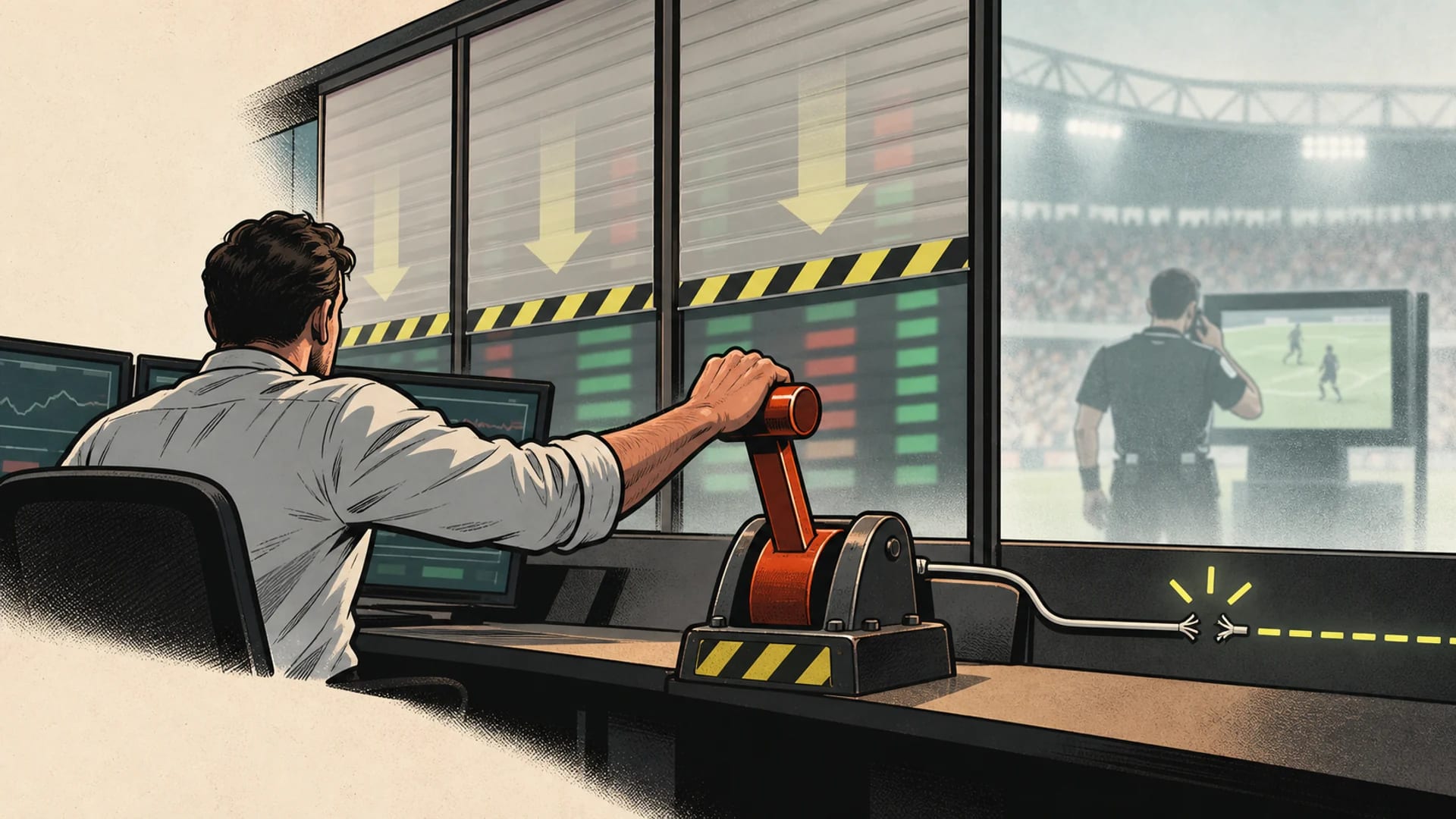
The market has been suspended: the sportsbook has put a brake on new acceptance while one of its inputs or decisions catches up. That brake is not, by itself, a verdict on bets already accepted. It is not the same as cancelling the market, settling it or closing a customer account.
Understanding those distinctions explains most of the apparent mystery.
The stop can arrive before the reason
Live betting compresses observation, pricing and acceptance into seconds. When an important event may have occurred, the safest immediate action is often to stop first and classify later.
Sportradar’s Unified Odds Feed documents a high-priority `bet_stop` message for exactly this purpose. It tells a receiving sportsbook to keep displaying odds if desired but stop accepting tickets on the affected active markets. The documentation says the reason may not be available when the stop is sent and can follow in a later message. The Bet Stop specification is one supplier’s feed design, not a description of every operator stack.
That ordering is rational. If a goal is being checked, waiting to write the perfect reason creates a window in which the displayed price may already be wrong.
Suspended is a temporary trading state
In the same feed, an active market accepts bets. A suspended market can continue to carry odds but should not accept bets for a short period. A deactivated market no longer supplies odds, although some markets can later become active again. Settled and cancelled are separate states. Sportradar’s market-status guide even uses the period around goal confirmation as an example of suspension.
The customer sees a simple lock. Behind it, the sportsbook may be doing several things:
waiting for an event to be confirmed or overturned;
recalculating the price after a score, card, injury or lineup change;
moving from pre-match to in-play production;
reducing exposure or checking whether a market remains competitive;
recovering from a delayed or broken data connection;
applying a manual trading decision.
No single cause should be inferred from the interface. A suspension can be routine and brief; it can also be the first visible sign of a larger incident.
Sometimes the heartbeat disappears
Not every stop begins with sporting action. The data system itself can become uncertain.
Sportradar describes “alive” messages sent by each producer every ten seconds. Its SDK treats a missing heartbeat as a producer-down event and instructs the customer system to suspend markets associated with that producer. After connectivity returns, the sportsbook should recover missed messages before reopening relevant active markets. The heartbeat and recovery guide makes the operational principle explicit: no fresh data, no confident price.
Our earlier article follows live sports data from the venue to the betting app. Suspension is the control that turns uncertainty in that route into a customer-facing action.
A sportsbook may also have its own thresholds and secondary sources. The presence of a suspension does not tell the customer whether the feed supplier, operator connection, pricing model or trader pulled the brake.
What happens to a bet request in flight?
This is the awkward moment: the customer taps while the market is moving from active to suspended.
The displayed price is not necessarily an accepted wager. Acceptance occurs when the sportsbook records and confirms the bet under its applicable rules. A request can be rejected, delayed or returned with a changed price if the market state moves first.
FanDuel’s Colorado house rules, effective 22 July 2026, say odds can change before acceptance and that the odds confirmed at acceptance govern. They also warn that in-play requests may be delayed and not processed immediately. Once a wager is accepted and recorded, the customer cannot amend or cancel it. Those rules apply to FanDuel Colorado, not every sportsbook or jurisdiction.
This produces three different customer outcomes around the same visible stop:
no acceptance — the request is rejected because the market suspended;
repricing — the customer is asked to accept a changed price;
accepted bet — the wager was recorded before the control closed the market.
Only the operator’s transaction record can resolve a disputed boundary. A screen recording may help establish the sequence, but the authoritative acceptance state normally sits in the betting system’s audit trail.
Existing bets do not vanish automatically
A market suspension blocks new betting. It does not automatically void wagers already accepted.
Those bets remain subject to the house rules for the sport, market and jurisdiction. They may later settle normally when the official result is clear. If an event is abandoned, a result is uncertain or an acceptance error occurred, specific rules may permit delay, resettlement or voiding.
FanDuel Colorado, for example, says it can suspend settlement while uncertainty about a result is reasonably resolved and can void a market if it cannot be resolved. It also reserves correction powers for human, technical or system errors, including bets accepted after an outcome was known. Again, that is a named ruleset, not a universal promise.
In Great Britain, the Gambling Commission’s RTS 5 requires operators to make the result and any payout clear, and to use their published rules where a game or event is interrupted. RTS 5 sets a regulatory outcome for that market, while an operator’s detailed settlement rules supply the sporting specifics.
Reopening is a new pricing decision
When uncertainty clears, the market may return — but not necessarily at the old price or with the same selections. The trader or automated model has new information. The sportsbook may reopen only part of the market, reduce limits or leave it closed because the relevant outcome is already known.
Cash-out availability can disappear during the same period because a cash-out offer also depends on a current price and operator acceptance. It is a separate transaction from the original bet. FanDuel’s Colorado rules state that cash out is discretionary and not guaranteed at any time.
The lock icon therefore communicates one narrow fact: new action is not currently available on those terms. It does not promise how quickly the market will return, what the next price will be or how an existing bet will settle.
The useful support answer
When a customer asks why a market is suspended, “trader’s decision” may be accurate but incomplete. A better answer distinguishes what can be known:
whether the bet was accepted and recorded;
whether only new betting is stopped or settlement is also delayed;
which published house rule governs the accepted wager;
whether the operator is waiting for official data or an event decision;
where the customer can dispute the eventual settlement.
Suspension is the sportsbook admitting that its current price should not become a new contract. That is often a sign of control working. The quality test comes next: can the operator preserve the acceptance record, recover the data chain and explain the final treatment under a rule the customer could have read?