
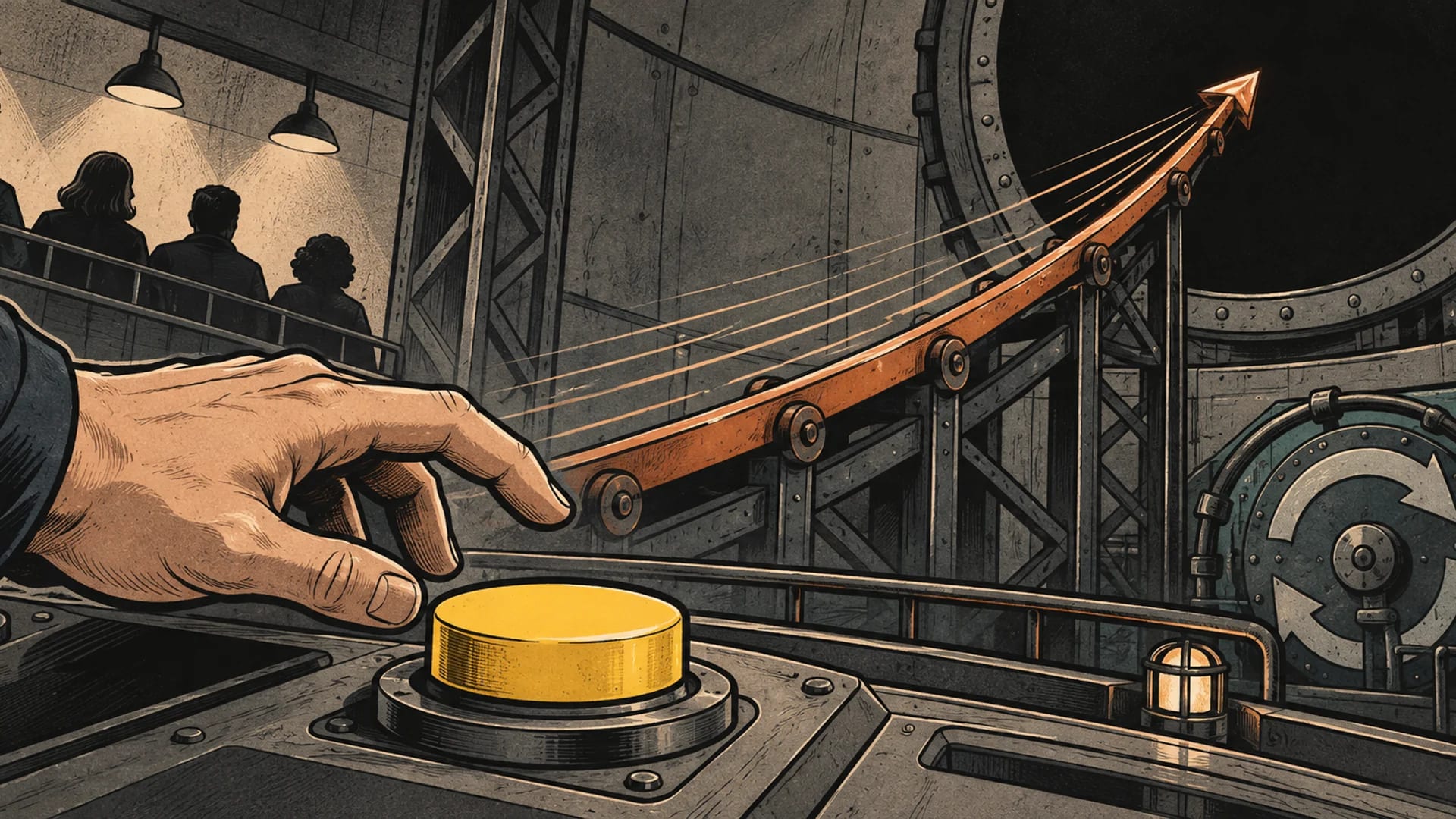
That is a remarkable amount of tension for a screen built from a number, a line and one important button.
A clock that displays reward instead of time
Most gambling results arrive after the player has committed. A crash round keeps the player inside the interval. The multiplier climbs, the possible return changes and the right to cash out can disappear at an unknown point.
Recent research now treats crash as a category in its own right. A 2026 paper in the UNLV Gaming Research & Review Journal describes the basic structure as a rising potential multiple that can end before the player exits, and analyses expected values and player behaviour in two products. The paper also cautions that very high outcomes are rare. Cash or Crash research article
Our separate explainer on how crash games work covers the multiplier, RTP and fairness boundary. The design question here is why the same simple mechanism can feel so active.
The interface replaces elapsed seconds with accumulating value. A change from 1.30× to 1.31× is visually small, but it is framed as money that could be secured or lost. Time is not shown as neutral duration. It is shown as a return moving away from the starting stake.
The button gives agency without prediction
The cash-out control matters. Pressing it can determine the realised return if the request arrives before the terminal event. It cannot reveal when that event will occur.
This creates a precise kind of agency: control over exit, not control over outcome. Good interface analysis has to hold both ideas at once. Saying the button is meaningless ignores its transaction role. Treating it as a method for predicting the crash point invents skill the control does not provide.
A controlled 2024 Psychological Science study examined a related, but not identical, post-bet cash-out choice. Across two experiments with 240 adults, participants placed larger initial bets when a later cash-out option was available. The authors proposed perceived reversibility and control as possible explanations. The task used delayed card outcomes and sports-betting-style offers, not crash games, so the finding cannot be transferred as a measured crash-player effect. It does show that adding an exit choice can change the decision made before the wait begins. Bennett and colleagues, 2024
Motion makes the unresolved state impossible to ignore
The rising line, aircraft or other moving object gives continuous feedback while the underlying question remains unresolved. Acceleration, camera movement and increasing pitch can make later moments feel different from earlier ones even when the screen does not disclose a new probability.
This is where design can blur information and atmosphere. The multiplier is material information: it tells the player the current potential return. A trail, shake, glow or swelling sound may communicate momentum without providing evidence about what comes next.
The distinction is easier to see if the animation is removed. A plain number changing against a silent background preserves the decision. The spectacle packages it.
Research on electronic gaming machines provides adjacent evidence, not a crash verdict. A systematic review of 51 experimental studies found that celebratory audio and visuals around “losses disguised as wins” were associated with overestimation of win frequency and arousal. Those studies concerned slot-like machines and near-miss or partial-return presentations. Crash products have a different temporal structure, so the result should guide questions about feedback rather than be cited as proof of a specific crash effect. Barton and colleagues systematic review
Other players become part of the scenery
Many crash interfaces show a stream of stakes, exits or recent multipliers. These elements can make the round feel shared even when each account has its own transaction. They also create movement before and after the central animation: somebody has just cashed out, another amount appears, the recent-history row changes.
That information can be useful if it is accurate and clearly labelled. It can also be misread. Another player’s exit does not disclose the hidden terminal point. A run of recent multipliers is history, not a forecast. Large visible amounts say nothing about whether the observer can afford the same exposure.
The social panel therefore performs two jobs. It reports activity and supplies an audience. The second job is cultural: the round feels less like a private calculation and more like a live event with spectators arriving at different moments.
The reset protects the rhythm
After the crash, the interface has only a short narrative problem to solve. It must confirm the result, clear the old tension and prepare the next commitment. History updates. Controls reset. A countdown may begin.
This reset is not empty time. It turns a terminal loss or cash-out into one item in a sequence. The previous round becomes a mark in the history strip while attention shifts to the next stake and exit setting.
Regulators increasingly treat pace and presentation as product controls. In Great Britain, RTS 14 says gambling products must not actively encourage loss chasing, stake increases or continued gambling after a player chooses to stop. For casino games within the relevant scope, it also restricts result-speed controls, celebrations of returns no greater than stake and the minimum interval before another cycle can begin. The same standard expressly recognises games where the customer loses unless they act to end the game. Product classification and the exact applicable requirements still matter. UK Gambling Commission RTS 14
Those rules do not declare all motion or sound illegitimate. They draw a line around how product design can shape pace, understanding and continued play.
What a responsible teardown should ask
A useful review of a crash interface does not ask whether it looks exciting. It asks what each element tells the player and what it merely makes the player feel.
Does the screen clearly separate current potential return from any suggestion about the future?
Is the cash-out status unambiguous, including pending, accepted and failed requests?
Are stake, realised return and loss shown without celebratory camouflage?
Does recent history look like a record rather than a predictive pattern?
Are other-player amounts authentic, relevant and presented without manufactured pressure?
Is there a genuine pause and a fresh affirmative action before the next stake?
Can the player reach limits, session information and an exit without fighting the game’s visual hierarchy?
The urgency of crash is designed from an unresolved choice, visible accumulation and a hard stop. None of those elements predicts the outcome. Together they make every fraction of the wait feel consequential — which is exactly why their presentation deserves more scrutiny than the small number of controls might suggest.