
They also show the limit of the thesis. Audience attention cannot be booked as guaranteed customer value, and a media asset does not remove product, regulatory or integration risk.
First separate the buyers
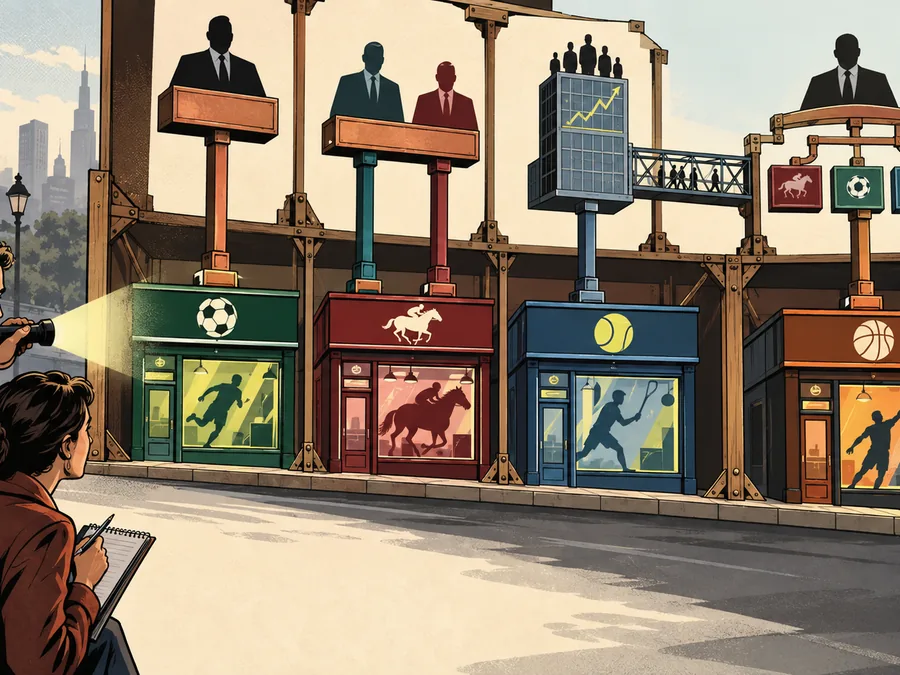
“Gambling company” covers businesses with different economics. An operator accepts wagers. An affiliate or performance-marketing group earns fees or revenue share for referring customers. A sports-media company sells attention, subscriptions or advertising. A data company sells feeds and tools.
An acquisition can combine those models, but it does not make them interchangeable. The distinction matters when reading management’s stated rationale.
PENN Entertainment, for example, is a casino and online-gaming operator with media and technology assets. Gambling.com Group describes itself in its 2025 Form 20-F as a provider of marketing and sports-data services to the gambling industry. It does not operate the gambling brands it reviews. Gambling.com Group’s filing
The operator thesis: brand, reach and a path into product
When PENN completed its purchase of Barstool Sports in February 2023, its announcement described Barstool as a media brand with a loyal audience and framed that audience as a route into customer acquisition and cross-selling. PENN also pointed to content, retail sportsbooks and a planned migration to its technology stack. The acquisition announcement
That was management’s investment thesis, not an independent finding that every follower would become a profitable customer. The language reveals what the buyer thought it was purchasing:
a recognisable identity that could be licensed to a sportsbook;
distribution through shows, personalities and social channels;
an existing relationship with an adult sports audience;
a media operation that could sit beside betting and casino products.
The intended advantage was not merely page views. It was control: one group could coordinate media, brand, product, technology and physical properties.
The affiliate thesis: own more of the useful layer
An affiliate-led group can buy for a different reason. Gambling.com Group acquired Freebets.com assets in 2024 and Odds Holdings, the parent of OddsJam and OpticOdds, in January 2025. Its 2025 annual report says the Odds acquisition expanded the group’s data services and brought products for both enterprise clients and consumers.
The company’s acquisition announcement was explicit about the intended shift. It said Odds Holdings would add recurring revenue from consumer subscriptions and enterprise clients that was independent of the core online-gambling affiliate business. The Odds Holdings announcement
Again, that is the buyer’s stated rationale. The useful distinction is between buying another traffic property and buying a capability. Freebets.com added a branded audience and publishing asset. OddsJam and OpticOdds added consumer and business-facing data products. Both sit near betting, but they create revenue in different ways.
Five assets that can sit inside one deal
| Asset | What the buyer may be trying to control | What the filing does not prove by itself |
|---|---|---|
| Brand | Recognition, trust or a licensed consumer identity | That recognition transfers to a new product |
| Audience | Direct reach through web, app, social, audio or video | That reach converts at an acceptable cost |
| Editorial distribution | Regular reasons for users to return | That content remains credible after ownership changes |
| Data and technology | Odds tools, user accounts, subscriptions or workflow | That systems integrate on time or without disruption |
| Commercial relationships | Advertisers, operator clients or affiliate partners | That contracts renew after the transaction |
The table is an analytical framework, not a universal acquisition model. A buyer may value one layer and close another. The purchase agreement and later segment reporting show more than the launch headline.
The Barstool exit is the necessary counterexample
PENN’s ownership history also shows why the simple funnel story is incomplete. In August 2023, after completing the Barstool purchase earlier that year, PENN sold the media company back to its founder for nominal cash consideration and moved its US sportsbook to an ESPN-branded alliance.
That alliance then ended early. A November 2025 SEC filing says PENN and ESPN terminated the sportsbook agreement effective 1 December 2025. The integrations and marketing exclusivities ceased, PENN stopped using ESPN trademarks and the sportsbook moved to theScore Bet. The termination filing
PENN’s 2025 Form 10-K says the rebrand and digital realignment changed its future cash-flow projections and contributed to an impairment in the Interactive segment. It also warns that losing the ESPN licence and transitioning brands could affect customer acquisition and retention. PENN’s 2025 Form 10-K
The lesson is not that media-and-betting combinations always fail. It is that audience reach, contract rights and economic return are separate. A deal can deliver users and still fail to meet the parties’ longer-term objectives.
Where value can leak
Integration is one source of leakage. Editorial systems, identity, data permissions, product accounts and compliance controls may have been built for different purposes. Joining them can take longer than the brand launch.
Trust is another. A publication that becomes visibly promotional may weaken the independent reason readers used it. Conversely, an operator may discover that a popular media voice cannot be cleanly extended into a regulated product across every state or country.
The revenue model matters too. Affiliate income can depend on search visibility, operator terms and regulatory access. Subscription revenue depends on renewal and product utility. Advertising depends on demand. Betting revenue depends on product, pricing, retention and outcomes. One audience does not make those risks identical.
Our sportsbook ownership map separates brand, parent, licensee and market-access layers. Acquisition analysis needs the same discipline: label what was bought and which company earns from it.
How to read the next announcement
Start with the buyer’s latest filing, then ask five questions.
Is the target primarily media, affiliate marketing, data, software or a regulated operator?
Is consideration fixed, contingent on performance or paid partly in shares?
Does management promise reach, subscriptions, technology or cross-sell — and which measure will later reveal delivery?
Who controls customer data and product accounts after closing?
What later disclosure would falsify the original thesis: impairment, disposal, lower guidance, contract loss or weak renewal?
This reading avoids two errors. It does not dismiss every media deal as a vanity purchase, and it does not treat stated synergies as achieved results.
Gambling groups buy media and affiliate businesses because attention, identity, data and distribution can be strategic inputs. The filings matter because they also record when those inputs fail to become durable economics.