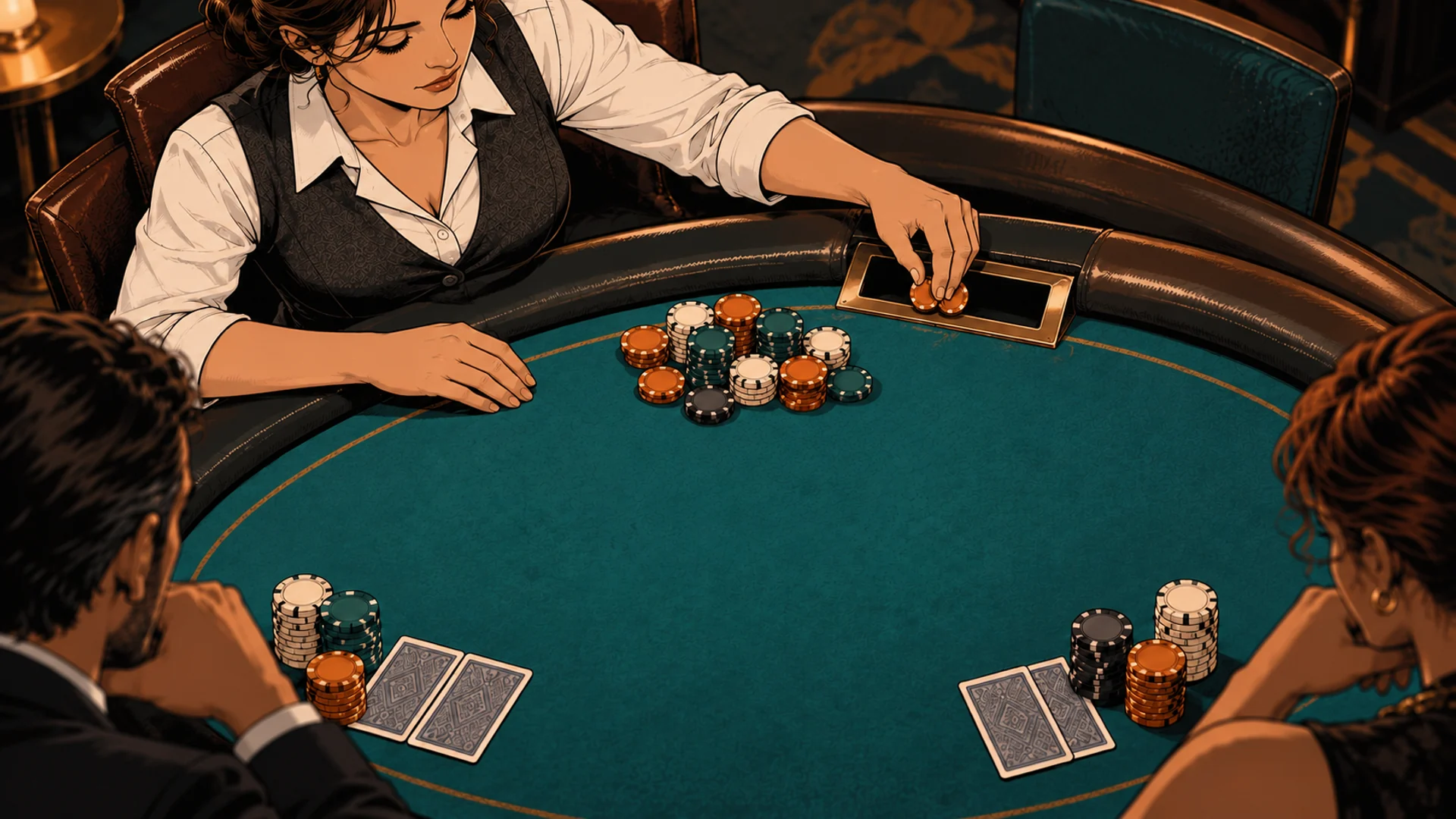
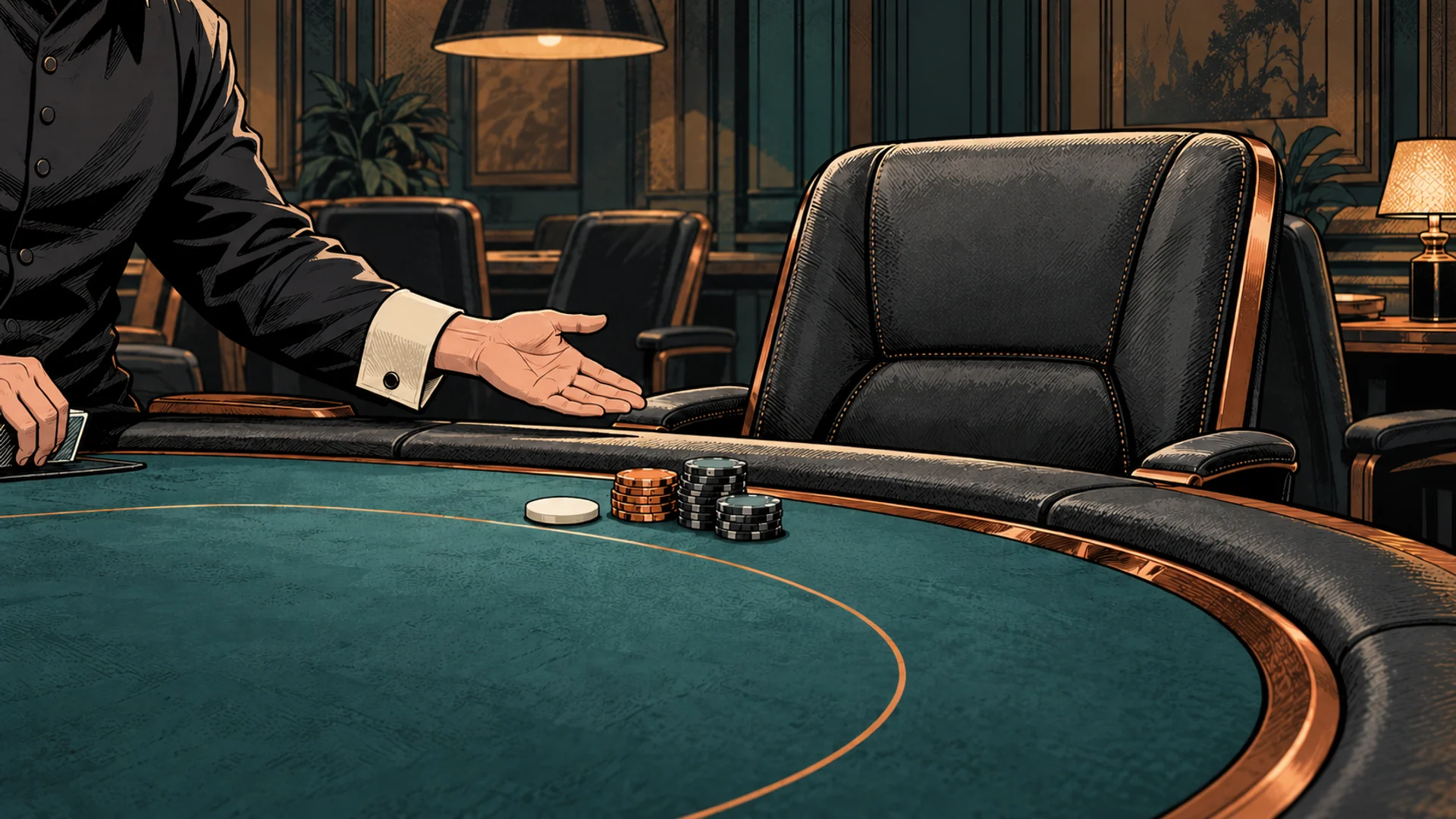
An empty chair does not tell you where the poker button goes next. Nor does a returning player's missed-blind payment necessarily count in full towards the next bet. The first question concerns position; the second concerns chips owed after an absence.
PokerStars' online tournament rules, PokerStars Live's cash-game rules and the Poker Tournament Directors Association's 2026 rules give different, specific answers. These English-language documents were checked on 27 October 2026. They describe their stated settings, not permission to play from a particular country or a rule for every poker room.
Online eliminations can change who pays
PokerStars' online Tournament Rules, section 2.4, move the button clockwise after each hand without giving it to the same player twice consecutively. An elimination can therefore cause someone to skip one or both blinds. That consequence is part of this published system, rather than proof of a missed payment.
Section 2.6 treats table moves separately. Random seating after a table breaks can occasionally put a player in the big blind on consecutive hands. Moving an individual to balance tables aims, where possible, to preserve a similar position relative to the blinds. Those are two different reasons for a seat change.
Sitting out is different again. Under section 4.1, an absent or disconnected tournament player continues to receive cards and have blinds and antes posted. The empty chair still represents a stack in the event. It is not the same position as a player who has been eliminated.
A cash-game return can include dead money
The PokerStars Live cash-game rules, rule 43, require someone posting both missed blinds to put in their combined amount. Only the big-blind portion counts towards the player's bet. The excess goes into the pot as dead money. The rule has a straddle exception, excluded here.
With invented blinds of one and two units, that payment is three: two live and one dead. If action returns facing a total bet of six, another four are needed to match it. Counting all three as live would leave the player one short.
Seven units have now been paid: six towards the bet and one dead unit. Assume sufficient chips, a valid bet and no ante, straddle or fee. These are teaching amounts, not quoted stakes. The dead unit stays in the pot; it is not the room's rake, covered in our poker-fee explainer.
Rule 39 separately gives a new player whose blinds have passed options to wait, post both or buy the button. It is not an online tournament's sitting-out procedure.
Dead button does not mean permanently fixed to a seat
The TDA's 2026 rules, version 1.1 dated 21 September, specify a dead button in rule 34. This voluntary association's rules require adoption by the event.
Rule 36-B also addresses multiple vacancies. Its example starts with the button at seat nine, small blind at one, empty seats two and three, and big blind at four. After the small blind is eliminated, the next button goes to empty seat three, with small blind at four and big blind at five. This preserves blind order and space for newcomers.
A dead button therefore need not stay fixed beside a vacancy. The same rule sets conditions against missed or consecutive big blinds in this placement adjustment. Table balancing has a separate provision: rule 12-A can require the moved player to post the big blind twice, and excludes the small blind as the worst position.
The record needs the reason for the vacancy
A disputed hand needs more than a photograph of an empty chair. Retain the game and event identity, hand number, positions before and after the change, and whether the player left, was eliminated or moved by staff. For a returning cash player, distinguish the posted total from the portion credited to the bet.
Our re-entry and rebuy report follows another seat distinction: retaining an entry versus starting a new one. Neither a remembered cash-room procedure nor a tournament label can settle the button question without the actual rulebook and sequence of hands.