
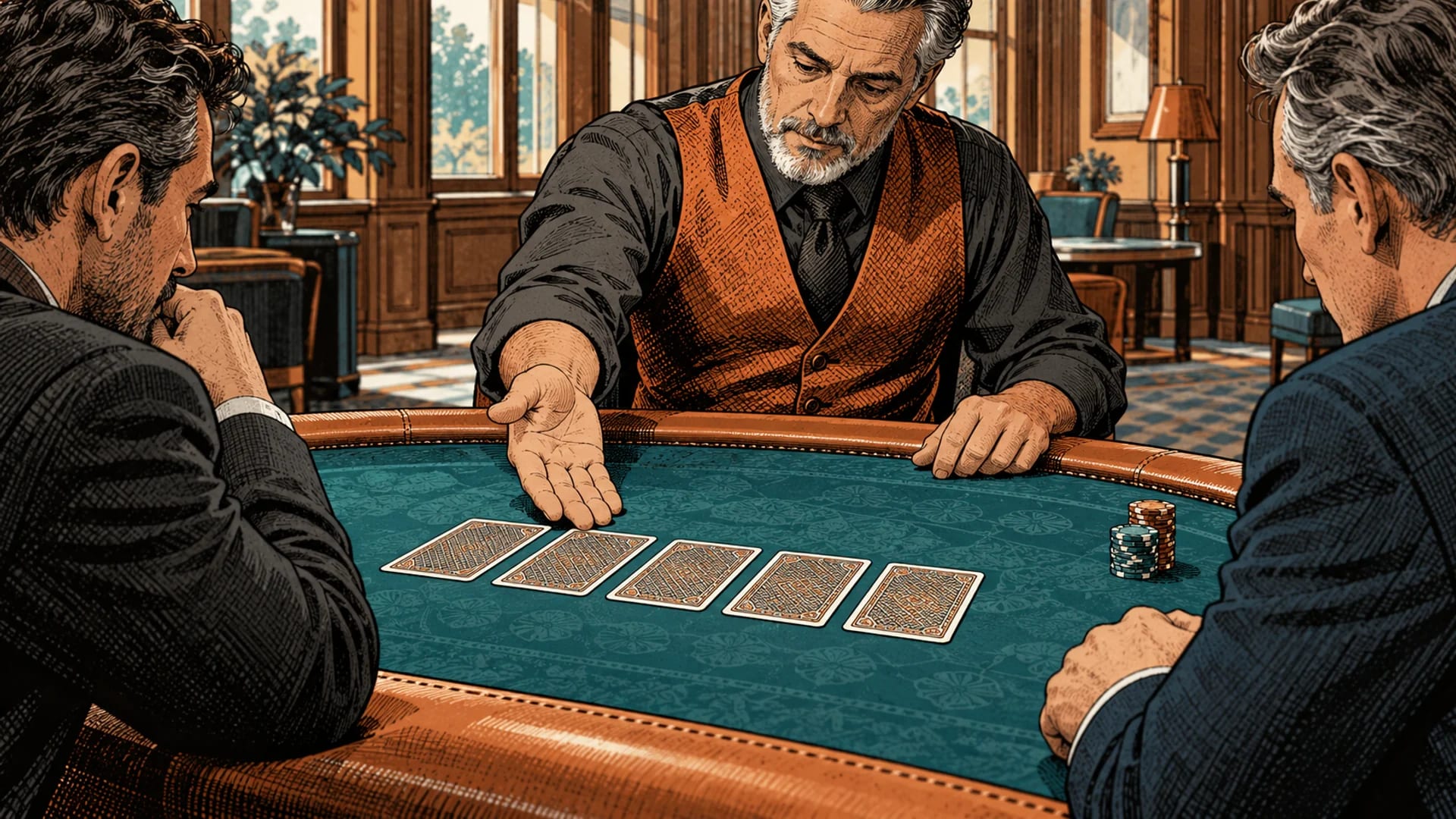
Both players can point to the same pair of aces on the table and still have different hands. In Texas Hold'em, the comparison at showdown uses each player's strongest five cards from the seven available: two private hole cards and five shared community cards. A side card can decide a hand even when the pair itself belongs to everyone.
The five-card selection may use both hole cards, one or neither. PokerStars' Hold'em rules explicitly allow those combinations and treat all suits as equal. There is no extra prize for keeping both private cards in the final hand.
The examples below are invented, use a standard 52-card deck and assume live, properly shown hands after betting has ended. Both players are eligible for one shared pot. No fees, side pots or odd chips enter these comparisons. They explain the result of completed hands, not which hands to bet.
The queen that separates two pairs of aces
The board is A♥ A♦ 9♣ 7♦ 2♠. Player A shows K♣ Q♥; Player B shows K♠ J♥.
Both have one pair of aces. The rest of each five-card hand matters:
| Player | Best five cards | Comparison |
|---|---|---|
| A | A♥ A♦ K♣ Q♥ 9♣ | Pair of aces, then king, queen, nine |
| B | A♥ A♦ K♠ J♥ 9♣ | Pair of aces, then king, jack, nine |
The kings match in rank. The next comparison is queen against jack, so A wins. The 7♦ and 2♠ are outside both best hands. They do not supply additional tiebreaks.
A kicker is a side card used to compare otherwise matching combinations. PokerStars' hand-comparison reference explains that, with the same pair, comparison continues through the remaining cards in descending order. Calling both hands simply "a pair of aces" leaves out the cards that settle this example.
The heart on A's queen has not beaten the heart on B's jack. The queen's rank is higher. Nor does a spade king outrank a club king. Suits can form a flush, but they do not provide a hierarchy for breaking an equal Hold'em hand.
One private card can do all the useful work
Change the board to Q♣ Q♦ 8♥ 5♠ 2♣. A holds A♠ 3♦; B holds K♥ J♣.
A's best five are Q♣ Q♦ A♠ 8♥ 5♠. Only the ace comes from A's hole cards; the three stays out. B's best five are Q♣ Q♦ K♥ J♣ 8♥.
Compare the shared queens, then the highest kicker. A's ace beats B's king, so A wins. B's jack does not make up for losing that first kicker comparison. Lower cards are considered only when the earlier ranks match.
Forcing A to include the 3♦ would construct a weaker selection than the rules require. The hand is the strongest five-card combination available to that player, not the two hole cards with three obligatory additions from the board.
The board can belong to both players
Now the community cards are 9♣ 10♦ J♥ Q♠ K♣. A shows 2♦ 3♠; B shows 4♥ 5♦.
Each player's best hand is the board's king-high straight: K♣ Q♠ J♥ 10♦ 9♣. Neither set of hole cards improves it. This is playing the board.
The two best five-card hands are identical, so the players share the pot. B's five is higher than A's three, but neither card belongs in the winning five. There is no sixth-card comparison after a complete five-card tie.
Assume 200 chips are available to distribute between these two eligible players. Each receives 100. That allocation does not say either player made a 100-chip profit: earlier contributions would be needed to calculate the hand's net result.
The question of who is eligible for which chips is separate. Our side-pot explanation covers unequal contributions; our pot-odds ledger separates a decision's call price from the amount eventually awarded.
Five hearts on the table do not settle every flush
A board that already contains a strong hand can still be improved. Take A♥ J♥ 8♥ 4♥ 2♥, with A holding K♥ 7♣ and B holding Q♥ 9♦.
A makes A♥ K♥ J♥ 8♥ 4♥. B makes A♥ Q♥ J♥ 8♥ 4♥. Both have an ace-high flush, but the second card in A's flush is a king and the second in B's is a queen. A wins.
The 2♥ drops out of both selections. The players are not required to accept the five-card flush displayed on the board when their hole cards produce a stronger one. "There is a flush on the board" describes the community cards; it does not finish the comparison.
Using one card is different from showing one card
Selection and presentation are separate rules. In the Poker Tournament Directors Association's 2026 rules, version 1.1 dated 21 September, rule 14-A requires proper tabling of both Hold'em hole cards. Rule 20 requires that presentation even when a player is playing the board.
Thus, using only A♠ in the one-card example does not mean showing only A♠ meets that tournament procedure. The unused 3♦ remains part of the player's two-card holding.
The TDA is a voluntary tournament association, not a law governing every cash room. Its rule 13 says the cards determine the winner rather than a player's verbal description. Its rule 21-A gives a positional procedure for an odd chip in board games. That remainder is an allocation issue, not evidence that one tied hand has a superior suit. Use the rules adopted by the particular event for procedural disputes.
Fees are another separate deduction, covered in our poker rake explainer. They can change the amount distributed without changing which of the four example hands is stronger.
In the first example, the decisive card is the queen. In the straight example, neither player's private cards count. Writing out the actual best five resolves both results without inventing a suit ranking or looking for a sixth card.