
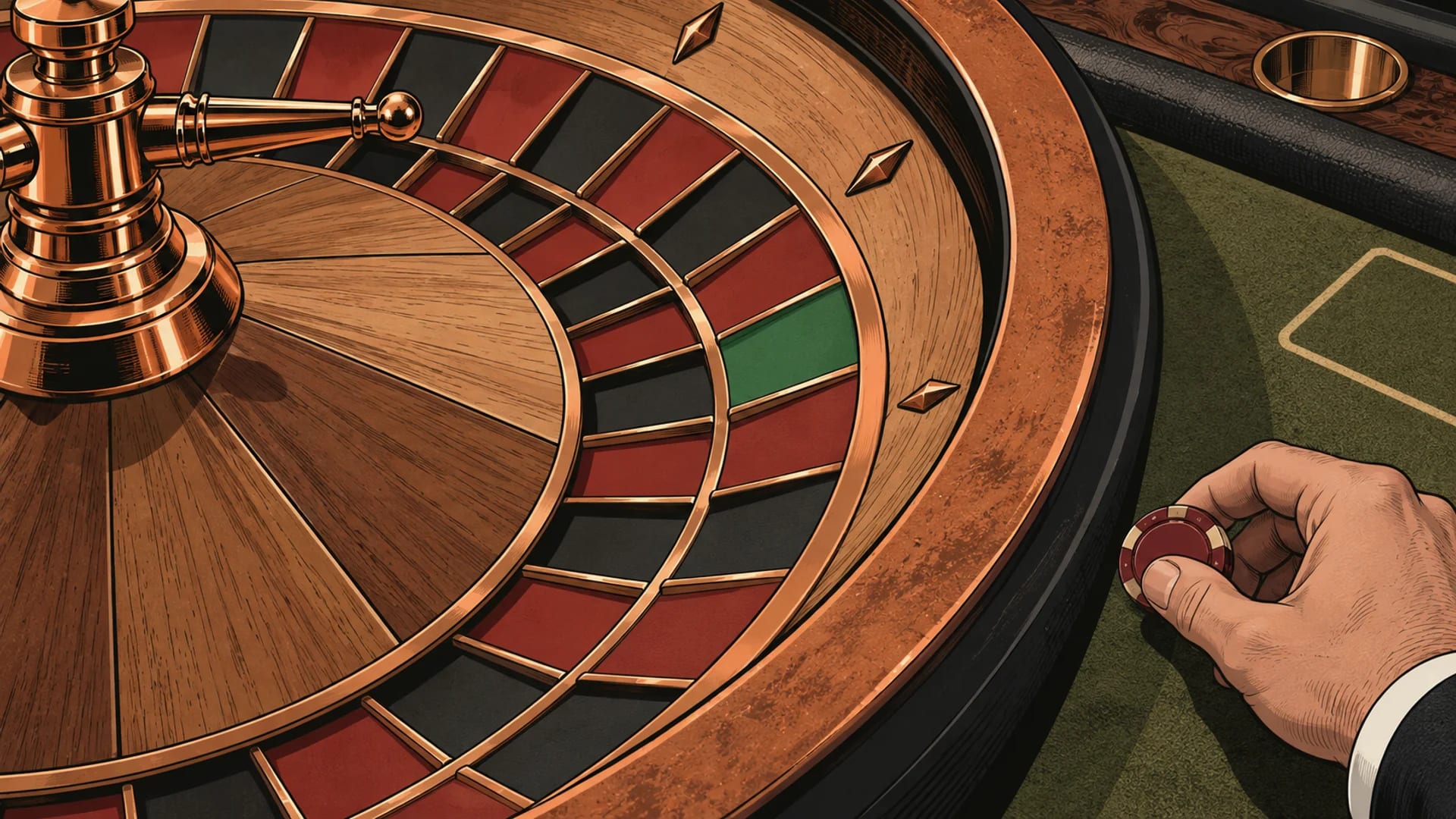
For a player reading a roulette table, the distinction changes how the offer looks. A large payout can sit beside a small probability, while an even-money payout can sit beside a probability below half. The examples here use one-unit stakes to explain the arithmetic. They are not recorded betting results or a method for making gambling profitable.
Count the pockets before reading the payout
A single-zero wheel has the numbers 1 to 36 and one zero, giving 37 pockets. A double-zero wheel adds 00, giving 38. The Venetian Resort Las Vegas describes these as its European and American configurations, respectively, while also listing other variants. Those labels are a useful starting point, but the wheel and the rules identify the game. The Venetian's roulette rules
For our calculations, every pocket has the same probability and consecutive completed spins are independent. A wager covering two distinct numbers therefore wins on 2 of the 37 or 38 possible results. Covering more pockets increases the chance that this wager wins, but the ordinary payout falls with that wider coverage.
Zero belongs in the denominator even when it does not belong in your selection. A red bet covers 18 numbers. The other results include 18 black numbers and either one or two zeros. Its chance of winning is therefore 18/37, about 48.65%, or 18/38, about 47.37%. Under the ordinary full-loss-on-zero rule used in our base model, zero loses for a red wager. Special zero-settlement rules need their own calculation.
A win has a profit and a returned stake
MGM Resorts' GameSense guide lists the familiar payouts: 35:1 for one number, 17:1 for two, down to 1:1 for red or black. The colon describes profit relative to the winning stake.
In a hypothetical one-unit straight-up wager, a win produces 35 units of profit and returns the one unit staked. The total coming back is 36 units. A loss returns nothing and costs the unit. For a one-unit red wager paying 1:1, a win returns two units in total: one unit of profit and one returned stake.
The stake is not a second prize. It was your money before the spin. Comparing a 35-unit profit with a 36-unit total return without recognising that difference adds a unit that was never earned.
The table below combines the standard bet coverage and payouts listed by Ontario Lottery and Gaming Corporation's PlaySmart guide with our probability calculations. It describes single-zero and double-zero configurations with equally likely pockets, the stated conventional paytable and no extra feature. Percentages are rounded to two decimal places; the fractions are exact.
| Bet | Numbers covered | Profit payout | Single-zero win probability | Double-zero win probability |
|---|---|---|---|---|
| Straight up | 1 | 35:1 | 1/37 = 2.70% | 1/38 = 2.63% |
| Split | 2 | 17:1 | 2/37 = 5.41% | 2/38 = 5.26% |
| Street | 3 | 11:1 | 3/37 = 8.11% | 3/38 = 7.89% |
| Corner | 4 | 8:1 | 4/37 = 10.81% | 4/38 = 10.53% |
| Six line | 6 | 5:1 | 6/37 = 16.22% | 6/38 = 15.79% |
| Dozen or column | 12 | 2:1 | 12/37 = 32.43% | 12/38 = 31.58% |
| Red/black, odd/even or low/high | 18 | 1:1 | 18/37 = 48.65% | 18/38 = 47.37% |
Each row is one wager, with its entire stake attached to that selection. It is not several separate one-unit bets placed on each covered number. Inside bets cover particular numbers or groups on the numbered layout; outside bets cover categories such as a colour, dozen or column. Low means 1 to 18; high means 19 to 36.
The zero changes the average without changing 35:1
Under the base model, the expected total return on a one-unit straight-up bet is its win probability multiplied by the 36-unit return. That is 36/37 units on a single-zero wheel, or 36/38 on a double-zero wheel. Subtract either figure from the one unit staked to get the expected loss: 1/37, about 2.70%, or 2/38, about 5.26%.
That expected loss as a share of the stake is the house edge. The seven conventional bet groups in the table have the same edge within each configuration because their total payout and probability balance to the same expected return. Red wins more often than a particular number, but its smaller payout does not remove the margin.
These averages are calculations over possible outcomes. A real session does not have to deliver that loss percentage, and 37 spins need not produce each single-zero result once. Our guide to return to player (RTP) follows the distinction between the average share of stakes returned and a player's balance.
The five-number bet on 0, 00, 1, 2 and 3 is an exception to that shared edge. Its listed 6:1 payout gives seven units back on a win. On an equally likely double-zero wheel, the calculation is 5/38 × 7 = 35/38 units returned in expectation. The missing 3/38 is about 7.89% of the stake. This is our calculation from the paytable, not a measured casino result.
PlaySmart's page prints 7.29% for that wager. Its stated 6:1 payout produces 7.89% under the model above, so we have used the calculated figure rather than repeating the percentage.
A special rule needs a separate line of arithmetic
The base table cannot supply an RTP for every game containing a roulette wheel. A different payout changes the expected return; an additional feature can require probabilities that an ordinary paytable does not disclose. Our report on multiplier roulette examines that separate problem. A headline multiplier is not enough to calculate the whole game's return.
Zero can also be settled differently. The French Roulette rules hosted by Loto-Québec describe a single-zero game with La Partage: when zero lands, half the stake is returned on red/black, odd/even and low/high wagers. The document states 98.65% theoretical RTP for those eligible bets and 97.30% for the other standard bets. This is a named Québec game document, not a rule attached to every single-zero wheel. Loto-Québec's French Roulette rules, pages 1 to 2 and 8
Our corresponding one-unit example on red returns two units on each of 18 red outcomes, nothing on 18 black outcomes and half a unit on zero. The expected total is (18 × 2 + 0.5)/37, about 98.65% of the stake. The chance of a red result is still 18/37. La Partage changes the loss on zero, not the number of red pockets.
For an online table, read the help panel for the version actually loaded. A familiar thumbnail cannot establish the rules beneath it; our casino-game version report traces the identifiers needed to make that comparison.
The previous spin does not change this model
With independent spins, a run of black results leaves the next spin's red probability at 18/37 or 18/38. Independence means the earlier outcomes do not change those next-spin probabilities. MGM's GameSense guide makes this point about previous results. It is a model boundary, not our inspection or certification of a particular physical wheel or online implementation.
Raising the stake changes the amounts at risk and paid, not the probability that a pocket is selected. For the conventional wagers above, the expected loss scales with the total staked. A larger wager does not repair the gap between the payout and the probability.
Before treating any roulette percentage as applicable, check:
whether the wheel has a single zero, a double zero as well, or another configuration;
which pockets the actual wager covers and what its winning payout returns;
whether zero produces a full loss, a partial return or another stated settlement;
whether the game adds features whose rules change the calculation.
Reading those details makes the wager understandable. It does not make its result predictable. The numbers here describe the terms and probabilities of a game; they do not make gambling a source of income.