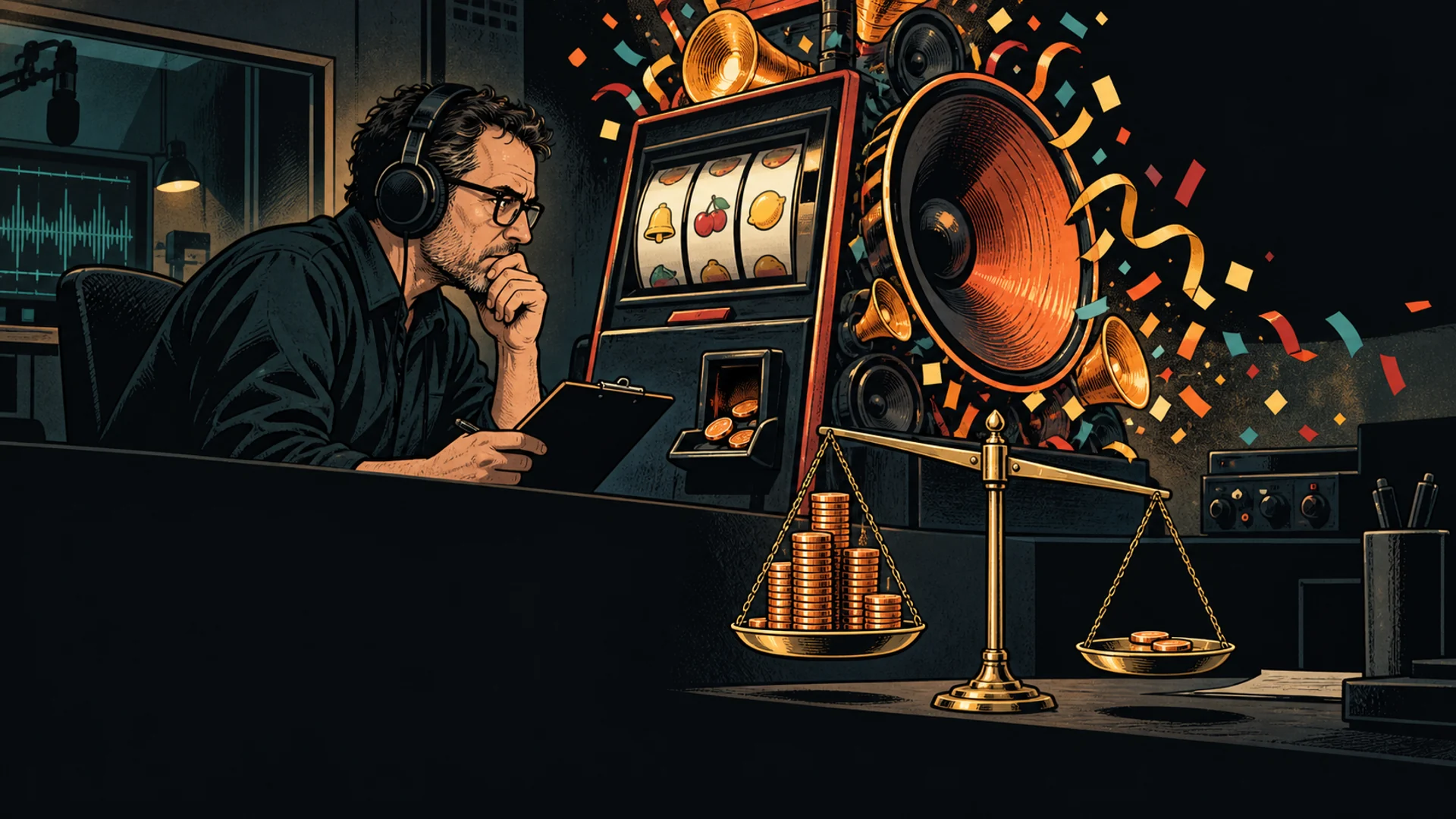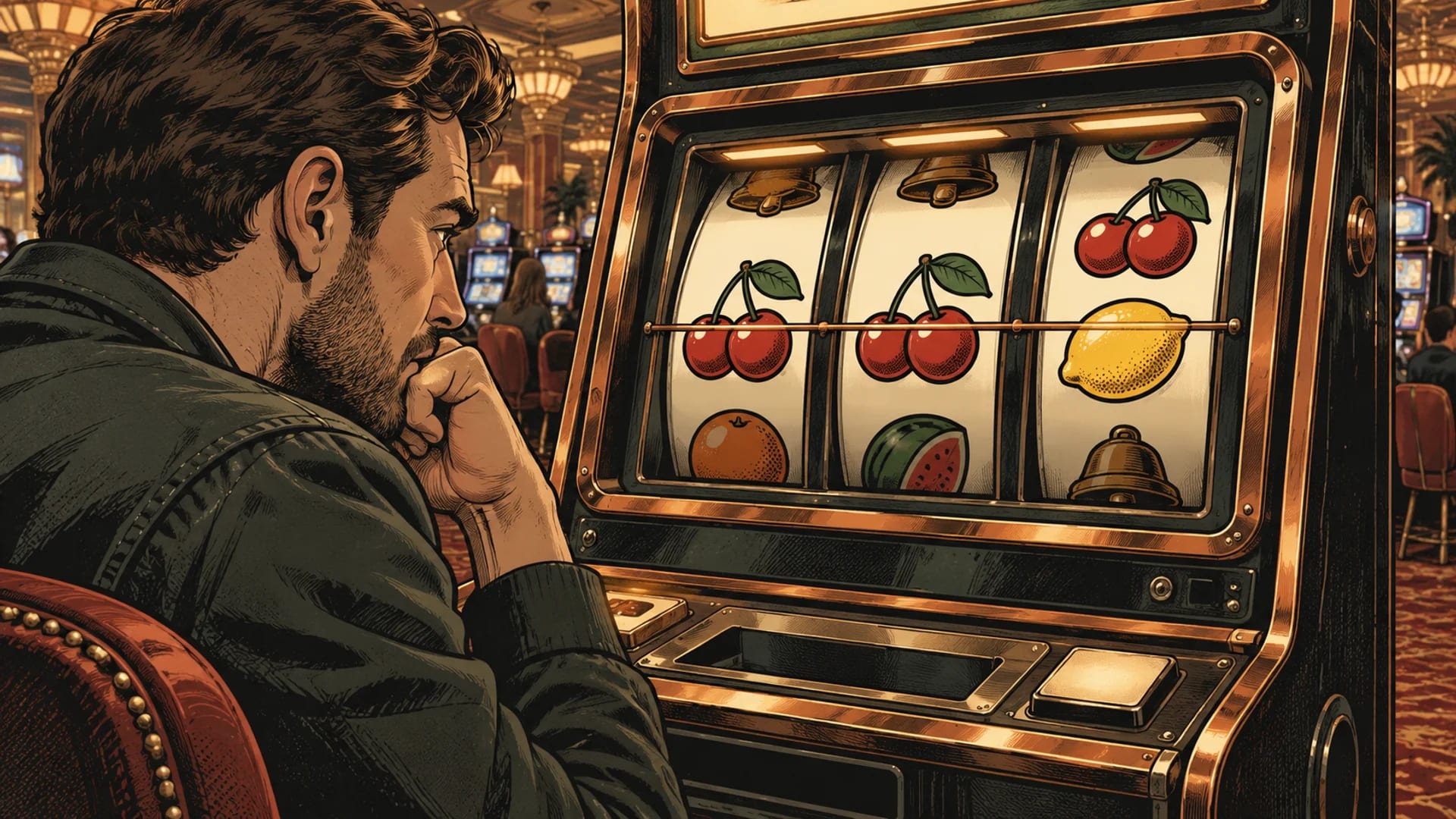
Two matching symbols sit on a slot's payline; the third stops just above it. In this illustrative example, the line pays nothing. The arrangement nevertheless gives the loss a particular appearance: almost a win. A slot near-miss is a losing outcome with that visual proximity, not evidence that the next spin is more likely to pay.
The distinction matters because the screen offers two accounts of the same event. The balance records a loss. The picture invites attention to how little appeared to separate it from a different result.
Researchers have tested that tension with deliberately simple slot tasks. Their findings are more interesting, and less universal, than the familiar claim that every near-miss delivers a dopamine hit.
The experiment gave players a choice
In a 2009 study, Luke Clark and colleagues used two simulated reels with six possible symbols. Participants sometimes chose the symbol on the first reel; at other times the computer chose it. The second reel then spun and stopped. A matching symbol on the payline won, while a symbol one position above or below it counted as a near-miss. Both near-misses and more distant misses returned nothing. Clark and colleagues, Neuron
The behavioural experiment involved 40 volunteers. They rated the outcome's pleasantness and their desire to continue. Near-misses were less pleasant than full misses, yet increased the desire to play when participants had selected the first symbol themselves. When the computer selected it, the pattern differed: near-misses reduced that desire relative to full misses.
That choice had no power to turn the losing result into a payout. It changed the participant's role in the task, which helps explain why the distinction interested the researchers. A result can feel personally close even when personal action supplies no useful prediction.
The experiment also makes a useful reporting limit visible. Its finding concerns a particular task, choice condition and rating. It does not measure the revenue effect of a current casino's animated reels, nor establish that every player responds in the same way. A studio claiming such an effect would need evidence from its own product.
Think of the difference from a missed shot in a sport. A player may reasonably learn something about technique from where a ball lands. A slot's adjacent symbol is not comparable evidence that the player is improving a motor skill. The image of closeness can survive even when that interpretation of closeness does not.
Brain activity is not a measured dopamine release
The same paper included a smaller imaging experiment with 15 participants. Near-misses recruited parts of the ventral striatum and anterior insula also involved in responses to wins. That is evidence of overlapping activity in a laboratory task, not proof that a loss and a win are identical experiences. It also cannot turn a brain scan into a measurement of a commercial game's addictiveness. The study's imaging results and methods
A later study, published in 2016, compared 22 people described by the researchers as pathological gamblers with 22 controls. Near-misses produced higher motivation to continue and greater striatal responses than full misses across participants; the gambling group showed amplified striatal responses to near-misses. The researchers also tested a dopamine D2 receptor antagonist against placebo. It did not reliably alter the brain response to near-misses in that experiment. Sescousse and colleagues, Neuropsychopharmacology
Those results support taking near-misses seriously as a product-design question. They do not support the tidy sentence that a near-miss has been shown to release the same dopamine as a win. That sentence replaces the measured outcome with a different one. It also erases differences between participant groups, experimental conditions and individual experience.
Neither paper is a diagnostic test for a reader, and neither offers a way to forecast a spin. They investigate responses to outcomes after those outcomes have occurred.
A near-miss and a small payout are different events
Consider a hypothetical game with a £1 stake. One losing result returns nothing but places a matching symbol close to the payline. Another returns 60p through a paying line. The first is a zero-return near-miss; the second is a 40p net loss with a payout event. Whether either result receives a celebration is a further design question.
Our article on a slot loss that sounds like a win examines those less-than-stake returns, often called losses disguised as wins. Combining both phenomena under one label makes it harder to say what the interface actually did.
An observer reviewing a recorded game cycle should therefore keep the stake, total return and final symbol arrangement together. A close-looking reel is not a substitute for the net balance change. A paying line is not sufficient evidence of a profit. These are separate facts that can be checked without making a claim about the player's state of mind.
In Great Britain, RTS 14F prohibits celebrating returns less than or equal to the total stake with win-associated audio or visual effects. Its guidance still permits certain brief result sounds and information displays. That rule concerns the presentation of a financial result; it is not a blanket prohibition on every losing arrangement that looks close. Gambling Commission: responsible product design
Britain draws a line at substituting the loss
The Gambling Commission addresses misleading near-misses more directly in RTS 7C. It prohibits designs that mislead customers about the likelihood of outcomes, including substituting a losing event with a near-miss. The guidance gives the example of replacing one failure with another failure designed to look closer to a win. RTS 7A separately requires acceptably random results and prohibits compensated, adaptive behaviour. These are requirements for games within the British standard's scope, not a declaration that every slot worldwide complies. Gambling Commission: generation of random outcomes
The resulting review needs to separate two questions. Did the system display the outcome generated under the game's rules? And did the artwork or feedback suggest something that outcome could not justify? A lawful losing arrangement can still be worth examining as a matter of communication; an intentionally substituted near-miss raises a different compliance issue.
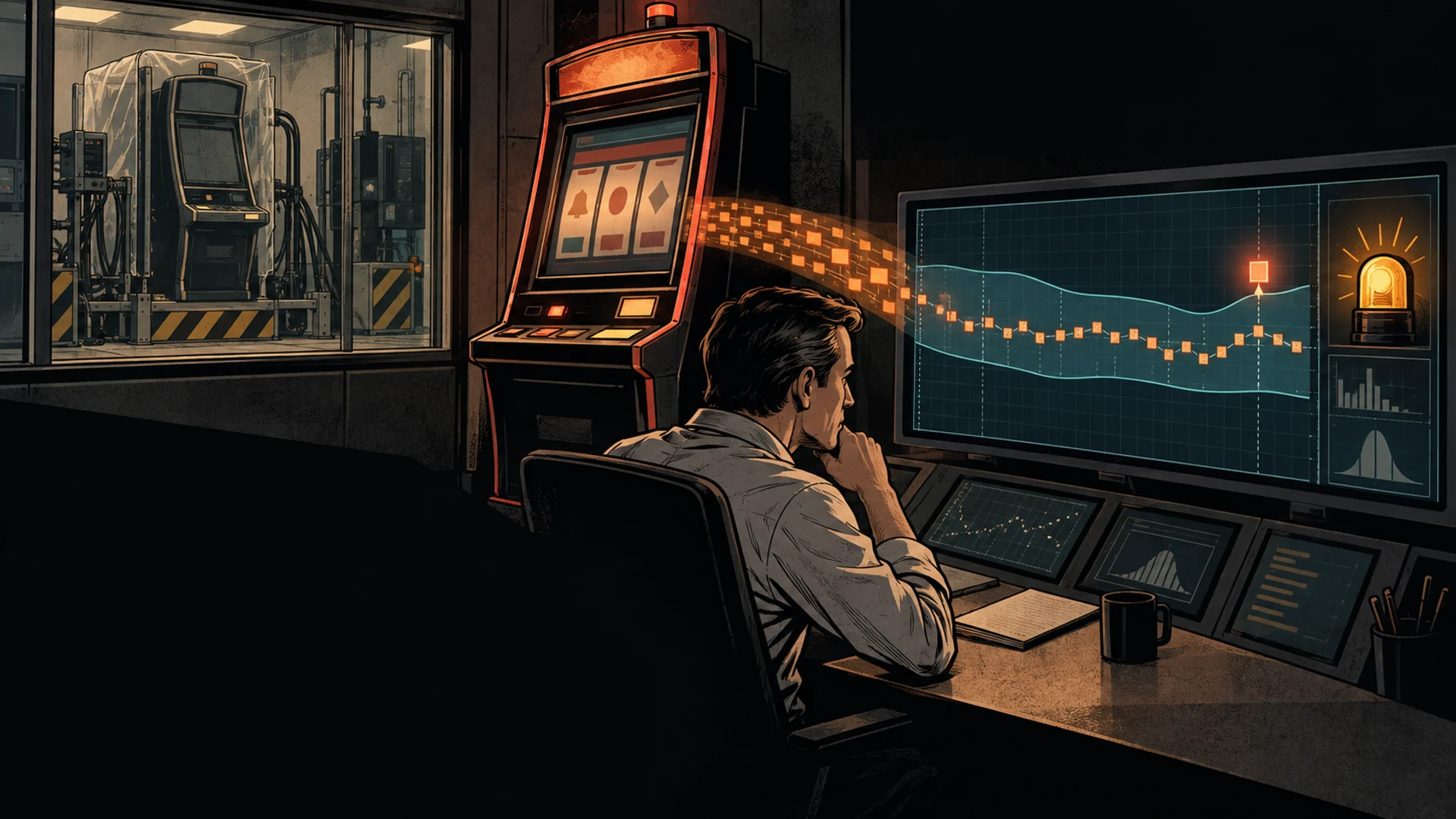
An illustration alone cannot establish how a game generated its result. That requires the relevant version, rules and technical evidence. Our account of how casino games are monitored after launch explains why a striking screenshot is only part of a product review.
The same restraint applies to RTP. A near-miss does not disclose a game's long-run payout percentage, and that percentage does not explain a particular player's next result. Those are questions about the payout model, covered separately in our explanation of casino RTP.
A recorded near-miss is enough to describe the symbol arrangement and the amount returned. Establishing that a system substituted the result requires technical evidence. Establishing how people responded requires a study. A close-looking loss should not be made to answer all three questions.