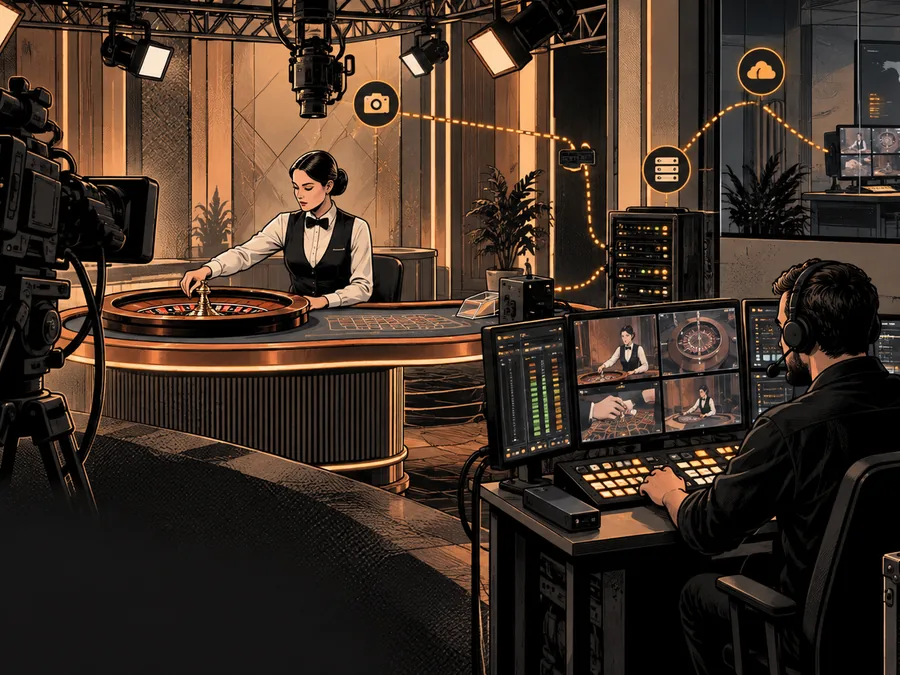
Live casino studios can be local for different reasons: an approved production location may be required by a jurisdiction, an operator may want a particular language or presentation, or a supplier may need additional capacity. Those explanations should not be collapsed into a single claim about rising demand.
For an operator evaluating supply, or an investor reading a studio announcement, the useful question is not simply how many tables were added. It is what the new facility makes possible that the existing network could not provide.
A licence can have a physical address
Michigan provides an unusually concrete example. Its published live-game framework quotes a rule requiring the live-game environment to be in the state at a board-approved location, unless the Michigan Gaming Control Board approves otherwise in writing. A supplier cannot treat an available video stream as sufficient permission to offer the underlying game. MGCB live-game framework, page 2
That is a Michigan requirement with an explicit exception route. It is not a worldwide rule that every country, language or operator needs its own studio.
The rule changes the business question. A supplier with spare production elsewhere may still need an approved local operation to serve a particular market. The constraint is not whether the internet can carry a picture across the border. It is whether the licensed activity can be conducted from that location.
That distinction also explains why the supplier-versus-operator licence boundary cannot be read from a product brochure. Buying access to a supplier’s tables does not merge the supplier, consumer operator and platform into one licensed entity.
The inspection is part of the product launch
On 5 October 2023, the Michigan Gaming Control Board announced approval for Authentic Gaming to stream from a Farmington Hills studio. The board said the approval followed fulfilment of its internet-gaming requirements, including an onsite review. It named the initial operator and platform relationships rather than describing a free-standing stream available to anyone. MGCB approval announcement
The framework makes the physical work more tangible. It calls for a site inspection before soft launch, security and surveillance arrangements, and demonstrations of staff procedures and system behaviour. It also gives the regulator access to the production environment and physical location. Those obligations make the room itself part of the regulated system, not scenery around a camera.
The operational implication is straightforward: a convincing demonstration video is not evidence that a facility is cleared to supply a particular operator. An approval, an integration and a date when customers can actually use the product answer different questions.
This is where a studio-opening announcement can get ahead of the reader. “Opened” may describe a building, installed capacity or a commercially available service. Unless the release specifies which milestone occurred, the editor should not silently substitute one for another.
Native-speaking is not the same as locally located
A table’s audience and its postal address are separate facts.
In December 2021, Evolution announced a dedicated environment for JVH gaming & entertainment group’s Dutch-facing JACKS.NL operation. It described native Dutch-speaking dealers and a host desk. That is evidence of a localised product. The announcement does not establish that the production room itself was in the Netherlands. Evolution’s JVH announcement
This distinction matters when a supplier says a product is “local”. It might mean the language heard by the customer, the branding on the set, the licence under which games are supplied, or the location of the studio. One word can conceal several different investments.
Language also involves more than replacing interface copy. A native-speaking table needs the people who deliver that service during its operating hours. However, the existence of that service does not establish an improvement in retention or profitability. Such a claim would need a defined comparison and evidence beyond a launch announcement.
For the mechanics of shared and dedicated tables, our live dealer casino guide follows the round itself. Here the distinction is about the business asset: a dedicated presentation is not proof of a new building, and a new building need not be dedicated to one consumer brand.
A second studio is not a disclosed return on investment
Evolution’s H1 report establishes that the second Michigan studio opened during the quarter. It does not provide a stand-alone profit-and-loss account for that facility. It would be unjustified to divide the group’s earnings by a table or studio count and present the result as the new site’s economics.
SYNOT Interactive’s live-casino product description illustrates the variety in what an operator can obtain: dedicated and shared environments, localised languages and different presentation capabilities. That is the supplier’s description of its offering, not independent evidence of commercial performance. SYNOT Interactive live casino
From an operator’s perspective, the relevant comparison is the particular capacity being purchased. A longer schedule on an existing table, reserved language-specific production and access to a newly approved territory solve different problems. They should not be compared only by counting camera feeds.
Our editorial reading is that studio expansion should be tested against the constraint it removes. If market access was the constraint, the approval and eligible integrations are central. If localisation was the constraint, the promised language and schedule matter. If the claim is capacity, the announcement should explain what additional service is available. None of these alone demonstrates how many customers will use it.
Three questions a studio announcement should answer
| Claim in the announcement | Evidence that would clarify it | What remains unproven |
|---|---|---|
| Access to a regulated market | Approved location, relevant permissions and eligible operator connections | Customer adoption and commercial returns |
| A localised offering | Named language, presentation and service scope | The studio’s country unless explicitly disclosed |
| More production capacity | Which facility or service was added and when it becomes available | Occupancy, utilisation and stand-alone profitability |
This is an editorial framework for reading disclosures, not an industry scoring model. A release can answer all three questions, only one, or none. The absence of a financial figure should stay an unknown rather than become an estimate dressed as reporting.
A good follow-up also separates what changes on launch day from what must continue afterward. The operating record matters long after the ribbon is cut; our account of casino monitoring after launch explains that distinction for the wider game supply chain.
Live casino distributes a shared product through many screens, but the activity being filmed still has an address, a staffing requirement and a permission boundary. The most revealing line in a digital expansion story may be the one that tells us where the door is.