
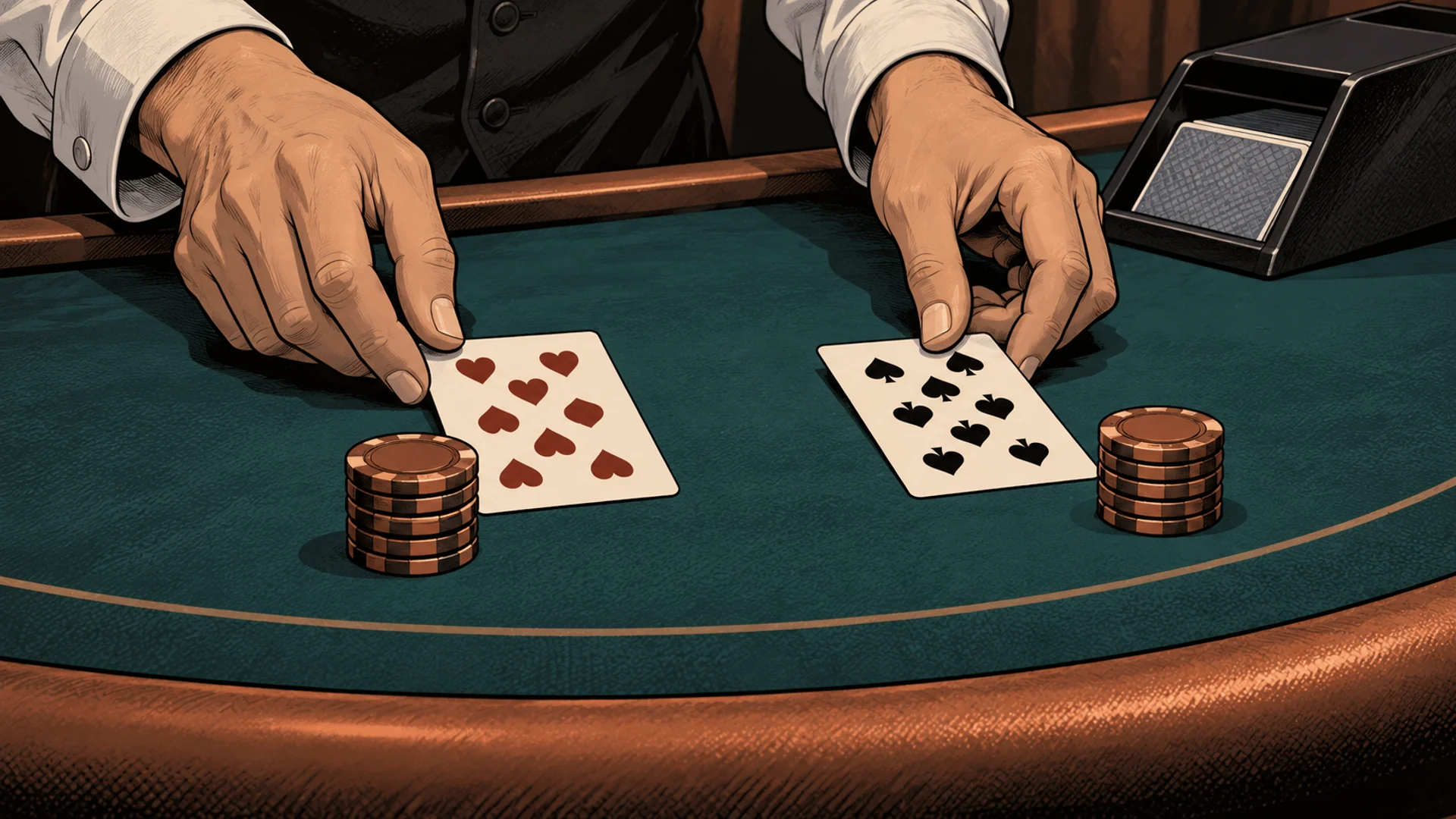
The extra hand costs as much as the first. Splitting a pair in blackjack separates the cards and adds an equal wager; it does not divide the money already on the table. Two hands can then produce different results against the same dealer.
MGM Resorts' GameSense guide describes splitting cards of equal value into separately staked hands. The restrictions need closer reading: another pair may not permit another split, and an ace can leave the player with fewer choices than an ordinary card.
Follow the money into the second hand
Take a hypothetical £10 initial wager. Adding £10 to split makes the total commitment £20. These pounds are teaching amounts, not a statement about the currency or limits at a US casino.
Assume one hand wins at even money and the other loses, with no doubles, side bets or dealer blackjack. The winning £10 earns £10 profit and returns its £10 stake. The losing £10 returns nothing. Altogether, £20 comes back against £20 committed: a net result of £0.
If both £10 hands lose in an ordinary settlement, the loss is £20. Both wagers remain at risk. Neither example predicts which cards will arrive or recommends splitting a particular pair.
A second pair needs its own permission
The Massachusetts Gaming Commission's Blackjack rules, section 11, prohibit resplitting by default. A notified operator option permits up to four hands at tables with up to six player boxes, or three hands with seven boxes. The named multiple-action variant cannot use that option; operators may separately prohibit resplitting aces.
Pennsylvania's section 633a.11 instead requires the operator's Rules Submission to specify permitted additional splits, including aces. A general description of splitting does not establish a particular table's hand limit.
For the budget, every additional equal £10 split wager adds another £10 committed. Three such hands require £30, before any other permitted wager. The maximum hand count and the money already staked answer different questions.
Split aces can stop after one more card
Massachusetts section 11(c)(2) allows only one added card per split ace, without further draws. Its section 12 repeats that restriction. Ordinary split hands may stand, draw or double, subject to the rules. Section 10 limits doubling to eligible first two cards and one further card; that does not override the split-ace restriction.
So permission to split aces, permission to split them again, and permission to take another card are separate clauses. Read all of them before interpreting a disabled control. A second ace appearing on the screen is not, by itself, evidence that another split should be available.
Twenty-one can pay as an ordinary win
MGM's guide expressly excludes blackjack payouts on split hands. Its ordinary winning wager pays 1:1, while blackjack pays the table's advertised 3:2 or 6:5. Massachusetts also excludes a split ace and ten-value card from its definition of blackjack.
On a hypothetical £10 winning hand paid at 1:1, profit is £10 and the total return is £20. A winning natural paid at 3:2 would instead earn £15 profit and return £25. Those are conditional payout calculations, not interchangeable outcomes for the same hand. The familiar total of 21 does not establish the premium payment.
Dealer blackjack has a separate settlement clause
Pennsylvania section 633a.11(d) says that if the dealer obtains blackjack after a split, only the original wager is collected, not the added split wager. In a simple £10-plus-£10 example, that means a £10 loss rather than a £20 loss. This is a Pennsylvania rule, not a promise for every online table.
Our blackjack insurance explainer follows a different wager on dealer blackjack. It cannot substitute for a split-hand settlement clause. Likewise, the casino-game version report explains why a familiar title is insufficient to identify the loaded rules.
When a settlement looks wrong, keep the hand identifier, the relevant rules and the amounts accepted for each hand. Ask the operator which clause governed the disputed payment. A screenshot of two matching cards will not show the full terms of the extra wager.