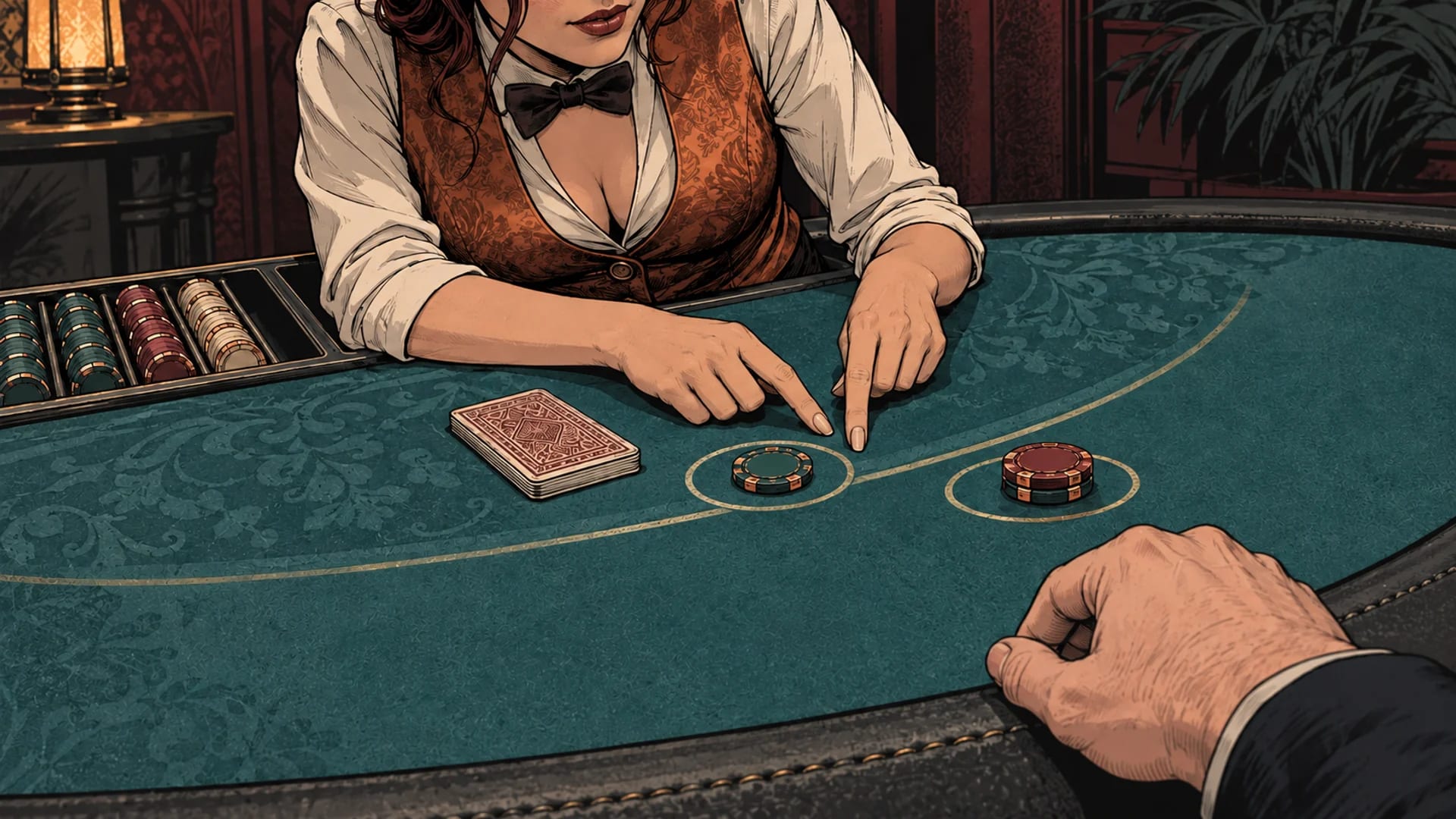

A dealer can accept a surrender decision and still collect the entire stake. Under the Massachusetts Gaming Commission's blackjack rules, an unresolved dealer blackjack separates the decision to stop playing from a final half-stake return.
Surrender lets a player give up the hand on the terms offered by that table. In the procedure examined here, the player normally loses half the original wager and receives the other half back. But the timing of the decision, the dealer's exposed card and the availability of the option all matter. It is not a cancellation button that can be pressed after any disappointing card.
The decision belongs to the first two cards
Section 8 of the Commission's Blackjack rulebook places surrender after the player's first two cards and the announcement of their total. The player must choose it before indicating whether to hit, stand, double down or split. Receiving another card and then asking for the original surrender option falls outside that window.
MGM Resorts' GameSense guide gives the short version: the player gives up the initial hand, the dealer takes half the original bet, and surrender is not available against dealer blackjack. Its rules section also says only some games offer the option. That is a useful introduction, not evidence that every MGM table or online blackjack version uses identical procedures.
The detailed settlement below is specifically the Massachusetts procedure in section 8, checked on 15 October 2026. It should not be imported into an unrelated online table merely because the interface includes a Surrender control.
The dealer's exposed card changes the wait
If the dealer's first card is neither an ace nor a ten-value card, section 8(a)(1) calls for an immediate half-stake collection and half-stake return. The dealer cannot have a two-card blackjack from that starting card.
With an ace, ten, jack, queen or king exposed, section 8(a)(2) instead describes placing the player's wager on top of their cards. Settlement waits for the dealer's second card. Dealer blackjack takes the whole wager; without it, the dealer collects half and returns half.
Consider a hypothetical £20 original stake, with no split, double, insurance or other side wager. Pounds are used only to make the arithmetic familiar, not to describe Massachusetts currency or table limits. In this example the player's initial hand is not a natural blackjack.
| Situation under section 8 | Amount returned from £20 | Net result on that stake |
|---|---|---|
| Eligible surrender; dealer shows two to nine | £10 immediately | £10 loss |
| Eligible surrender; dealer shows ace or ten-value card, then has no blackjack | £10 after the check is resolved | £10 loss |
| Surrender awaiting that dealer check; dealer has blackjack | £0 | £20 loss |
The £10 coming back in either half-return case is the player's own money. No profit has been paid. The other £10 has been lost, and the surrendered hand cannot subsequently win because the dealer later busts.
A quick check is a different sequence
The same rulebook permits a card-reader procedure in section 6(i). When the dealer's exposed card could form blackjack, the reader checks the hidden card before players receive additional cards. A dealer blackjack ends the normal hand and triggers settlement. By contrast, section 6(g)'s base procedure deals the dealer's second card after player decisions.
There are two timing questions to ask: when can surrender be selected, and when does the half-stake settlement become final? Section 8's deferred settlement shows why an early decision can still be conditional on a later dealer-blackjack check. The timing of the prompt alone does not establish what happens to the stake. A comparison of "early" and "late" surrender needs the actual rules for both tables, not an assumption that this document describes every variant.
An insurance wager also remains separate. Section 8(b) expressly says that insurance and surrender are settled independently. Our blackjack insurance explainer follows that extra wager's stake and payout; a result there cannot be substituted for the result on a surrendered main hand.
An absent option may be part of the rules
Massachusetts section 8(c) makes surrender optional for the licensee and excludes it from the named multiple-action and specific progressive-blackjack procedures. Section 6(j)'s alternative dealing procedure also excludes surrender. Those references identify particular variants, not every blackjack game with any progressive feature.
For an online game, start with the loaded version's rules and the decision window. A missing control before play may reflect a table without surrender; a control disappearing after another action is a different question. Our casino-game version report explains why the game title alone cannot settle which rules apply. If the displayed rules and recorded settlement disagree, keep the hand identifier and ask the operator to explain the specific clause it used.
Giving up a hand with a £10 loss is still losing £10. This article explains the settlement conditions, not which hands to surrender or a way to make blackjack profitable.