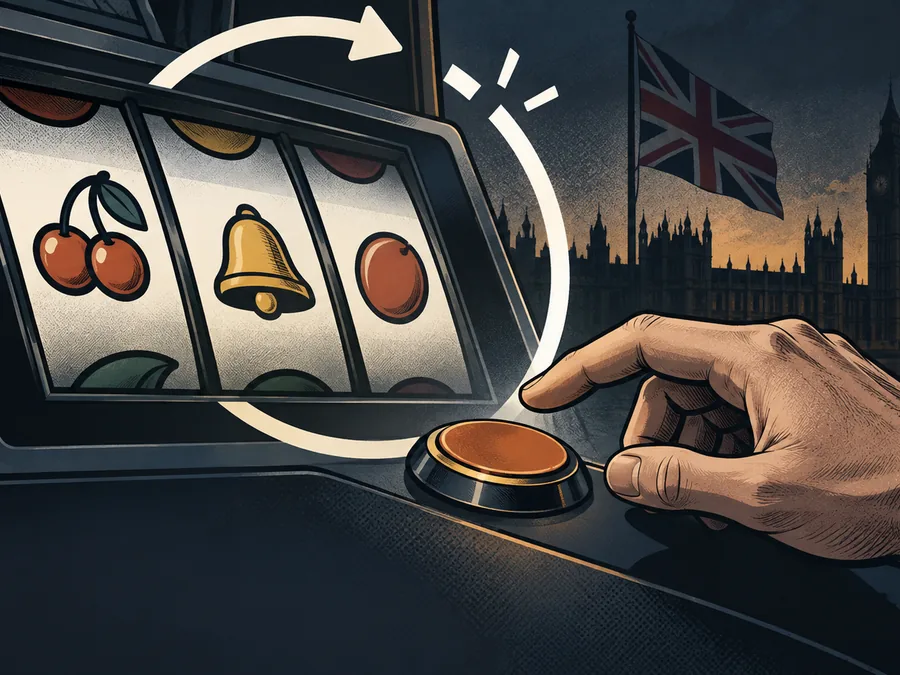

A slot can look like one long feature on screen while asking for money more than once. That is where Britain’s online stake limit becomes more interesting than the familiar £2 and £5 numbers. The rule caps the total amount staked in each game cycle, not the price of an entire evening and not every type of online casino game. An extra paid choice inside a feature has to fit within the same cycle’s remaining allowance. Gambling Commission stake-limit guidance
For an adult aged 18 to 24, the maximum is £2 per online slot cycle. From 25 onwards it is £5. Those are ceilings, not suggested stakes or amounts the regulator calls safe. The practical question for a game studio and its casino client is whether every place a player can risk more money has been accounted for before the next cycle begins.
Two limits arrived on different dates
The £5 ceiling for adults aged 25 and over took effect on 9 April 2025. The lower £2 ceiling for adults aged 18 to 24 followed on 21 May 2025. Both attach to remote casino operating licences in Great Britain, including licences issued before the new condition. Gambling Commission implementation dates and licence condition
The two-stage start matters to an operator’s product work. It is not enough to reduce the highest stake option in a catalogue. The game must apply the correct ceiling to the customer’s age, including when a feature offers a further paid choice. The government’s consultation response explicitly said the ceiling should not become a new default pushed at players; lower stakes should remain available. DCMS consultation response
That distinction makes the limit different from a personal deposit or loss limit. It controls a single slot game cycle. It does not set a total daily budget, and it cannot tell a customer how much play is affordable. Our guide to casino RTP makes a separate point: the game’s long-run return model does not tell someone what a short session will cost.
A feature can contain another stake without becoming a new spin
The legal wording defines a game cycle from the player’s initiation of a slot game until the money staked has been lost or the money won has been delivered or made available for collection. It also defines an online slot by reel-based play, including non-traditional reel representations. The Gambling Commission’s guidance turns that definition into concrete examples. Official guidance and reproduced licence condition
| Situation in an online slot | Amount already staked in the cycle | What the cited guidance permits |
|---|---|---|
| Customer aged 27 starts at £5 | £5 | No further paid opportunity in that cycle |
| Customer aged 27 starts at £2 | £2 | Further staking of up to £3 in that cycle |
| Customer aged 19 starts at £2 | £2 | No further paid opportunity in that cycle |
These are the regulator’s examples, not a catalogue of permitted game features. They show why “£5 per spin” is useful shorthand but an incomplete product specification. A bonus or second-screen decision does not reset the allowance merely because the animation or layout has changed. A customer who has staked £2 at age 27 may be offered a further paid choice worth at most £3 before that cycle ends; a 19-year-old who began at £2 has no room for another paid choice in the same cycle.
There is another boundary. The Commission describes an example in which a player can accept a prize offer or risk it for a larger one without staking additional funds. The regulator treats that differently from asking the player to put in more money. The interface may feel like a new decision in both cases; the stake rule is concerned with how much additional money is paid or risked. Gambling Commission scenarios
This does not decide every edge case for every game. A studio still needs to map its own feature sequence to the licence condition and the Commission’s guidance. The approved version of a casino game can differ by market; a familiar feature name is not proof that its stake path works identically in Great Britain.
The rule is about slots, not the casino lobby
The licence condition applies to online slots. The Commission says it does not impose the same statutory per-cycle maximum on roulette or blackjack. The relevant definition is reel-based casino play, including a game that uses changing images rather than a traditional physical-looking reel. Gambling Commission scope guidance
That is a product classification, not a loophole label. Replacing a reel graphic with another visual treatment would not, by itself, prove that the game has moved outside the defined category. The government’s response anticipated boundary-pushing products that combine slot-like play with other formats and said the definition was intended to capture them. DCMS response on the scope of online slots
The stake ceiling also sits beside older design controls. The Commission says the minimum interval between starting one online slot game and beginning the next cycle is 2.5 seconds. A capped stake therefore does not replace rules on speed or the requirement for an active decision before a new round. Our account of why autoplay disappeared in Britain follows that separate design choice. Gambling Commission stake-limit and speed guidance
What the product team actually has to count
Imagine a game with a basic spin, a paid choice during a feature and an optional gamble after a prize. The regulatory test is not whether all three controls fit beneath a big number printed on the main button. It is where one game cycle starts and ends, whether either later choice asks for a further stake, and whether the total for that cycle stays within the applicable age-based ceiling. The first two questions are grounded in the licence condition; the need to trace the entire product path is the editorial implementation inference.
For a supplier, that implies testing the game logic rather than only the display. For an operator, it implies checking the configuration delivered to customers in Great Britain and the age information used to select a limit. Those are operational implications, not a claim that every operator uses the same code or that we have audited a particular casino. The distinction between studio, supplier and operator responsibilities is set out in who makes an online casino game.
It also matters when a game is changed later. A new paid feature or altered sequence should be assessed against the same cycle boundary rather than assumed compliant because the base spin still has an appropriate maximum. Our account of post-launch game monitoring explains why a released game is not beyond review.
A ceiling is not an impact study
The policy aims to limit the intensity of rapid losses from high-stake slot play. DCMS acknowledged that only a minority of spins were above its proposed general ceiling before implementation, while arguing that unusually large stakes can still create acute risk. It also warned that the cap was not an objectively safe stake and should not be promoted as a default. Government response and evidence discussion
There is not yet a defensible causal headline saying how much harm the 2025 ceilings prevented. In February 2026 the Gambling Commission said evaluation of online slot stake limits was still under way, with emerging insights expected by the end of 2026. That work uses consumer and operator research alongside quantitative data; it had not then published a final impact estimate. Gambling Commission evaluation update
For now, the concrete change is visible in the product contract: one age-dependent ceiling for each online slot game cycle, including any further paid choices before that cycle ends. The larger question—whether this particular ceiling changes harmful outcomes, and for whom—belongs to evidence that the evaluation has yet to deliver.