
Sometimes one company owns several of those roles. The roles still remain distinct.
Roll the credits before opening the game
An online casino game is closer to a small software production than a single illustrated screen. The exact team changes with the product, but the work usually crosses these functions:
| Role | What it contributes | What it does not automatically control |
|---|---|---|
| Game studio | Concept, mathematics, rules, art, sound, client code and game logic | The operator’s customer account or every market where the game appears |
| IP owner or licensor | Permission to use a brand, character, music or other protected property | The fairness or technical operation of the finished game |
| Remote game server provider | Hosts game logic, sessions, outcomes or content delivery | The operator’s entire casino platform |
| Test house | Tests specified software against a jurisdiction’s requirements | Commercial approval, placement or player acquisition |
| Aggregator | Connects portfolios of games to operators through a distribution layer | Authorship of every third-party game it carries |
| Casino operator | Chooses the catalogue, market, presentation and customer relationship | Ownership of all underlying game code or intellectual property |
| Platform and wallet | Maintains accounts, balances, reporting and the connection around play | The creative design of each supplied title |
The industry’s contracts can combine or rename these jobs. A vertically integrated supplier may develop games, host them and distribute third-party content. An operator may own a studio. A small studio may outsource its server or certification work. The table describes responsibilities, not mandatory corporate boundaries.
The studio begins with a probability model
Artwork is visible, but the game starts with rules and mathematics. A team defines possible outcomes, how an outcome is selected, the paytable, feature triggers, volatility and the theoretical return for a specific configuration. Designers then decide how the player initiates a round and how the game explains the result.
Engineers turn that model into software. The client displays the interface on mobile or desktop. Back-end components may generate or receive an outcome, maintain the game state and exchange messages with the operator platform. Quality-assurance staff test ordinary play, interrupted sessions, localisation, device behaviour and error handling.
This is one reason “the same game” can exist in several approved versions. A jurisdiction may require a different speed, information display or feature set. An operator may select an available mathematics profile or denomination. Those variations need version control; they are not permission to change live probabilities without disclosure.
The British Gambling Commission’s RTS 7D states that rules, payouts and outcome probabilities may not be changed while a game is available, except as provided by the rules, and that relevant changes should be brought to the customer’s attention. UK Gambling Commission RTS 7
Testing is a release gate, not a creative department
Testing requirements depend on jurisdiction. In Great Britain, gambling software made available under a Gambling Commission operating licence must meet the Commission’s remote technical standards and follow its testing strategy. Technical standards guidance
The Commission says new games, and updates that affect fairness, require external testing before release. Its current strategy also requires change documentation and describes separate controls for development, testing and release. Testing procedure Approved test houses are accredited independent businesses; they assess defined requirements, while the licensee remains responsible for appointing a house approved for the relevant work. Test houses
Certification is therefore not a global quality badge. It is evidence tied to a version, scope and regulatory standard. A report for one market or channel does not automatically authorise every other deployment.
The server keeps the game separate from the lobby
When a player taps a tile, the casino front end can open a game supplied from another system. The operator platform identifies the session and communicates with the wallet. The remote game server hosts the title or its back-end logic, returns game-state information and records transactions according to the integration.
That separation lets a supplier serve more than one operator without rebuilding the game inside every casino. It also means a visible failure may belong to several systems: the game client, remote game server, aggregator connection, operator wallet or network between them.
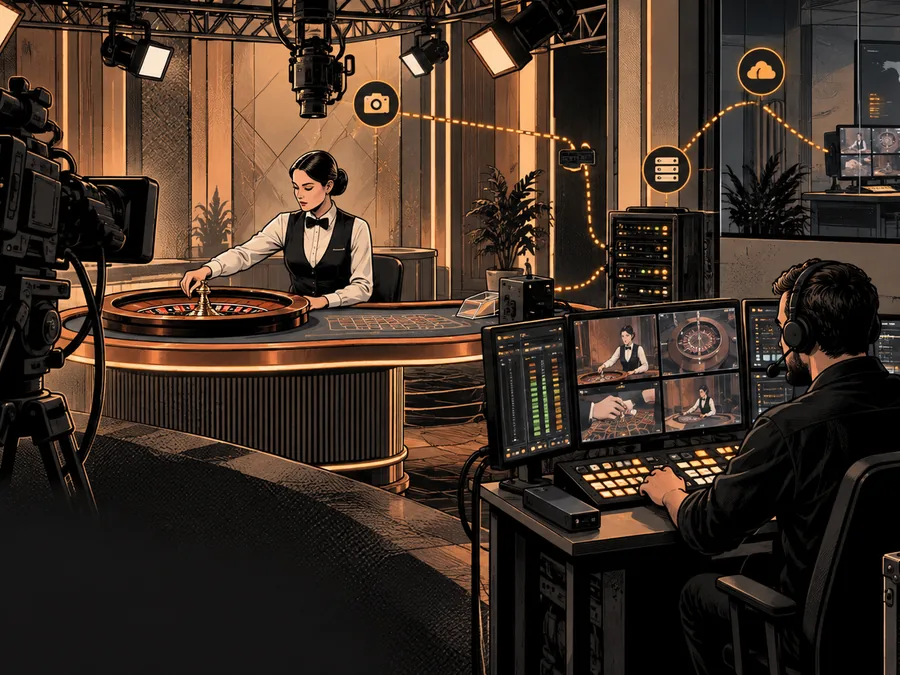
Our guide to what iGaming means maps the wider chain around the player-facing product. The live dealer studio explainer shows how a physical table, production system and operator wallet add another set of roles.
Aggregation turns one integration into a catalogue
An aggregator connects games from several studios or server platforms to operator customers. It may standardise integrations, manage commercial relationships, supply reporting and help distribute new releases. It does not necessarily host every outcome or own every title.
Light & Wonder’s 2025 annual filing offers a useful real-world example. The company says its iGaming segment provides internally developed and third-party games through content-aggregation platforms, remote gaming servers and other systems. It describes its Open Gaming System as a network connecting studios, operators and players, while its player-account platform is a separate product. Light & Wonder 2025 Form 10-K
Evolution shows a different combination. Its 2025 annual report describes a group spanning live casino, RNG games and slots, and a back-end structure intended to offer partners games through one integration. That is the company describing its own operating model, not proof that every supplier works the same way. Evolution Annual Report 2025
The operator makes the final publishing decision
The operator controls the casino seen by the customer. It chooses suppliers and titles, checks that the contractual and regulatory route is valid, configures availability, places the tile in a lobby and connects play to customer balances and controls.
That last mile is editorial as well as technical. Search position, thumbnail, category, promotion and recommendation determine whether a game is visible. A supplier can deliver a title; the operator decides whether it sits on the front shelf.
The operator also owns obligations that cannot be outsourced by changing the logo in the footer. It must understand what software and third parties are involved, monitor the live product and respond when a release behaves differently from its approved rules.
The cleanest way to understand a casino game is to ask for its credits: who designed the model, who runs the server, who tested this version, who distributes it and which operator made it available here. The tile is the beginning of that answer, not the end.