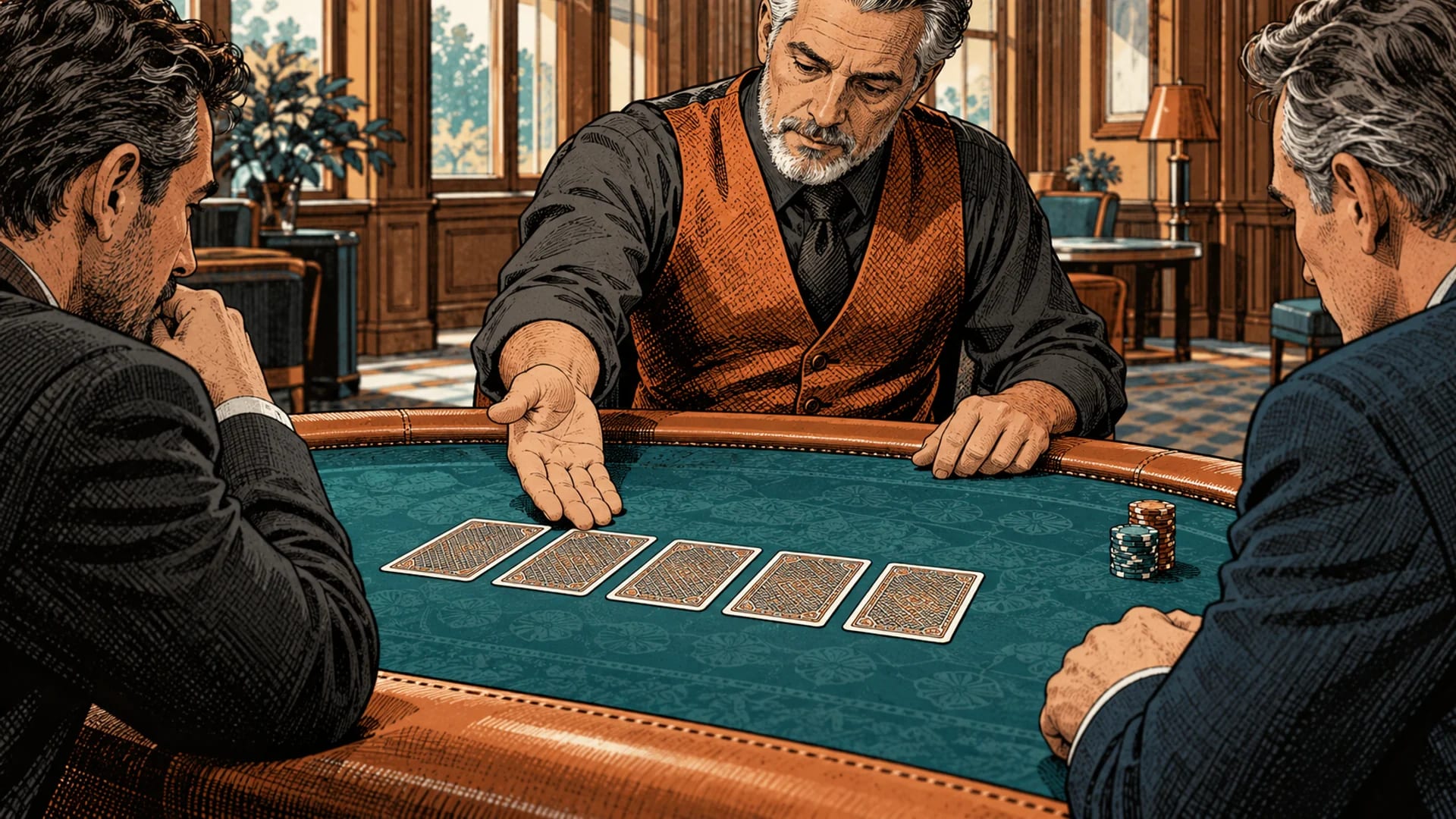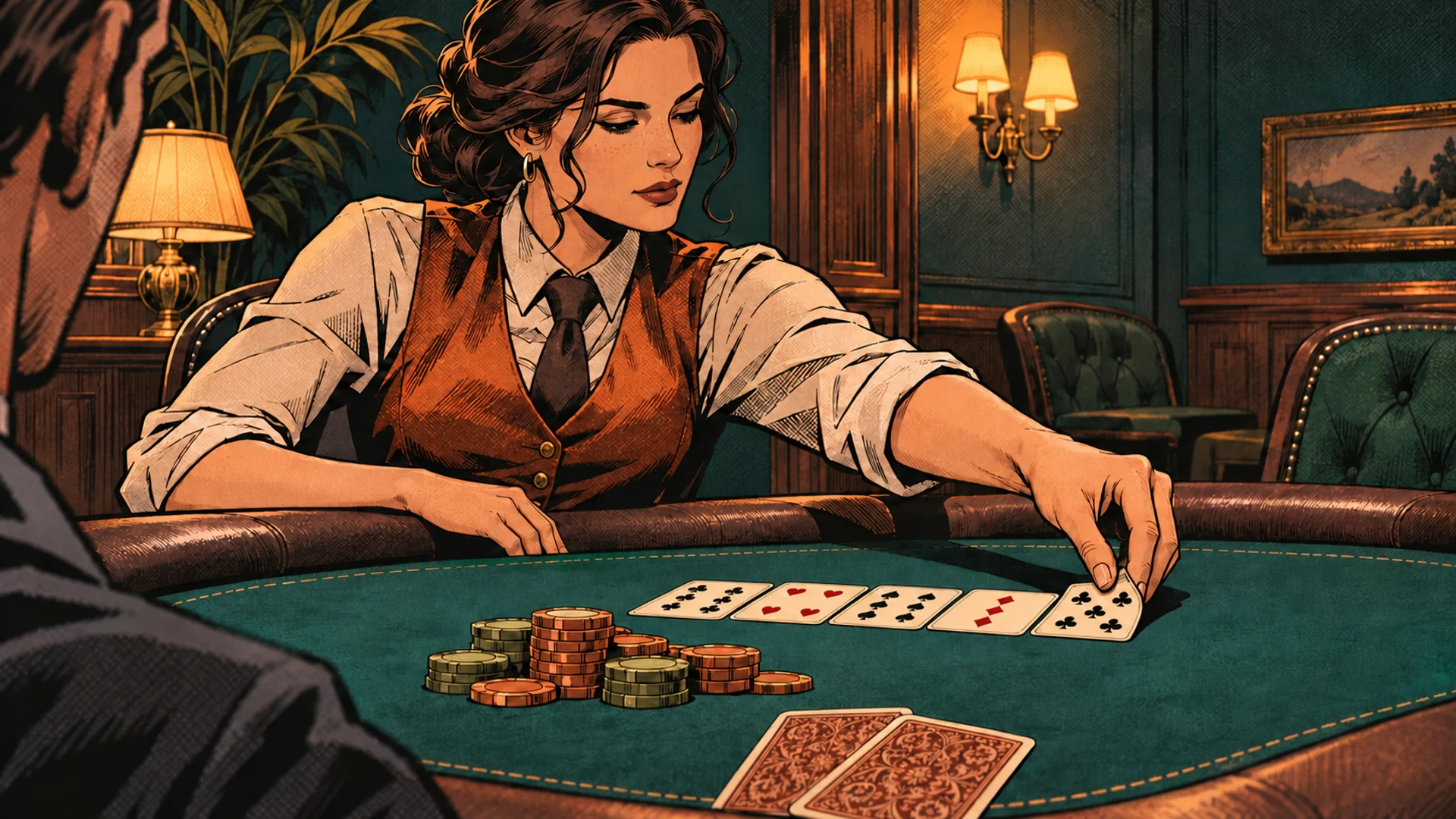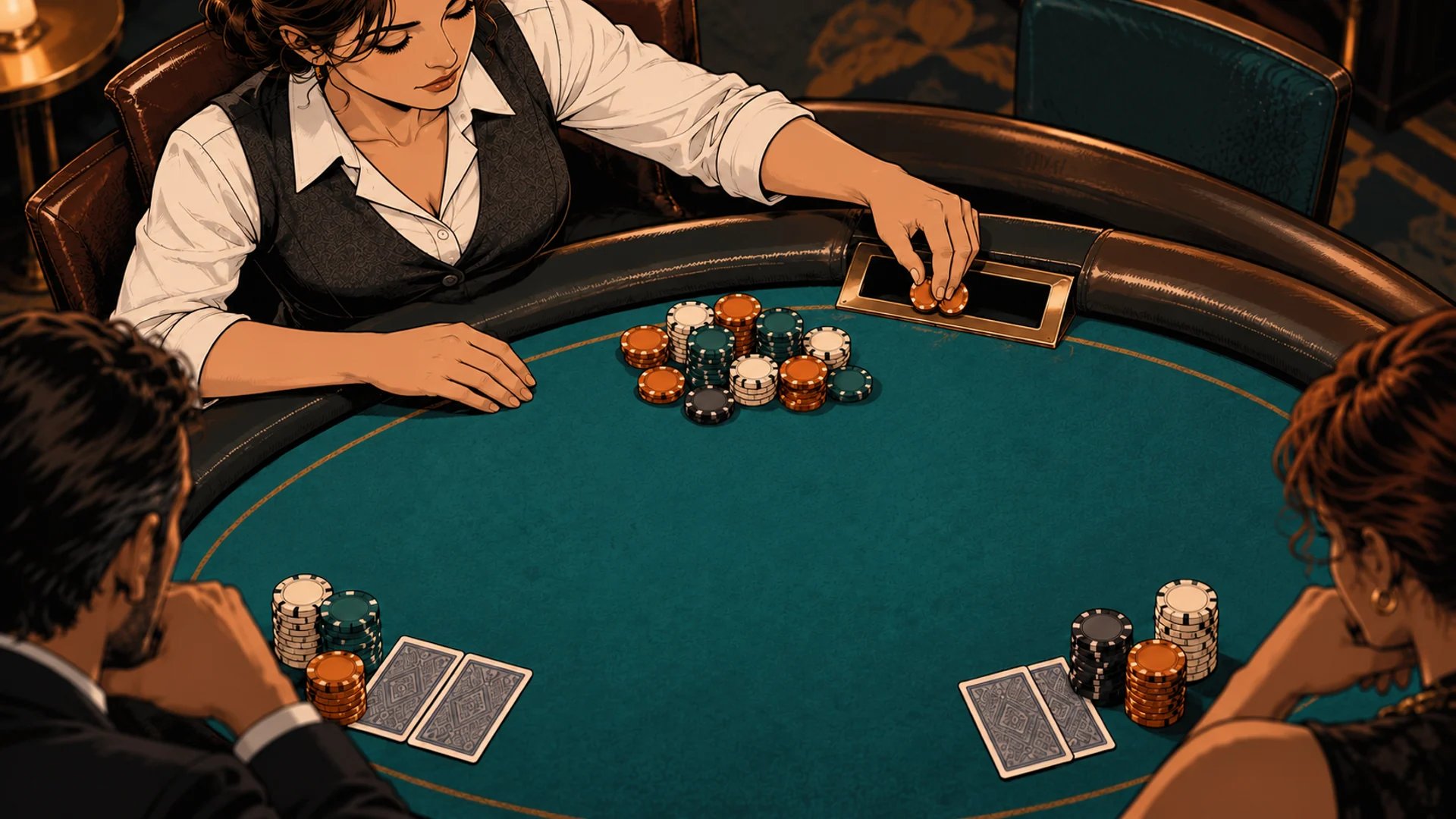

One player asks for two new cards, another asks for three, and a third keeps the original five. The dealer finishes the exchange. The betting has not finished: the player who kept everything still has a decision to make.
Five-card draw gives each player five private cards, with one opportunity to replace cards between two betting rounds. In the high-hand version, the strongest five-card hand wins a contested showdown. There is no shared board to complete anyone's hand.
This walkthrough follows the dealing and exchange procedures in section 12 of the Massachusetts Gaming Commission's poker rules. The regulator's active rulebook list identifies the poker edition as 18 June 2026. Its draw provisions cover both high and low games in licensed Massachusetts casino rooms; the example here uses high only.
Four antes, then a bet of two
In this invented game, A holds the button at a four-seat table. B is next clockwise, followed by C and D. Everyone starts with 100 units and pays an ante of one, putting four in the pot before any cards arrive.
Our teaching table uses a standard 52-card deck, no jokers or wild cards, and fixed betting units of two before the draw and four afterwards. It has no separate blinds. These are declared example rules, not an advertised casino offering. Nobody goes all-in, and fees and deck shortages are excluded.
Bicycle's Basics of Poker explains antes, calls, folds and fixed limits, including draw games with a larger limit after the exchange. An ante is already committed to the pot; it does not count as a call on the next betting round.
The dealer gives each player five cards face down, one at a time clockwise from B, with A last on each pass. Under our example's opening-action rule, B acts first and checks. C bets two. D calls two, A calls two, and B folds when the action returns.
B's one-unit ante stays in the middle. A, C and D have each contributed three altogether: one ante plus two on the betting round. The pot is ten. Those three players remain eligible to win it.
C changes two cards; A changes none
The exchange starts with C, the first remaining player clockwise from the button. D follows, then A. Under the named Massachusetts procedure, the dealer burns one card before giving out replacements. Players can keep their original hand or discard cards for replacement, one for one.
C's original five are J♥ J♠ A♦ 5♣ 9♦. C discards the five and nine, keeps three cards, and receives J♦ 4♣. The completed hand is J♥ J♠ J♦ A♦ 4♣.
D started with K♥ K♠ 2♥ 6♦ 9♣. D discards the two, six and nine and receives K♣ Q♥ 3♠. The final five are K♥ K♠ K♣ Q♥ 3♠.
A keeps A♠ A♣ 8♥ 8♣ Q♦, exchanging nothing. Keeping all five is called standing pat. A still holds exactly five cards, as do C and D. The discarded cards have left their former hands; nobody keeps seven cards and selects a favourite five.
These choices and replacement cards are invented to make the procedure visible. They are not advice about which cards to discard. This deal has enough unused cards to finish the exchange without recycling discards.
Standing pat leaves another wager to answer
The final betting round begins with C. C checks. D bets four. A calls four, then C calls four. All three have matched the new wager, so betting ends.
A's decision to keep the original cards did not check, call or end this round. A had to respond to D's four-unit bet. The exchange changed the cards; the following betting round changed how many chips the players committed.
The last three payments add twelve to the earlier ten, making a final pot of 22. A, C and D have each put in seven: one ante, two before the draw and four afterwards. B contributed only the ante.
At showdown, all five cards in each surviving hand count. Contrast that with our Hold'em showdown examples, where players select their strongest five from two private cards and five shared ones.
| Player | Final five cards | Hand compared at showdown |
|---|---|---|
| A | A♠ A♣ 8♥ 8♣ Q♦ | Two pair: aces and eights |
| C | J♥ J♠ J♦ A♦ 4♣ | Three jacks |
| D | K♥ K♠ K♣ Q♥ 3♠ | Three kings |
Section 3 of the Massachusetts rules supplies the high-hand ranking. Three of a kind beats two pair, and kings outrank jacks within the same three-of-a-kind category. D wins the pot. A's pair of aces does not turn two pair into a stronger category.
Receiving 22 means gaining 15
D receives 22 units, including the seven D supplied. The net gain on the hand is 15. A and C each lose seven, and B loses one. The four final stacks are A 93, B 99, C 93 and D 115, still totalling the original 400.
No house fee has been taken. A real room's poker rake or time charge needs its own calculation. Unequal all-in contributions would also require separate treatment of who can win each pot.
A hand can end earlier if everyone except one player folds. Equal high hands can share a pot; suits do not break an otherwise equal hand under the Massachusetts ranking. Low draw uses a different winning test and is outside this example. Check the room's game, exchange and betting rules before treating this teaching configuration as the table's procedure.
Sources checked on 5 November 2026. This is an explanation of an invented hand, not a record of play or a recommendation to gamble.