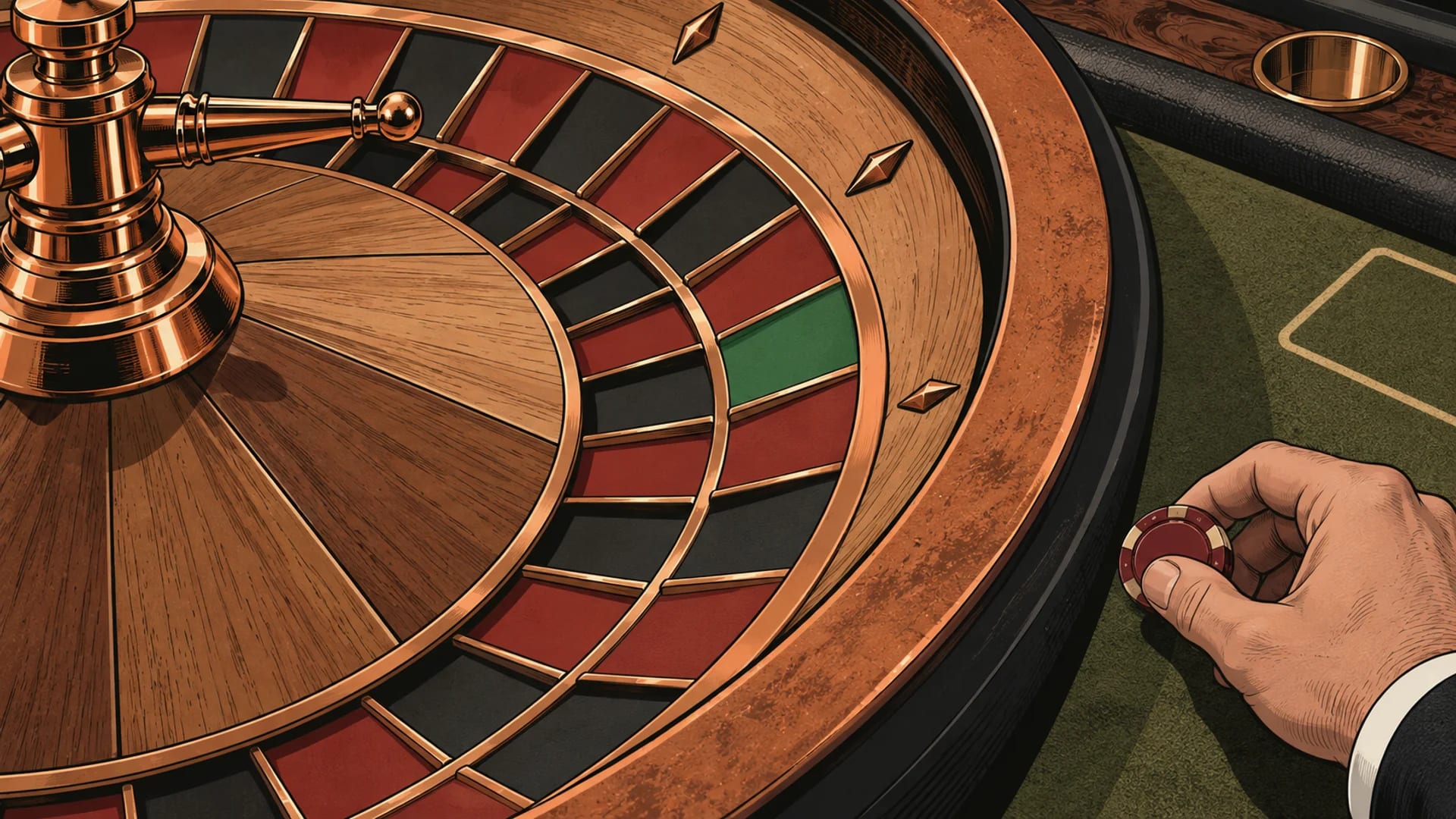

Consider a made-up roulette display: red, red, red, red, red. Black feels overdue. The gambler's fallacy is treating an earlier streak as evidence that the opposite result has become more likely when successive trials are independent.
Independence means that learning the earlier results does not change the probability assigned to the next one. A history display can show an extraordinary run without becoming a forecast. MGM Resorts' GameSense roulette guide makes that distinction: previous spins do not make a result more or less likely to recur.
For readers trying to interpret those displays, the useful question is what the history changes in the game itself. Our examples are invented calculations, not observations of a casino session or a method for choosing a winning bet.
A rare sequence and the next spin are different questions
Use a single-zero model with 37 equally likely pockets: 18 red, 18 black and one zero. Assume consecutive completed spins are independent. The Venetian's published rules distinguish its single-zero configuration from its double-zero and other roulette variants. The calculations here apply only to the stated model, not every product with a wheel on its screen.
On any one spin in this model, black has probability 18/37, about 48.65%. Red has the same probability; zero accounts for the remaining 1/37. Neither colour has a 50% chance.
Now separate a prediction made before six spins from a question asked after five spins have finished. Before the sequence starts, six specified red results have probability (18/37)^6, about 1.33%. Once five reds are already known, the question is only about the sixth result. Its red probability is 18/37 again.
| Question | Information already known | Calculated probability |
|---|---|---|
| Six reds, specified before the first spin | None of the six results | (18/37)^6, about 1.33% |
| Five reds then black, specified before the first spin | None of the six results | (18/37)^6, about 1.33% |
| Red-black-red-black-red-black, specified in advance | None of the six results | (18/37)^6, about 1.33% |
| Black next, after five reds have appeared | The first five results are settled | 18/37, about 48.65% |
Each of the first three rows names one exact colour sequence. A neat alternation has the same probability as the all-red sequence because every specified red or black result contributes the same factor, 18/37. That does not mean one exact sequence has the same probability as a whole category containing many sequences.
The last row conditions on something that has already happened. Multiplying in the probability of the five known reds would answer the earlier, six-spin question instead. A rare lead-up does not make a reversal compulsory.
The same reasoning rules out treating red as certain to continue because it has been appearing. Under the independence assumption, neither a reversal story nor a continuation story changes the next-spin calculation. Our roulette odds explainer covers the separate issue of how pocket counts relate to payouts.
A proportion can move closer without repaying the imbalance
A smaller thought experiment shows why an average need not correct earlier outcomes. Suppose 20 independent tosses of a fair coin have already produced 16 heads and four tails. Heads account for 80%, and the numerical gap is 12.
Imagine a continuation containing exactly 50 heads and 50 tails. Across all 120 tosses, the totals would be 66 heads and 54 tails. The heads share would fall to 55%, even though the gap would still be 12.
Or imagine adding exactly 490 heads and 490 tails to the original record. The combined 1,000 tosses would contain 506 heads and 494 tails: 50.6% heads, with the same 12-result gap. These balanced continuations are illustrative constructions, not predictions that the next batch will split evenly.
The earlier imbalance occupies a smaller share of a larger total. No extra tails had to arrive to cancel it. This arithmetic explains how a proportion can approach half without a balancing mechanism assigning the next outcome.
A gambling balance introduces money and payouts as well. Recognising the fallacy does not remove the game's margin or limit a possible loss. The house-edge session example examines that different calculation; a favourable-looking history does not supply a repayment schedule.
Check the process before calling results independent
Cards drawn without replacement provide a contrasting model. Start with a well-shuffled, standard 52-card deck containing four aces. Before any card is exposed, the chance of an ace on the first draw is 4/52.
If that first card is an ace and stays out of the deck, three aces remain among 51 cards. The next-draw probability becomes 3/51. If the first card is not an ace, four remain among 51, giving 4/51 instead. Here the information changes the remaining population.
This is an elementary deck example, not a blackjack or baccarat strategy. Actual shoe sizes, shuffling and dealing rules determine the applicable model. A falling count of available cards and a roulette history display are different mechanisms.
For remote gambling within Great Britain's regulatory scope, the Gambling Commission's RTS 7 on random outcomes requires acceptably random results and prohibits compensated behaviour that changes outcome probabilities during play. Its guidance permits properly described bonus or special features with different rules when based on random events. A claim that a game changes its chance of paying solely to compensate for previous results is a different claim from a feature operating under disclosed rules.
The standard is not our certification of a particular wheel, game build or operator. Nor does our RTP explanation make a published average into evidence that a payment is imminent.
In the opening example, five red results establish the history. To argue that black has become more likely, something must have changed the next trial's probability. In the independent-spin model, the five red results do not do that.