
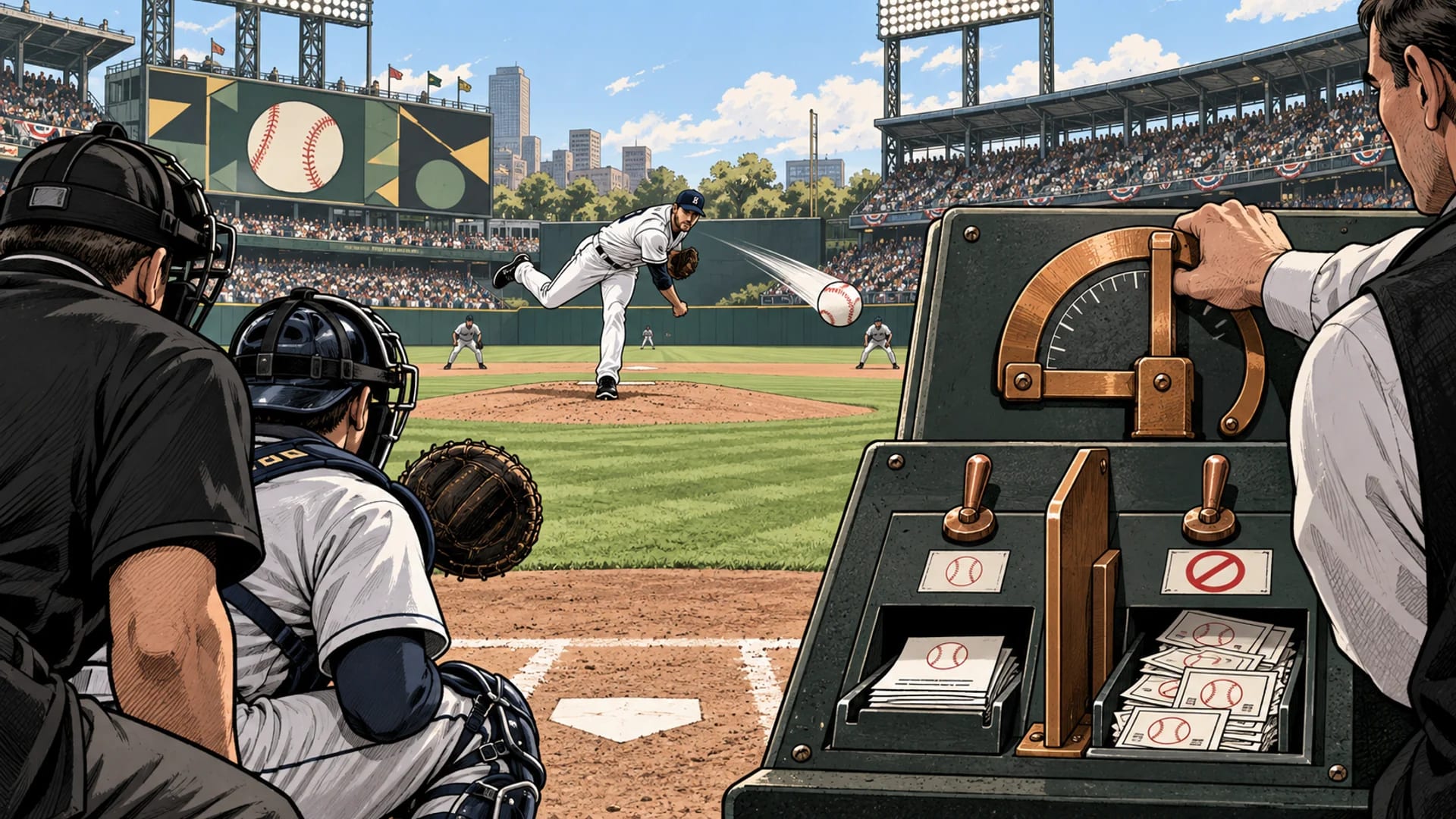
One pitch can be a ball, a strike or a reading on a velocity gun. It can also be the entire outcome of a bet. In November 2025, Major League Baseball said its authorized sportsbook operators would cap wagers on those pitch-level markets at $200 per wager and keep them out of parlays. The league’s concern was not that every baseball prop is suspect. It was that a market settled by one small event, sometimes controlled by one player and irrelevant to the game result, offers a particularly direct target for manipulation. MLB announcement
The rule is easy to overstate. MLB did not announce a universal ban on pitch-level betting, a $200 lifetime ceiling for a customer or a change to the law in every state. It announced an agreement with its Authorized Gaming Operators, effective immediately on 10 November 2025. The league said participating sportsbook operators represented more than 98% of the US betting market; that is MLB’s coverage claim, not an independently audited measurement in the release. Scope and effective date in MLB’s release
Why a single pitch changes the integrity equation
A game-result bet asks about the combined work of teams across innings. A pitch-level microbet can turn on one action. MLB named ball or strike and pitch velocity as examples. It argued that most prop bets aggregate multiple events influenced by more than one actor, while these one-off markets can be determined by a single player and have little bearing on the final score. That is the league’s stated risk model; it does not establish that every pitch market has been manipulated or quantify how often it happens. MLB’s explanation of pitch-level risk
The difference is about leverage. If a wager can be settled by an action that barely affects the contest, a would-be manipulator may face a smaller sporting cost than if the scheme required changing who wins. The league’s response aims to reduce the possible payout from that narrow event. It is a structural argument, not a claim that a $200 stake makes bad conduct impossible. The integrity concern also lives alongside an ordinary product reality: customers see these markets inside live-betting interfaces, where the price and availability of an option can change from one pitch to the next. Our live data pipeline explainer describes how those event feeds reach a sportsbook; it is a separate question from whether a particular market should be offered.
The cap and the parlay exclusion do different work
The $200 limit applies per wager on the specified pitch-level markets for the operators in MLB’s arrangement. It constrains the size of a single bet. Excluding the same selections from parlays removes a route by which multiple outcomes could be combined into a larger payout. MLB explicitly said both measures were meant to reduce the incentive for misconduct and the ability to work around a single-bet cap. The release does not disclose operator-by-operator controls, a customer-level aggregate exposure limit or a public effectiveness study. MLB’s two-part safeguard
That missing exposure detail matters. “$200 per wager” is not synonymous with “a customer can risk only $200 on a pitch,” let alone “all bets on a player are capped.” How operators detect related bets, prevent circumvention or apply any tighter internal limits is not explained in the announcement. A cautious reader should distinguish the published agreement from protections that might exist inside an individual sportsbook but have not been documented there. Our guide to sportsbook market suspension covers another trading control: a market can be paused when conditions change. Suspending a market and imposing a standing wager cap solve different problems.
Nor did MLB say it was eliminating all microbetting. It chose a narrower intervention for a named class of markets. That leaves product teams with two separate questions: whether a market is authorized and adequately monitored in a state, and whether the operator’s interface enforces the league-partner limits when that market is available. The announcement answers the second question only at the level of a public commitment, not a technical audit. MLB’s announced scope
The difficult edge is a changing bet menu
A sportsbook can rename, regroup or remove a market without changing the physical event that settles it. If a restriction is tied only to one label in a menu, a pitch-level selection appearing elsewhere could escape the same treatment. That is an implementation risk inferred from the league’s product-level rule, not a documented failure by any operator. MLB’s release names a type of outcome and two examples, but it does not publish a machine-readable taxonomy of every affected selection. MLB’s description of the covered markets
The distinction gives an auditor a sensible question: are the cap and parlay exclusion attached to the underlying pitch event across all relevant screens, or only to a particular display name? The source does not answer it. It is also possible for an operator to apply stricter limits than the public commitment. Neither possibility changes what the announcement actually establishes: a common floor agreed with MLB’s authorized partners, not a disclosed uniform implementation design.
New York drew a line around regulator authority
Eight days after MLB’s announcement, the New York State Gaming Commission publicly addressed the same issue. Its chairman said New York reserves authorization of specific wagers to the commission and that no wager is offered there without staff review. He welcomed exposure limits as a step, but said the state might eliminate a wager type it considered manipulable rather than merely restrict its size. Those remarks show why a league–sportsbook agreement is not the final word on what may be offered in a particular jurisdiction. New York Gaming Commission, 18 November 2025 meeting transcript
The transcript also says commission staff were re-examining individual-player props and certain same-game parlays. That is a review, not evidence in the cited meeting that New York had already banned every pitch-level market. The chairman described the state’s own integrity-monitoring requirement for licensed mobile sports wagering and its ability to decide which wager types are permitted. These are New York-specific statements; they should not be repackaged as a federal rule or as the practice of every US regulator. New York commission transcript
The contrast is useful. MLB and its sportsbook partners tried to change a product category across a large share of the market through agreement. A state regulator can decide whether that category is allowed at all within its jurisdiction. Neither route removes the need to detect suspicious patterns once bets are taken. Our account of the DraftKings–Simplebet deal examines the commercial appeal of fast, granular markets; the MLB action shows the constraint that integrity concerns can place on that same product design.
What the announcement cannot prove yet
MLB framed the limits as a way to protect game integrity while retaining the transparency and data access of regulated betting. Those benefits are part of the league’s rationale. The November release does not report before-and-after suspicious-betting rates, a reduction in manipulation attempts or a measured decline in affected handle. It also does not tell readers exactly how every operator identifies a pitch-level selection across different bet menus. MLB release and stated rationale
For now, the precise conclusion is smaller and stronger: MLB’s authorized operators agreed to a per-wager cap and parlay exclusion for pitch-level markets, while state regulators retain their own authority over the menu of legal bets. The next meaningful test is not whether a $200 sign appears in a release. It is whether operators enforce the restriction consistently and whether integrity monitoring reveals fewer opportunities to exploit a single pitch. The cited primary sources establish the policy and the regulatory boundary, not its eventual success.