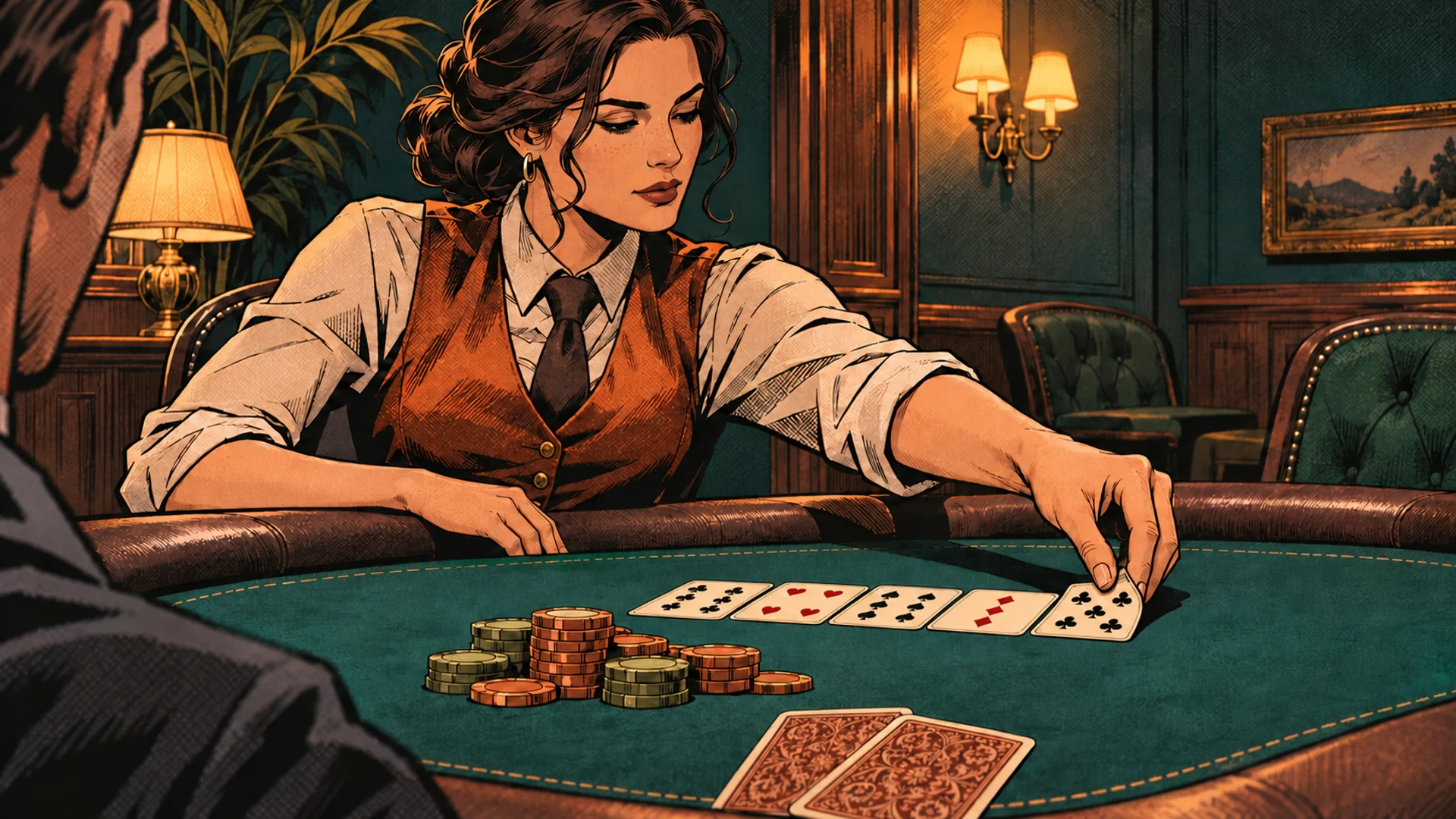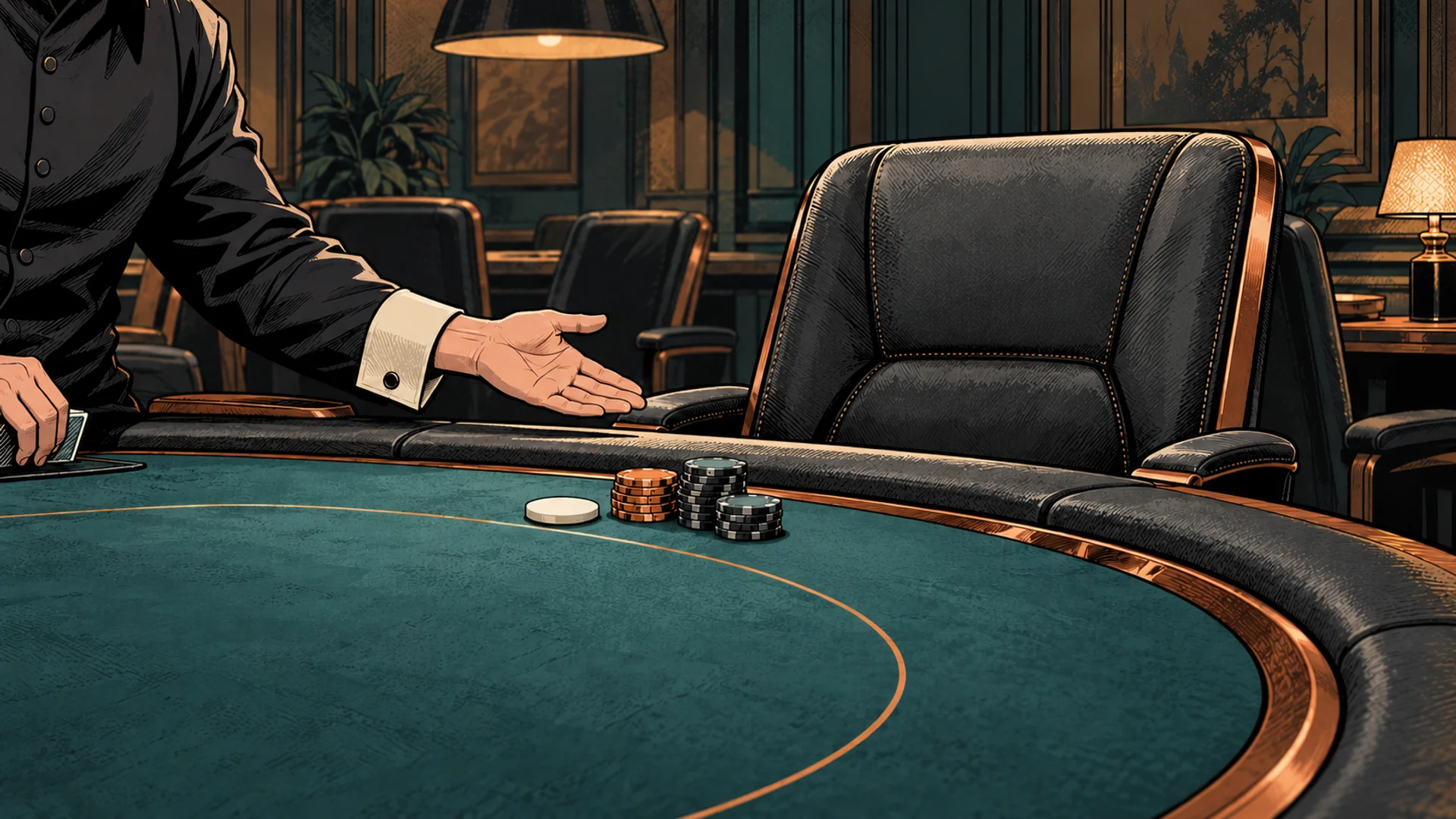
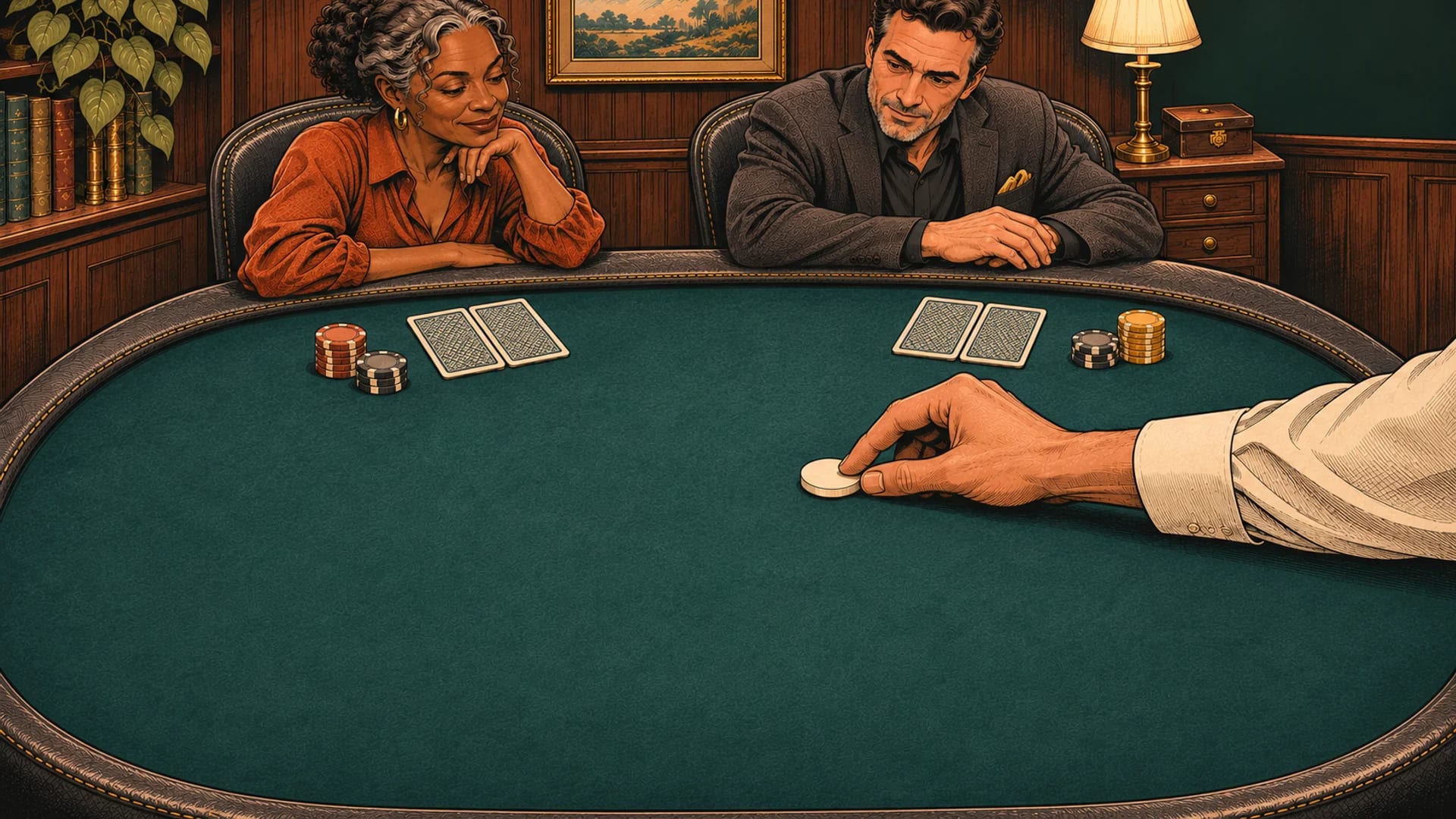
The big blind can watch everyone make a first decision before the flop, then have to speak before most of them on the next betting round. The chair has not moved. The starting point for action has.
Poker positions describe seats relative to the dealer button. In ordinary Hold'em without a straddle, the opening action starts immediately clockwise from the big blind. On the flop, turn and river, it starts with the first remaining player who can act clockwise from the button. The Venetian's published Hold'em rules identify the first preflop player. Section 10(h) of the Massachusetts Gaming Commission's poker rules places the flop's opening decision with the first player to the button's left who has not folded. A raise can send action around again; a position chart shows the opening order, not a promise of one decision each.
Read the button before the chair number
A dealer button is a marker for the hand's dealer position. At a staffed table, the casino employee distributing cards stays outside that rotation. The player beside the marker does not become the employee who deals. The 2026 WSOP rulebook's dealer-button definition describes its clockwise movement after each hand.
For a full table with nobody entering or leaving, the button advances one player clockwise between hands. The next two players clockwise are the small blind and big blind. Their compulsory wagers start the pot. The first player after the big blind is under the gun, usually shortened to UTG.
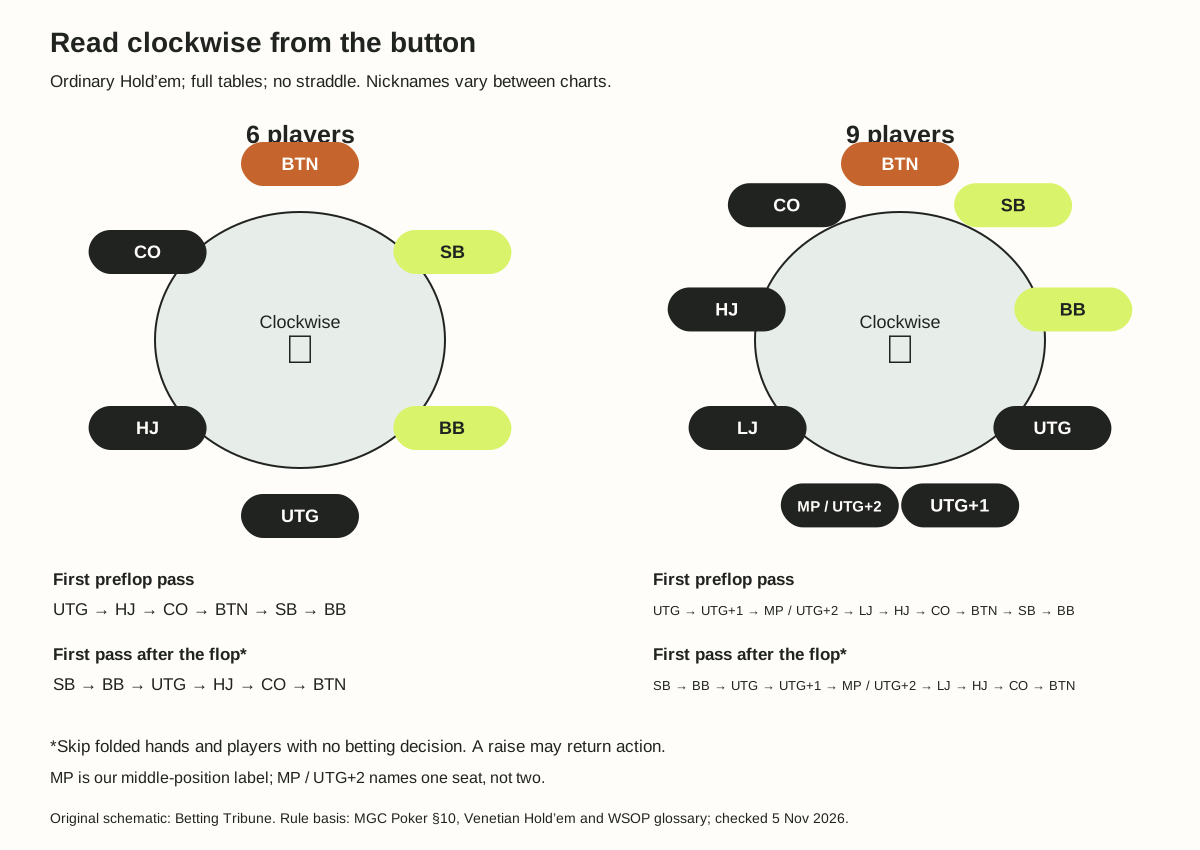
Our original six-seat and nine-seat maps place the button at the top. Read clockwise from it. They assume ordinary Hold'em, enough chips for each stated decision, no straddle and no vacant seats. They are seating diagrams, not starting-hand charts.
Six seats and nine seats share an anchor
The labels below run clockwise from the button. BTN means button, SB small blind, BB big blind, CO cutoff, HJ hijack and LJ lojack. The cutoff sits immediately before the button in the direction of play; the hijack is one seat before the cutoff.
| Place clockwise from BTN | Six players | Nine players |
|---|---|---|
| Start | BTN | BTN |
| Next seat | SB | SB |
| Second seat after BTN | BB | BB |
| Third seat after BTN | UTG | UTG |
| Fourth seat after BTN | HJ | UTG+1 |
| Fifth seat after BTN | CO | MP, also labelled UTG+2 here |
| Sixth seat after BTN | Back to BTN | LJ |
| Seventh seat after BTN | Not a separate seat | HJ |
| Eighth seat after BTN | Not a separate seat | CO |
Our nine-seat map uses MP for the middle seat between UTG+1 and the lojack. Counting it as UTG+2 also states how far it sits after the first player to act. These are the map's naming conventions; the clockwise order comes from the occupied seats.
Early, middle and late are group descriptions rather than extra chairs. Writers can group the hijack differently, and six-player diagrams may call UTG the lojack because it is three seats before the button. Count the actual players between a label, the blinds and the button before comparing two charts.
Follow the first pass around each table
With six players, the first preflop pass is UTG, HJ, CO, BTN, SB, BB. With nine, it is UTG, UTG+1, MP, LJ, HJ, CO, BTN, SB, BB. Posting the big blind has not already used up that player's decision. If everyone still involved only calls the blind, the BB can check or raise when action reaches it.
After the flop, a full six-seat order starts SB, BB, UTG, HJ, CO, BTN. The nine-seat version starts SB, BB, UTG, UTG+1, MP, LJ, HJ, CO, BTN. A folded hand takes no further turn, and an all-in player has no further betting decision. The actual list therefore often contains fewer players than the seating chart.
Consider an invented nine-player hand. A has the button, B the small blind, C the big blind, followed clockwise by D, E, F, G, H and I. Preflop action opens with D. A acts before the blinds on that first pass.
Suppose only D, H and A remain able to bet when the flop arrives. Starting clockwise from A skips B and C, so D acts first, H next and A last. If A had folded too, H would act after D. H would be in position against D for their later betting decisions, although H's original seat was the hijack. Acting later is a relationship between remaining players, not a requirement to own the button.
Our complete Hold'em hand follows chips through the betting rounds. The separate side-pot example explains why a player with no chips left can still have a claim to part of the pot.
The marker stays put until the hand finishes
Moving from preflop to flop does not move the button. Nor does a fold award it to the next remaining player. In the invented hand, A's marker identifies the same position until that hand is over, whether A folds or continues.
For the next hand, with all nine players still seated and no exceptional movement, B takes the button, C the small blind and D the big blind. E now opens the preflop action. A's chair has stayed where it was, while its position has become the cutoff.
Two-player play needs a different map. Under rule 36-C of the Poker Tournament Directors Association's 2026 rules, the button is also the small blind. That player acts first before the flop and last on the later betting rounds. Our heads-up explanation follows that arrangement and the transition from three players.
TDA version 1.1, dated 21 September 2026, describes voluntary tournament procedures for events that adopt them. Rule 34 specifies a dead button. The Massachusetts and Las Vegas documents describe their own settings; none establishes a procedure for every room or a game's availability in another country. Vacancies and eliminations need the room's actual movement rule, which our full-table maps exclude. The dead-button report covers that separate problem.
Sources were checked on 5 November 2026. In the nine-player example's next hand, D posts the big blind and E faces the first decision. The same chairs now hold different obligations.