A poker decision clock can reach zero while the player still has time to think. At the 2026 WPT Seminole Hard Rock Poker Showdown Championship, a remaining time-extension chip added another 30 seconds automatically. Once those chips ran out, expiry meant a forced check if no bet was pending, or a fold when facing a bet or raise.
The shot clock measures the current decision. The time bank is the player's reserve of extra thinking time. In this tournament, physical extension chips recorded that reserve. The fresh countdown for the next action did not replenish the chips already spent.
Those details come from the event's official 2026 player guide, pages 3 and 4. The championship took place on 24-29 April. Its published rules, checked on 3 November 2026, provide a dated example of how one tournament handled the distinction. Other events and online rooms can allocate and consume time differently.
A fresh countdown can use an old reserve
The Showdown rules introduced the Action Clock after level 14 on Day 2. Players initially had 15 seconds for their first decision before the flop and 30 seconds after the flop. At the final table of six, both allowances were 30 seconds.
There was also a distinction within the same betting round. If action returned to a player who had voluntarily committed chips before the flop, that player received 30 seconds for the subsequent decision. Posting the small or big blind did not qualify as voluntary commitment.
The dealer controlled the clock. After a bet or raise, the dealer first counted and announced the amount, including an all-in, before starting the next player's timer. A reset therefore belonged to a particular action, rather than granting the whole table a shared pool of seconds.
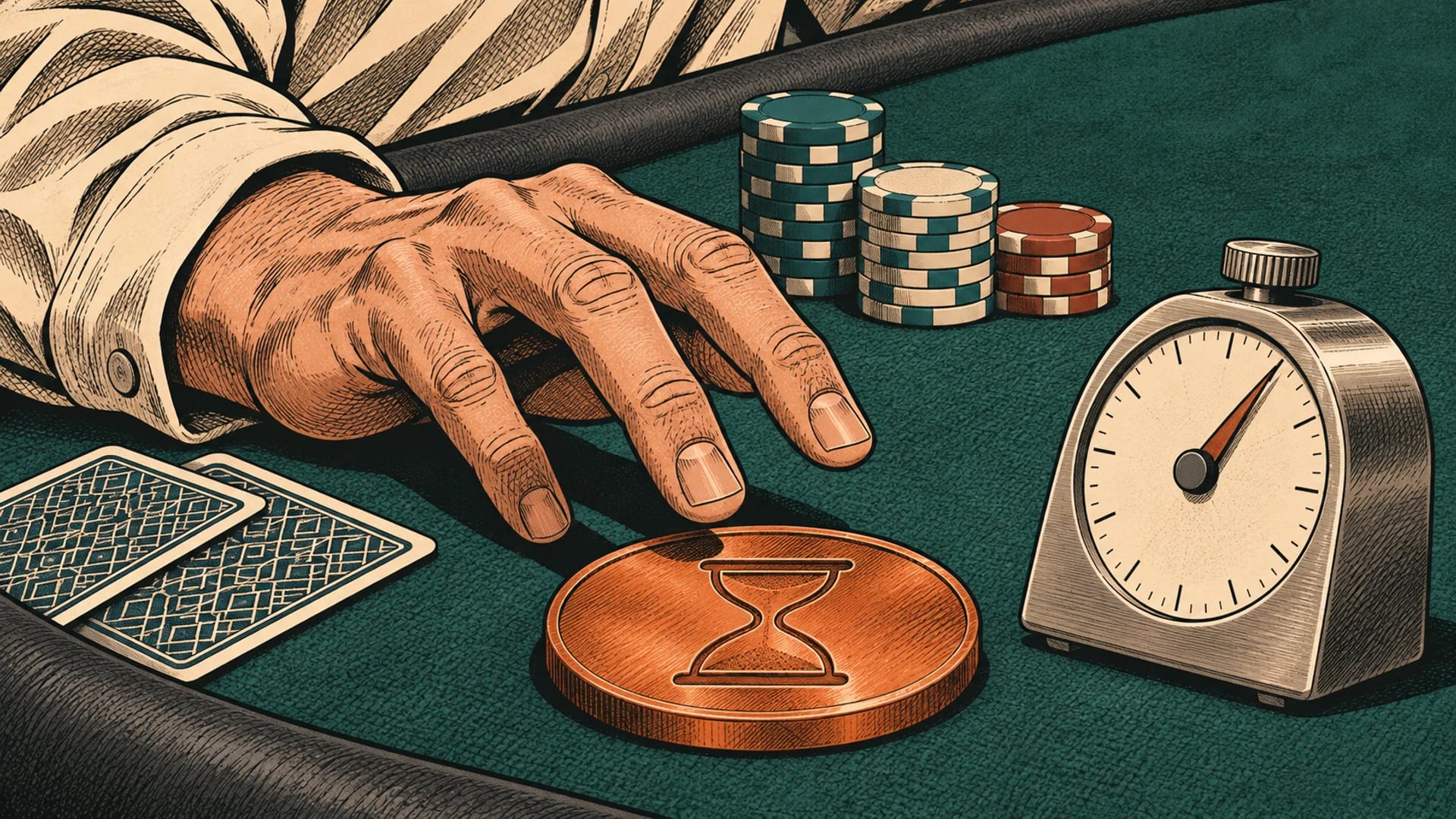
Each extension chip added 30 seconds. The guide scheduled these grants:
| Stage in the 2026 Showdown Championship | New chips per player | Treatment of unused chips |
|---|---|---|
| When the Action Clock began | 5 | Available for later decisions |
| Start of Day 3 | 5 | Added to the remaining reserve |
| When 24 players remained | 5 | Added to the remaining reserve |
| Day 5, final six players | 5 | Earlier unused chips carried forward |
The event rules said the chips accumulated rather than reset. A player arriving at a grant with two chips therefore had seven after receiving five more. The guide capped the unspent allocation at 20 for a player who reached the final table without using any.
Consider a separate illustrative decision after the flop: the player starts with a 30-second clock and one extension chip. If the countdown expires, the dealer automatically adds another 30 seconds and collects the used chip after the player's action on that street. The player has consumed the reserve even if they act before all the extra seconds pass.
Players could also put several extension chips forward while thinking. The dealer added the corresponding time immediately, and the guide ruled out refunds of those chips. An unused part of an activated extension could not be saved as a fresh chip for the next hand.
Calling the clock follows another procedure
Under rule 31 of the Poker TDA's 2026 rules, version 1.1 dated 21 September, the tournament director judges whether reasonable time has passed and may impose a clock or approve a player's request. A player making that request must be at their seat.
That procedure allows up to 25 seconds followed by a five-second countdown. If time expires while the player faces a bet, the hand is dead; without a bet to face, it is checked. A tie goes to the player; the director may adjust the allowance. This is a requested or imposed countdown, separate from the Showdown's stock of extension chips.
The tournament clock governs blind levels. TDA rule 25 says a new level starts with the official display, signal or announcement, with the new betting limits applying to the next hand. Minutes left in a blind level do not tell a player how many seconds remain for a decision.
For a disputed timeout, the applicable event rules must answer when the dealer started the timer, which allowance applied, whether an extension remained and what expiry required. Acting out of turn raises a separate question about whose action was due. A visible countdown alone cannot settle either ruling.