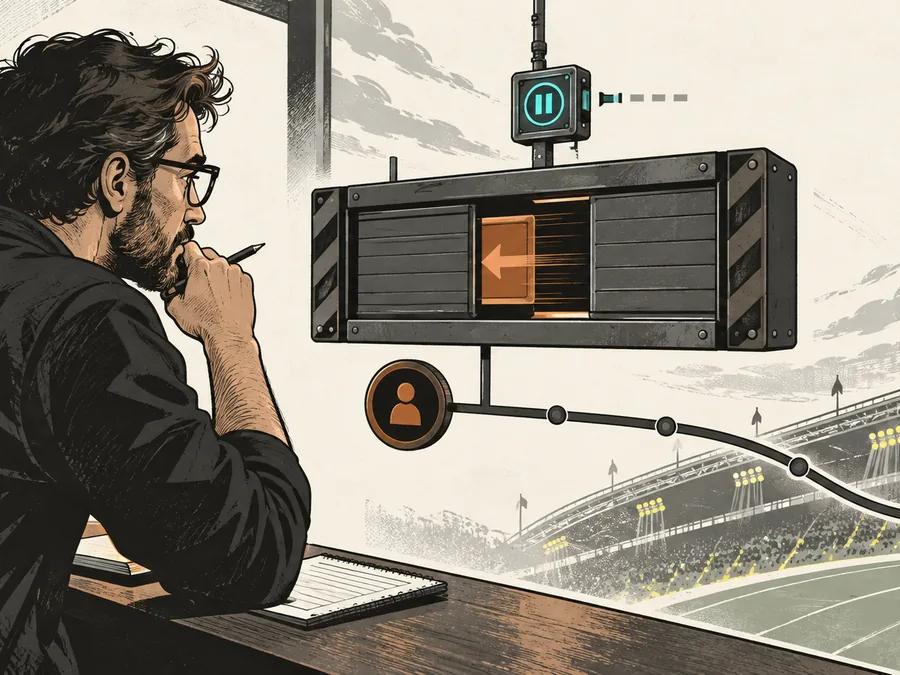

Usually, it has not. A market move changes the offer available for the next bet; it does not normally replace the price recorded on an already accepted fixed-odds ticket. The important exceptions are not ordinary price movement. They are rulebook events such as an obvious pricing error, a late bet accepted after the action changed, the wrong market or participant, or an incorrect settlement.
The decisive record is therefore the accepted bet confirmation—not the live market screen, the early return estimate or a later cash-out quote. What counts as accepted, and what an operator may do when its price was wrong, depends on the applicable house rules and jurisdiction.
The screen, bet slip and ticket are three different moments
A fixed-odds wager passes through at least three visible states. The market screen advertises a current price. The bet slip repeats a quote while the customer chooses a stake. The accepted ticket records the transaction after the sportsbook approves it.
Those moments can be only seconds apart, but the market can move between them. DraftKings’ current US general betting rules say that when odds change after a selection enters the slip but before acceptance, the customer can manually accept the change or configure the account to accept it automatically. Bet365’s Ohio house rules similarly say a changed line, spread, handicap, price, selection or market is highlighted in the bet slip for review and acceptance.
| What the customer sees | What it represents | Has a fixed-odds bet been accepted? |
|---|---|---|
| Price on the market screen | An offer that can move or disappear | No |
| Price in an unsubmitted bet slip | A quote awaiting submission and operator acceptance | No |
| “Odds changed” prompt | A revised offer before acceptance | No, unless the revised bet is then accepted |
| Bet ID and accepted price in open bets or history | The operator’s acknowledgement of the transaction | Normally yes, subject to the published rules |
An app animation is not the legal definition of acceptance. The electronic acknowledgement, transaction log and rules do that work. In Great Britain, Gambling Commission licence condition 4.2.6 requires betting licensees to publish the core acceptance and settlement rules and issue a slip or electronic acknowledgement for each transaction.
A moving line does not normally rewrite an accepted price
Once a conventional fixed-odds bet is accepted, the ticket should identify the selection, stake and price that govern its potential return. Prices still move around it because the sportsbook is responding to new information, exposure or market activity. The updated line is an offer to someone betting now, not a retrospective edit of everyone who bet earlier.
That is the difference between market movement and bet amendment. Market movement is routine repricing. A bet amendment changes a field or settlement basis on an existing transaction and needs a rule-based reason.
This is also why a sportsbook market suspension should not be read as an automatic cancellation of every open ticket. Suspension stops or slows new acceptance while the operator checks data, price or event status. Existing bets then follow the relevant market and settlement rules.
The phrase “the odds changed” can hide a simpler issue: the bettor remembers the quote on the event page, while the operator accepted a different price after a slip prompt. The useful comparison is not memory versus the current screen. It is the accepted ticket versus the transaction history.
Obvious error is an exception, not another name for movement
Sportsbook rules commonly reserve a remedy for a price that was plainly wrong when accepted. The industry labels include obvious error, palpable error and blatant error. These terms do not mean “the price later looked generous.” They usually point to a material mismatch with the general market or with the known probability and state of the event.
Operator remedies are not uniform:
| Published rule example | Error test described | Stated remedy |
|---|---|---|
| Betfair Sportsbook | Price materially different from the general market or clearly incorrect given the chance at the time | Bet stands; a winning bet may be settled at the correct price |
| bet365 Ohio | Clear outlier against public information or comparable industry offers | Incorrect-price bet generally stands at a revised price; specified extreme cases are void |
| FanDuel Indiana specials | Obvious pricing or wording error in the named special market | Cancel the affected special and offer it again at the correct price or wording |
Betfair’s current general sportsbook rules state that, for the defined error cases, bets stand but winning bets are settled at a correct price determined reasonably. Bet365 Ohio defines an obvious error and gives separate treatment for incorrect prices, handicaps, cash-out amounts, events and markets. FanDuel’s Indiana house rules show yet another market-specific remedy for obvious errors in specials.
These examples are not interchangeable policies. They show why “can a sportsbook change my odds?” has no operator-free answer once a genuine error clause is engaged. The exact rule, market and licensed location matter.
A late bet can look like a price change
Live betting creates a sharper boundary. Pictures and data feeds arrive with delay, and an operator may accept a request after a goal, score, card or other material event has already changed the true state of the market.
That is not merely a line moving after the bet. It is a late-bet question: did the operator accept a transaction using a stale event state, and what does its rulebook prescribe? Bet365 Ohio, for example, distinguishes late bets on markets covered live from bets where a participant had already gained a material advantage. Betfair separates bets accepted after the off and bets placed after the final result was already determined.
The operational reason for suspending an in-play market is to prevent that gap from widening while data and pricing catch up. No system can make the broadcast, data feed, trader and bet request reach the same millisecond. The rules define what happens when the controls miss.
Cash out is a new offer, not the original ticket price
A falling cash-out amount is often described as the sportsbook “changing the odds.” It is a different transaction. Cash out is a later offer to settle all or part of an open bet before the underlying event reaches its normal settlement point.
FanDuel Indiana’s rules define cash out as a value determined by the operator, offered at its discretion and not guaranteed for every bet or moment. The quote can change during the request delay. That changing quote does not, by itself, alter the accepted odds or stake on the original ticket.
Our explainer on why cash out becomes unavailable follows the quote through repricing, suspension and acceptance. If no cash-out request is accepted, the original wager remains governed by its own terms. If one is accepted, the cash-out settlement becomes the relevant record for the portion closed.
Settlement changes are not always odds changes
A ticket can produce a different return without its original price being secretly replaced. A void selection in a multiple may change how the remaining legs are calculated. A dead heat can divide the effective stake. A non-runner can trigger a deduction under the relevant racing rule. An official result correction can cause a market to be resettled.
Those are settlement mechanics. They should be explained by the market rule and calculation, not disguised as a new price. Our guide to voids, pushes and dead heats separates three labels that can all return money for different reasons.
Great Britain’s Gambling Commission says licensees must publish how they treat errors, late bets, withdrawals, non-runners, reformed markets and maximum payouts. It also says special rules agreed for a particular bet must not be overridden by conflicting rules or later rule changes. Separate Commission guidance on reducing winnings on open bets says broad clauses allowing lower payouts must not be unfair, while recognising clear and obvious odds errors and Rule 4 as examples that may fairly amend potential returns.
That is a regulatory boundary for Great Britain, not a universal rule for every sportsbook worldwide.
How to audit a disputed price
The strongest question to support is not “what were the odds on the screen?” but “what did the operator accept, and which published rule changed the outcome?” A useful evidence pack contains:
the bet ID, acceptance timestamp, selection, market, stake and recorded odds;
the confirmation or transaction-history entry, not only a screenshot of the live event page;
the settled return and the operator’s calculation;
the exact house-rule and sport-rule sections cited by support; and
any message identifying an obvious error, late bet, void, resettlement or cash-out acceptance.
The operator should be able to distinguish a pre-acceptance price update from a post-acceptance correction. If the explanation says only that “odds changed,” ask which field in the accepted transaction changed, when it changed and under which rule.
For Great Britain disputes, the Gambling Commission’s complaints guidance says to check the terms, complain to the operator with dates, times, amounts and evidence, and retain copies. If the internal procedure does not resolve the matter, eligible transaction disputes may move to the operator’s alternative dispute resolution provider; the Commission describes the ADR route and its eight-week boundary. Other jurisdictions have their own regulators and escalation paths.
The durable answer sits on the accepted ticket
A sportsbook can move the public line whenever its next offer changes. That is not the same as changing an accepted bet. For a normal fixed-odds ticket, the accepted price remains the reference point.
The narrower exceptions must be named: a pre-acceptance update, an obvious error, a late bet, a wrong market, a cash-out transaction or a settlement rule. When an operator cannot identify which one occurred, “the odds changed” is not an adequate audit trail.