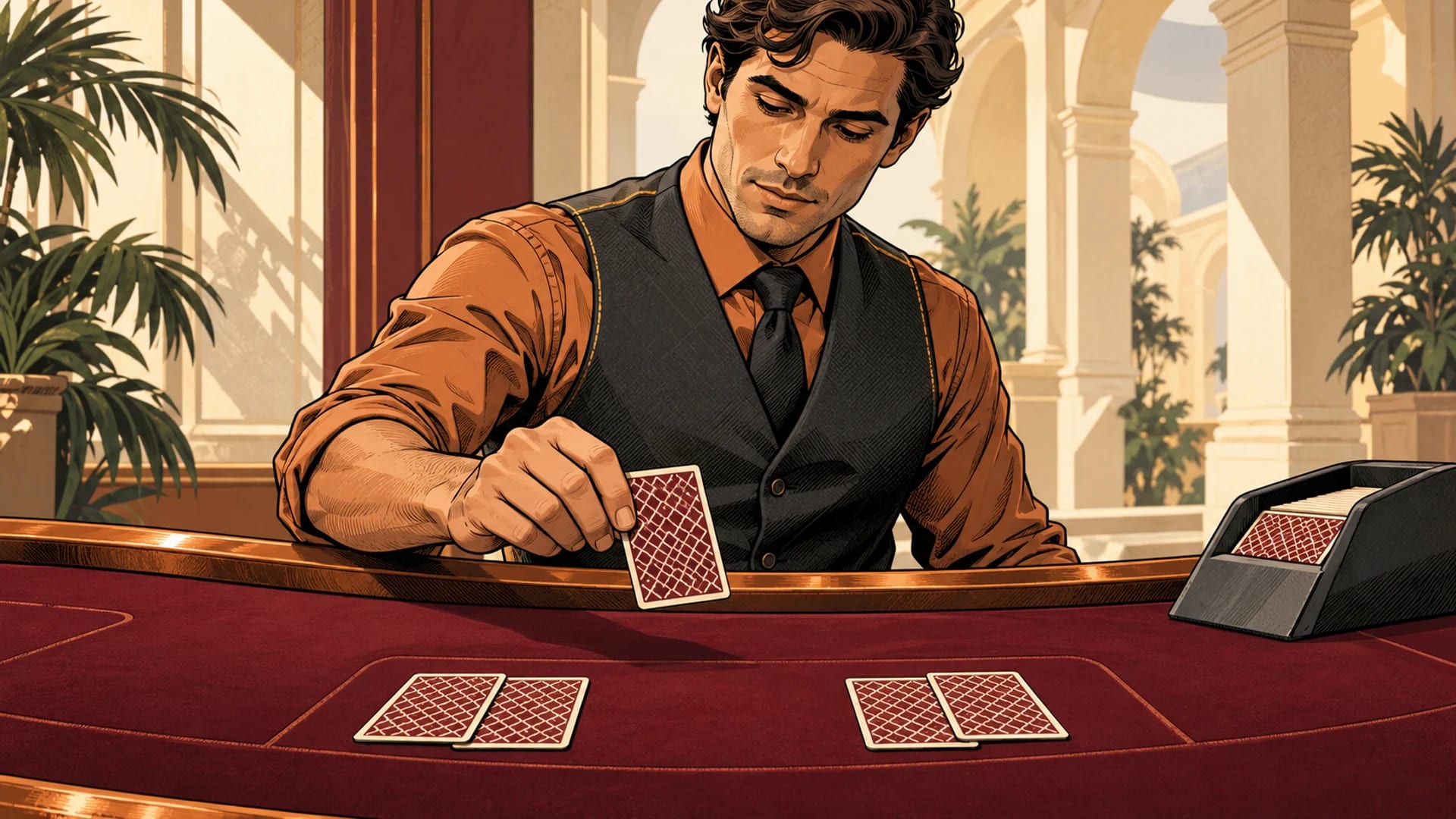

A pair can earn a side-bet payout while the dealer collects both main wagers. Three Card Poker can settle the same three cards in opposite ways because Ante/Play compares hands, while an eligible Pair Plus wager pays for the player's hand category.
That separation does not make the side bet insurance. A small payment on one line can leave the round well below break-even.
This guide reads theScore Bet's public Evolution game description, the operator-hosted Evolution rules compilation carrying a 30 December 2024 filename, and New Jersey's published three-card poker regulations. They were checked on 22 October 2026. These are documented rules, not confirmation of the build, eligibility or limits available in any reader's casino.
The Play wager is new money
The theScore Bet game description requires an Ante before the deal. Pair Plus is an optional additional wager. After receiving three cards, continuing requires a Play wager equal to the Ante.
In an invented round with a 10-unit Ante and a 2-unit Pair Plus, the initial commitment is 12 units. Making the required equal Play adds 10, bringing the amount at risk to 22. The Play does not come out of the original Ante.
The amounts below are teaching units, not quoted table limits or a suggested gambling budget. Each example assumes Play has been made, no fees and no other side bets.
The dealer needs queen-high to qualify
In theScore's description, a dealer below queen-high causes the Ante to win at 1:1 and the Play to push, meaning its stake comes back without profit. A qualifying dealer's hand is compared with the player's: a player win pays both wagers at 1:1, a loss collects both, and an exact tie returns both stakes.
Queen-high is a hand threshold. A dealer holding Q-clubs, 4-diamonds and 2-spades qualifies; it need not contain a pair.
Suppose our player instead has K-clubs, 9-diamonds and 4-spades against the dealer's J-hearts, 8-clubs and 3-diamonds. The dealer does not qualify. The 10-unit Ante returns 20, the 10-unit Play returns 10, and a losing 2-unit Pair Plus returns nothing. The total returned is 30 against 22 committed, for an 8-unit gain. Neither hand earns an Ante Bonus.
A side-bet win can accompany an 18-unit loss
Now give the player 7-clubs, 7-diamonds and K-hearts, against the dealer's 9-clubs, 9-diamonds and Q-spades. The dealer qualifies and its pair of nines beats the player's sevens.
Use the Pair Plus schedule in the Evolution compilation hosted by Hollywoodbets, PDF pages 162-166. Its pair pays 1:1. Both main wagers lose, but the 2-unit Pair Plus earns 2 units of profit and returns its 2-unit stake.
| Wager | Committed | Total returned |
|---|---|---|
| Ante | 10 units | 0 |
| Play | 10 units | 0 |
| Pair Plus | 2 units | 4 units |
| Whole round | 22 units | 4 units |
Four minus 22 is minus 18. Calling Pair Plus a winning bet is accurate; calling the whole round a win is not. Our roulette payout explainer follows the same distinction between profit and money returned.
The cited Evolution document lists this Pair Plus schedule. The last column is our arithmetic for a hypothetical 2-unit winning stake, excluding its returned stake.
| Hand | Profit payout in this document | Profit on 2 units |
|---|---|---|
| Mini Royal: A-K-Q of one suit | 100:1 | 200 units |
| Other straight flush | 40:1 | 80 units |
| Three of a kind | 30:1 | 60 units |
| Straight | 5:1 | 10 units |
| Flush | 4:1 | 8 units |
| Pair | 1:1 | 2 units |
This is not a universal paytable. New Jersey's section 13:69F-20.11 specifies minimum Pair Plus payouts, including 3:1 for a flush, rather than establishing the exact payout at every table.
A straight beats a flush with three cards
New Jersey's rankings, section 13:69F-20.3, run from straight flush through three of a kind, straight, flush and pair, followed by high-card hands. A-K-Q is the highest straight; A-2-3 is the lowest. Suits do not break a tie.
Our enumeration of a standard 52-card deck finds 22,100 unordered three-card hands. Excluding straight flushes from both categories leaves 720 straights and 1,096 flushes. Those are our calculated hand counts, not a player's probability of beating the dealer or a quoted RTP.
For a final invented round, give the player 4-clubs, 5-diamonds and 6-hearts against that dealer pair of nines. The straight wins. With 10 on Ante, 10 on Play and 2 on Pair Plus under the cited Evolution schedule, the main wagers return 40 combined. Its straight Ante Bonus adds 10; Pair Plus returns 12 including its stake. Total return is 62 against 22 committed, a 40-unit gain.
The Ante Bonus is a separate payment attached to an eligible Ante and Play, not a second name for Pair Plus. These examples explain settlement, not a decision rule for choosing hands or stakes. Baccarat's automatic third-card rules concern a different game entirely.
Independence from the dealer does not settle the fold clause
New Jersey's section 13:69F-20.10(b) forfeits both Ante and Pair Plus when a player who placed both declines to make Play. By contrast, the cited Evolution PDF says a qualifying Pair Plus hand can pay even after a fold. TheScore's public guide describes folding as forfeiting the bets placed.
Those descriptions cannot be merged into a promise that Pair Plus always survives folding. None of our worked rounds folds. The older compilation is evidence of its documented terms, not an override for a table's current rules.
As our report on casino-game versions explains, a shared title is insufficient identification. For a disputed round, keep the accepted wagers, hand identifier and the applicable rules screen. Ask the operator which fold clause and paytable governed that game.