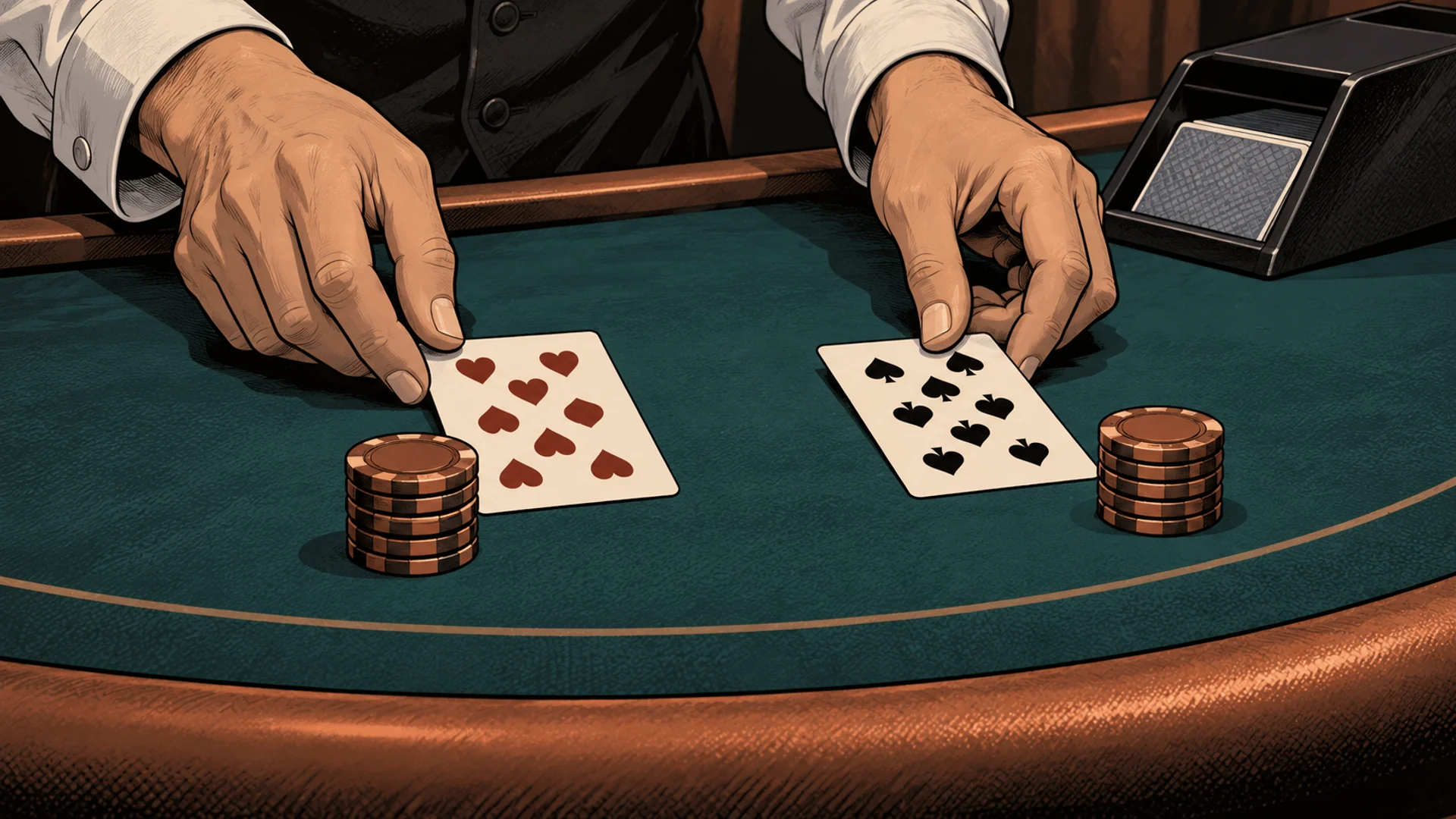

After a double-down card lands, a disappointing total does not create another chance to hit. The extra wager commits more money to a hand that receives only one further card under the ordinary blackjack procedures examined here.
To interpret a Double control, find whose money funds it and which hands qualify. The dealer's blackjack check can also affect the amount collected. An ordinary double, a Spanish 21 rescue and a Free Bet marker can produce different account entries.
The added stake still pays at the ordinary rate
Take a hypothetical £15 opening wager and another £15 accepted for a full double. The player has committed £30. Pounds make the example easy to follow; these are not US casino denominations or a suggested stake.
For an ordinary even-money win, £30 earns £30 profit and the £30 stake comes back, giving a total return of £60. An ordinary loss costs the full £30. A qualifying tie, usually called a push, returns £30 and produces no profit. Exclude dealer blackjack, insurance, side bets and special payout variations from these examples.
The Massachusetts Gaming Commission's Blackjack rules, section 3, provide the ordinary 1:1 win and equal-score settlement used here, with a dealer-blackjack exception. A larger payment follows from the larger wager, not a new 2:1 payout rate. The extra money has also increased the amount that can be lost.
The window closes before an ordinary hit
Massachusetts section 10 permits an added amount up to the original stake on eligible first two cards, including the first two of a split hand. Blackjack and a two-card total of 21 are excluded. One more card ends the draw. Its alternative section 6(j) procedure narrows doubling to totals of 9, 10 or 11.
Pennsylvania's section 633a.10 also describes a wager no greater than the original amount, a first-two-card window and exactly one further card, placed sideways whether dealt face up or down. The cap allows less than a full match under that rule; it does not establish which amounts an unrelated online interface accepts.
Splitting has its own restrictions, particularly for aces. Our split-hand explainer follows those limits. A general permission to double after a split should not be read without the clauses governing that particular hand.
Dealer blackjack is not the same as an ordinary loss
Pennsylvania section 633a.10(b) limits collection to the original wager if the dealer obtains blackjack after the player doubles. With £15 initially staked and £15 added, the result under that clause is a £15 loss and £15 returned. An operator applying another game's rules may have a different procedure; the Pennsylvania clause cannot settle a dispute elsewhere.
Ordinary Massachusetts surrender belongs before a player indicates a double, split, stand or draw. Section 8 therefore does not offer a fresh half-stake exit after a double-down card. The separate surrender article examines that initial decision and its settlement timing.
Rescue returns a different part of the wager
In Massachusetts Spanish 21, section 9, a player may rescue the added double-down wager after the extra card, provided the hand has not exceeded 21. The original wager is forfeited. The same section permits doubling on two or more cards, another reason not to borrow its action window for ordinary blackjack.
For an equal £15-plus-£15 double rescued under that rule, £15 returns and £15 is lost. There is no profit. A smaller added wager changes that arithmetic: £15 initially plus £5 added means £5 returned and £15 lost. Rescue retrieves the added amount, not automatically half the total commitment.
Free Bet changes who supplies the extra amount
Massachusetts Free Bet Blackjack, section 8, permits a free double on an initial two-card hard 9, 10 or 11, with a marker called a lammer instead of an extra player stake. Other eligible totals require the player's own added wager. Section 6 makes remaining main wagers push when the dealer reaches 22, collects the free markers and prohibits surrender.
With a £15 original wager and its matching free-double marker, an ordinary winning settlement under sections 6 and 10 earns £30 profit and returns only the player's £15 capital: £45 in total. The marker is not another £15 of the player's deposited money coming back. The rulebook does not turn the original stake into a free wager.
When comparing a hand record with a balance movement, identify the original amount and every addition, including any non-cash marker. Then match the final card sequence to the named game's settlement clause. These calculations explain payments after a result; they do not tell a player when doubling will win.