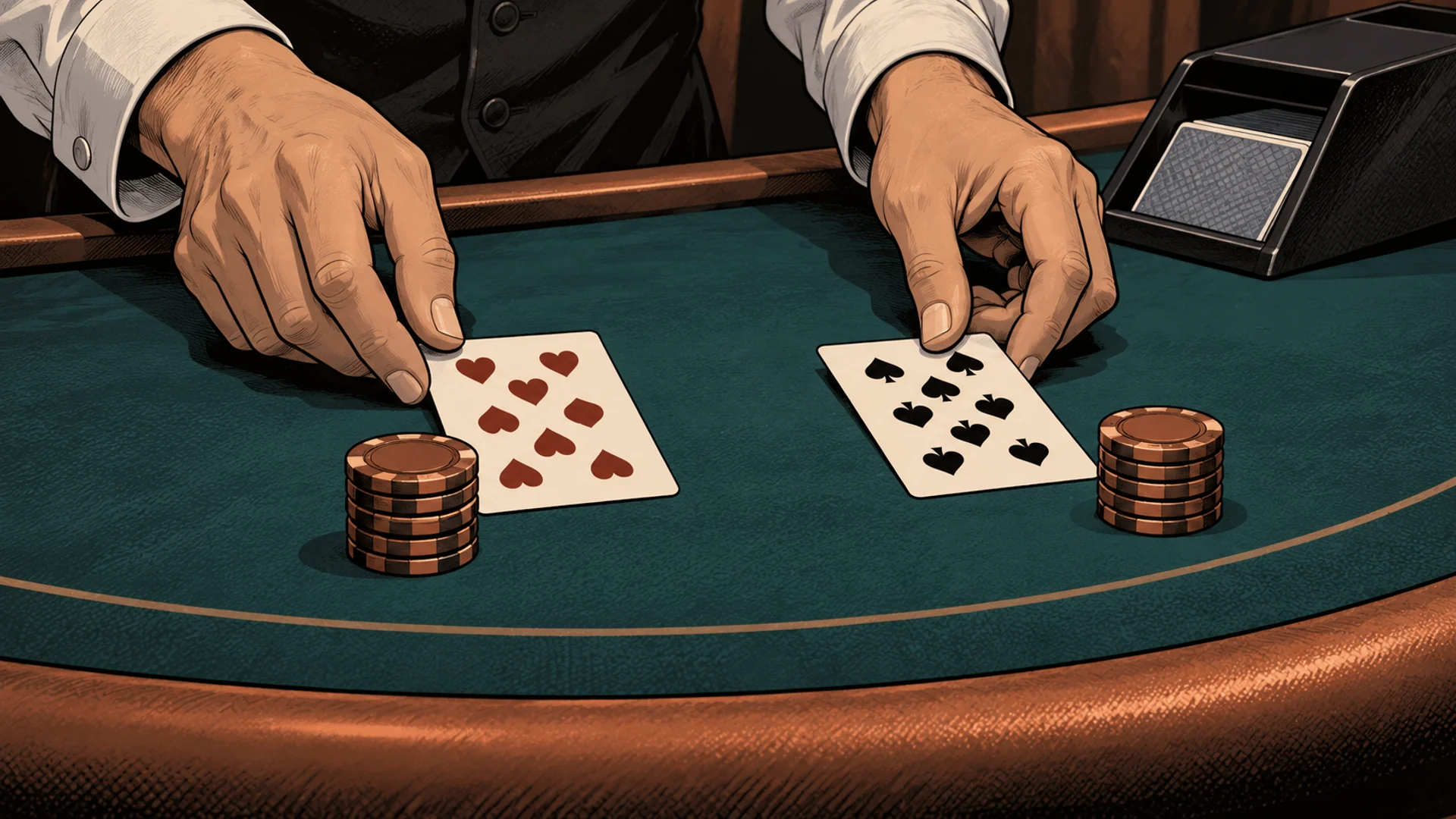
Four and five make nine. Add an ace and that blackjack hand can now be scored as 20, with the ace worth 11. Add a nine after that, and the useful total falls to 19 because the ace must count as one. The cards have not been removed; their permitted values have changed.
That is the distinction behind blackjack soft versus hard hands. A soft total uses an ace at 11 without exceeding 21. A hard total has no ace that can still do that. A visible ace alone does not establish which label applies.
Score the whole hand again
The card values in Bicycle's blackjack rules are straightforward: numbered cards use their pip values, picture cards count ten, and an ace can be one or 11. Pragmatic Play's Live Blackjack help sheet, publicly hosted by YesPlay, uses those values too. It illustrates ace-five as six or 16.
A useful way to check a total is to begin with every ace worth one. If the hand contains an ace and adding ten to that total does not exceed 21, one ace can count as 11. Otherwise, keep all the aces at one. If even that lowest total exceeds 21, the hand has busted.
The following invented sequence follows one ordinary player hand. It demonstrates scoring, not advice to request any of these cards, a prediction of a deal or a recorded casino round.
| Cards held at this point | Calculation using the available ace value | Working total |
|---|---|---|
| 4, 5 | 4 + 5 = 9 | Hard 9 |
| 4, 5, ace | 4 + 5 + 11 = 20 | Soft 20 |
| 4, 5, ace, 9 | 4 + 5 + 1 + 9 = 19 | Hard 19 |
| 4, 5, ace, 9, 2 | 4 + 5 + 1 + 9 + 2 = 21 | Hard 21 |
In the second row, counting the ace as one would also produce a legal total of ten. The soft label describes the higher usable total of 20. In the next row, retaining 11 would produce 29, so that valuation no longer works.
This explains the apparent drop from 20 to 19 after another card. The extra nine is accompanied by a ten-point reduction in the ace's value: 20 + 9 − 10 = 19. No stake has been refunded, and no card has disappeared.
A hand without an ace has no such adjustment. Nine and eight total 17, but another nine would take that hand to 26. Calling 17 hard describes its scoring; it is not a statement about whether the hand should take another card.
With several aces, only one can take eleven
Two aces cannot both be 11 in a live hand scored at 21 or below: they would already total 22 before any other card. With two aces alone, one can instead be 11 and the other one, producing soft 12.
Now consider a separate invented hand containing ace, ace and eight. Its lowest total is ten. Raising one ace by ten gives soft 20. If a ten-value card is added, both aces must count as one and the hand is hard 20: 1 + 1 + 8 + 10.
A further two would produce 22 even with both aces at one. That hand busts. The earlier soft label did not protect every later state of the hand; it described the ace value available at that earlier point.
These examples count card ranks, not suits. The cited Live Blackjack document says suits do not affect the main hand's score. Its separate side bets have their own combination rules, so that statement should not be borrowed to describe every wager at the table.
The score does not decide the action or payment
A dealer and a player can have the same soft total under different instructions. The H17/S17 explainer addresses the dealer's obligation at soft 17. The scoring distinction here does not replace that procedure or supply a player strategy chart.
Permission to draw can also end while an ace still counts as 11. The cited Pragmatic Play rules give each split ace only one added card. A split ace followed by a four is numerically soft 15, but the rule does not allow another hit on that split hand. Our split-hand guide separates those restrictions from the extra wager.
Reaching 21 is another separate question. The table's five-card 21 is not a natural blackjack under the cited rules. The natural belongs to the initial two-card ace and ten-value combination; the document also excludes a ten-value card added to a split ace. A total of 21 and entitlement to a blackjack payment are therefore different facts. Our 3:2 versus 6:5 comparison examines the payment line.
The public help sheet identifies a named game, not every currently loaded version or customer account. Its scoring examples cannot certify the rules at another table.
A hand record needs the cards as well as the displayed number. Soft 20 followed by hard 19 can be consistent with an added nine and an ace moving from 11 to one. The action and settlement still have to follow the rules governing that hand.