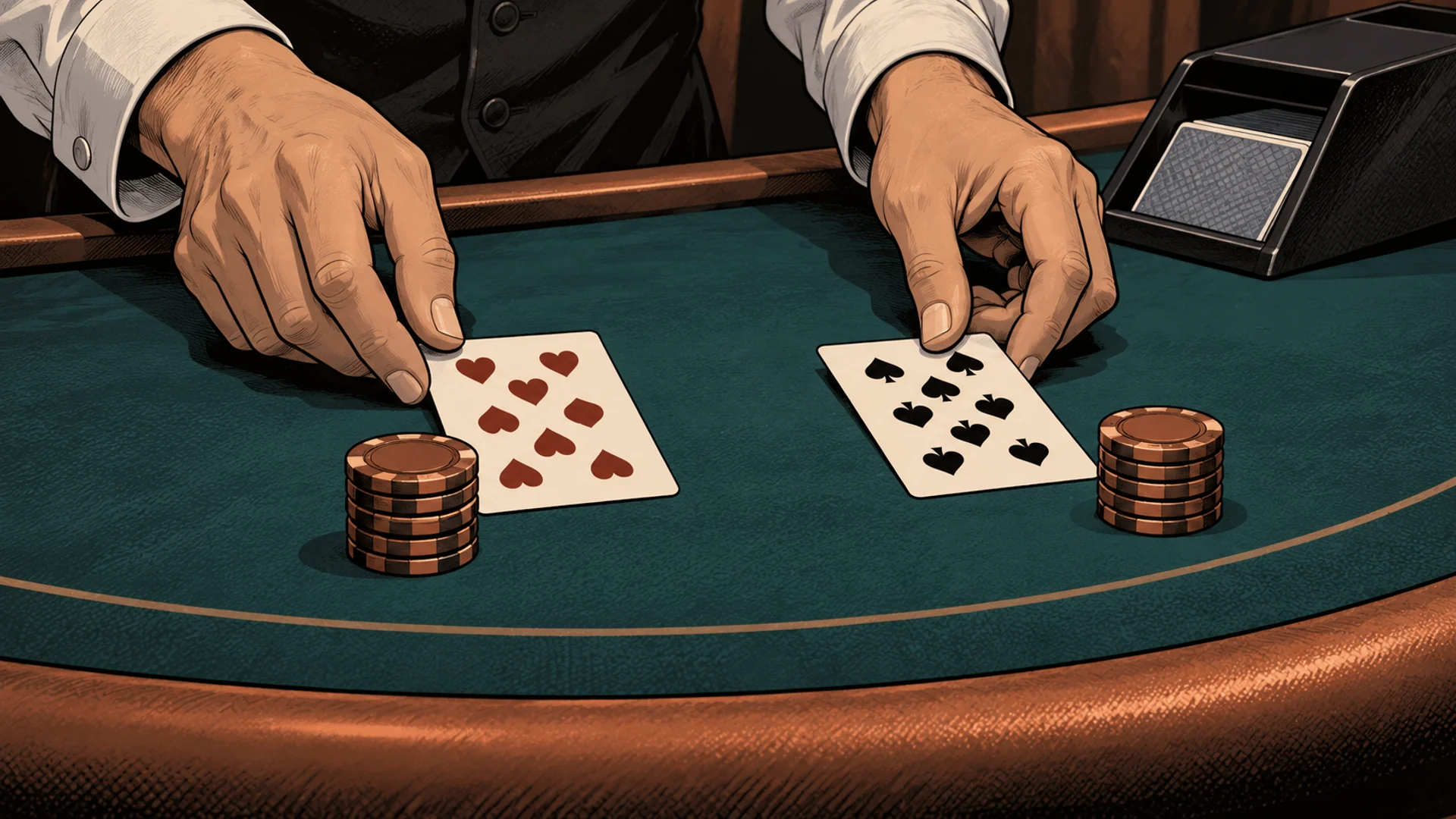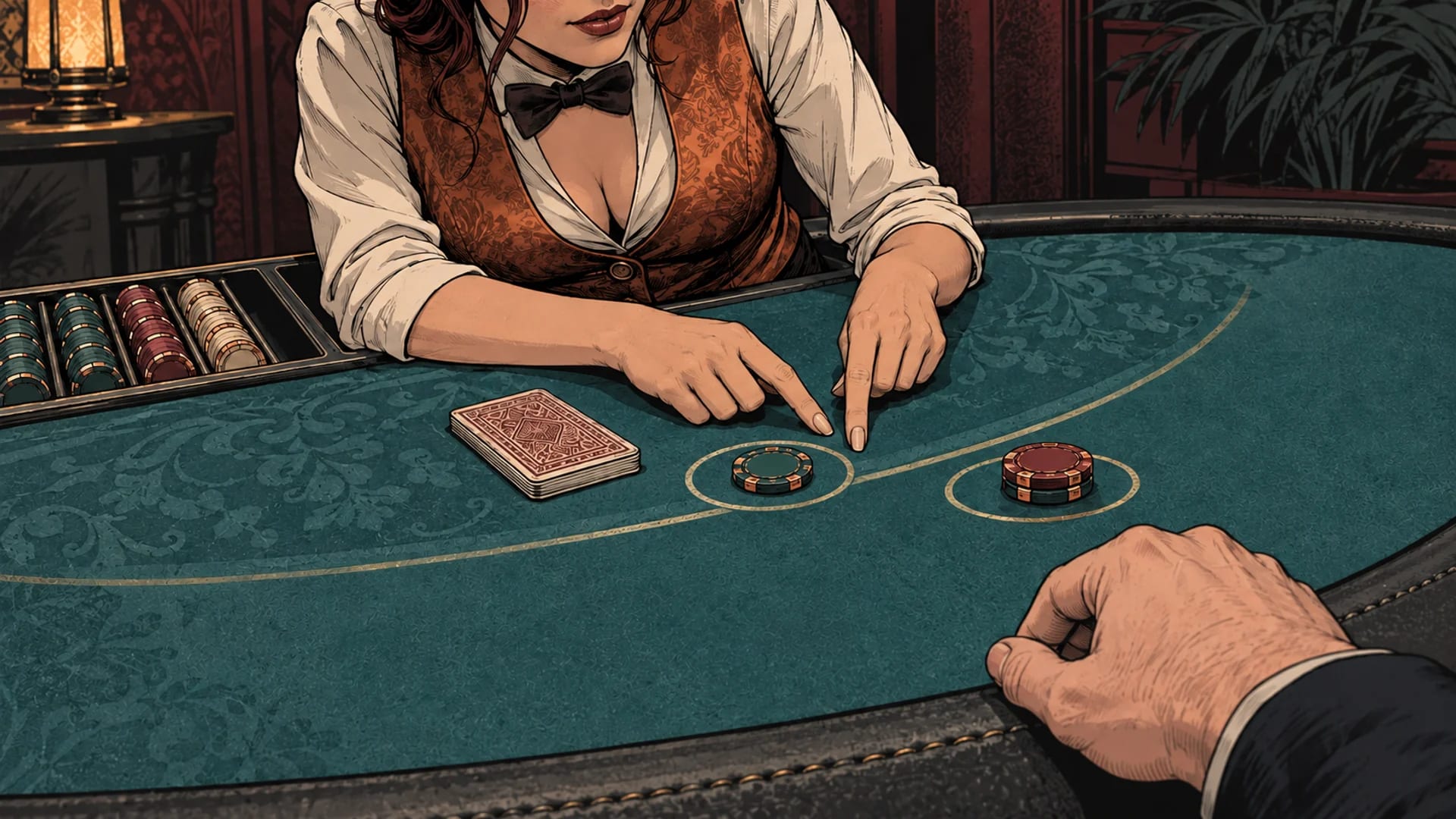
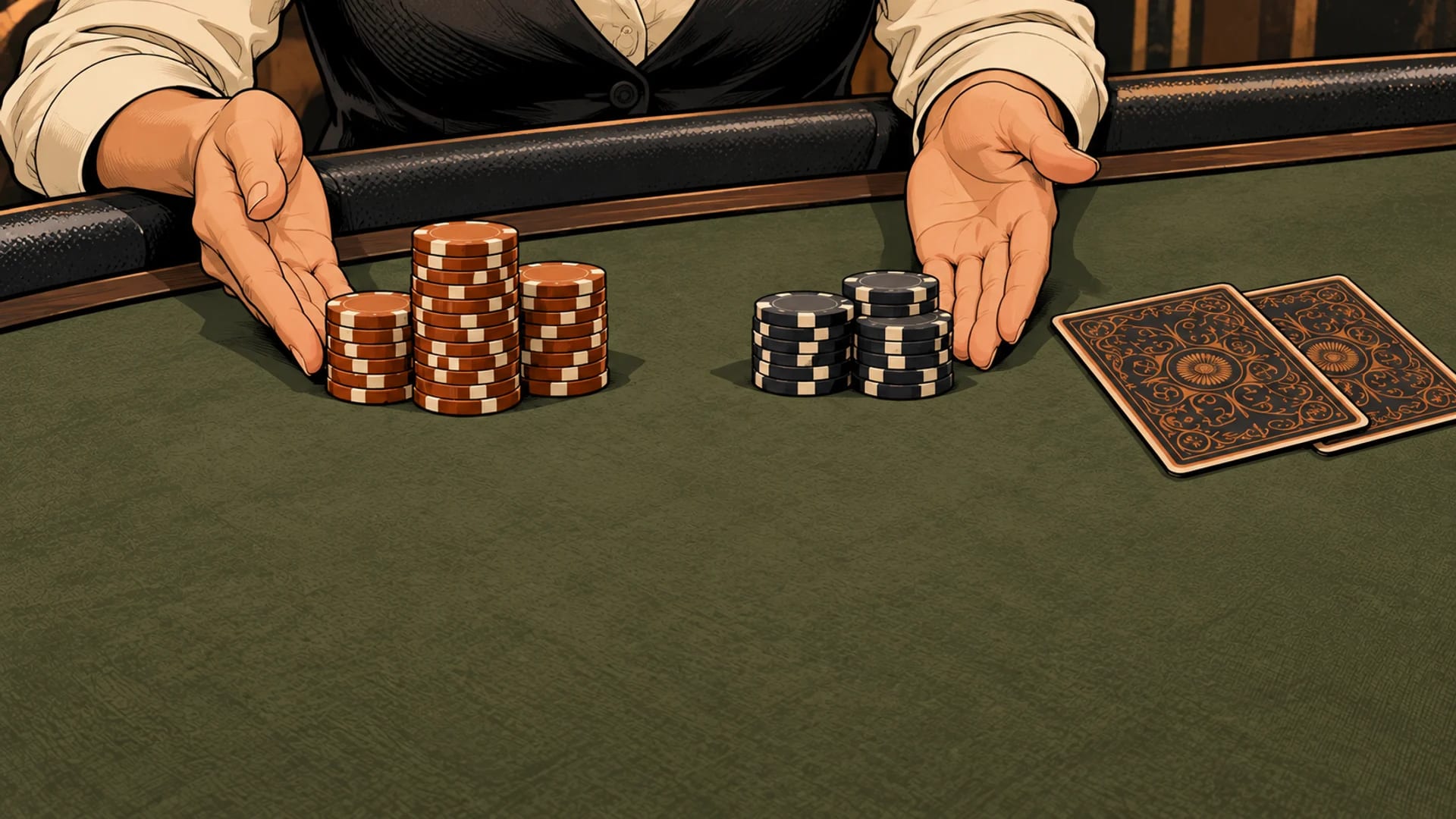
The gap sits in the table's payout line before a card is dealt. Both MGM Resorts' GameSense guide and The Venetian Resort Las Vegas' rules describe blackjack paid at either 3:2 or 6:5, depending on the game. The name on the table does not select the ratio for you.
These are explanations of published rules and hypothetical cash payments. The pounds make the arithmetic readable; they do not describe US table denominations, a recorded casino visit or an invitation to wager. A particular online game or physical table needs its own applicable rules.
Separate the profit from the money coming back
Read 3:2 as three units of profit for every two units staked on the qualifying winner. On £10, that is £10 × 3/2 = £15. The £10 stake remains the player's money and returns alongside it. Adding the two produces £25, not £15, in total.
At 6:5, the corresponding calculation is £10 × 6/5 = £12 profit. Including the returned stake makes £22. Six is a larger numerator than three, but the denominators are different: 6/5 is 1.2, while 3/2 is 1.5.
The examples assume a qualifying natural that wins, with no separate charge, side bet, bonus restriction or deduction. They compare the same £10 main wager under two different payout rules.
| Settlement line | 3:2 winning natural | 6:5 winning natural |
|---|---|---|
| Cash wager committed | £10 | £10 |
| Profit earned | £15 | £12 |
| Original stake returned | £10 | £10 |
| Total returned | £25 | £22 |
The change removes £3 from this payment. Relative to the £15 profit under 3:2, the reduction is 20%. Relative to the £25 gross return, it is 12%. Calling both figures a "20% smaller return" would mix the two denominators.
Neither percentage is the whole game's house edge or return to player. Those require the probabilities and settlements of the other possible results too. Our RTP explainer follows that distinction between a game's expected return and one credited payment.
A natural has a two-card history
For the Venetian's definition, the original deal must pair an ace with a card worth ten. That second card can be a ten, jack, queen or king. The resulting 21 qualifies for the blackjack payout described by the table, subject to the rest of its settlement rules.
An illustrative initial ace and king therefore has a different classification from a hand that starts with a seven and four, then draws a king. Both total 21. The latter needed a third card and does not meet that initial-two-card definition.
MGM's guide separately says split hands do not receive blackjack payouts. After splitting aces, an ace and a newly dealt ten-value card can total 21 without qualifying for the natural premium under that rule. Our split-hand article examines the extra wager and those restrictions; this comparison concerns the amount paid once the hand's category is established.
For a hypothetical £10 ordinary winning hand at 1:1, profit is £10 and £20 comes back in total. That is a third payment, distinct from the £25 natural return at 3:2 and the £22 natural return at 6:5. A screen showing only "21" leaves out the card sequence needed to choose between them.
The same caution applies to ties. The Venetian describes an ordinary tie as a push, leaving the wager on the table rather than paying a win. A blackjack payout label cannot establish that a tied hand has won. Our blackjack push explainer covers simultaneous naturals and named variant exceptions in more detail. Do not transfer one variant's tie rule to another table merely because both display 3:2.
The ratio does not make the cards arrive more often
Holding the deck and dealing process fixed, changing only the payout from 3:2 to 6:5 changes the money paid on the qualifying result. It does not change which two-card combinations constitute a natural or how often that unchanged deal produces them.
This separates a payout comparison from a forecast. The £3 difference in the £10 example applies to each qualifying winning natural being compared. It does not mean £3 disappears on every dealt hand, nor does it predict how many naturals a session will contain. A session loss cannot be calculated from that £3 figure alone.
The comparison also assumes equal stakes. On an invented £20 main wager, 3:2 produces £30 profit and £50 total return; 6:5 produces £24 profit and £44 total return. The gap becomes £6 because twice as much was committed. Raising the stake increases the money exposed to a losing hand; it does not repair the payout ratio or improve the chance of a natural.
Identify the wager behind the payment
MGM lists the natural payout on the table, while its ordinary winning wager pays 1:1. For an online game, preserve the rules panel for the version actually loaded. Our casino-game version report explains why the lobby thumbnail is insufficient evidence of the terms beneath it.
The main hand and an additional wager also need separate entries. Insurance, for example, has its own dealer-blackjack condition and payment. A combined credit cannot be interpreted as the natural's payout without separating the stakes and results. The insurance explainer traces that extra wager.
If a natural appears to have been underpaid, retain the initial card sequence, hand identifier, accepted main stake and applicable payout rule. Compare the reported profit with the full amount returned. The relevant question is which hand category and ratio the operator used for that payment. A total of 21 and a balance increase, on their own, do not answer it.