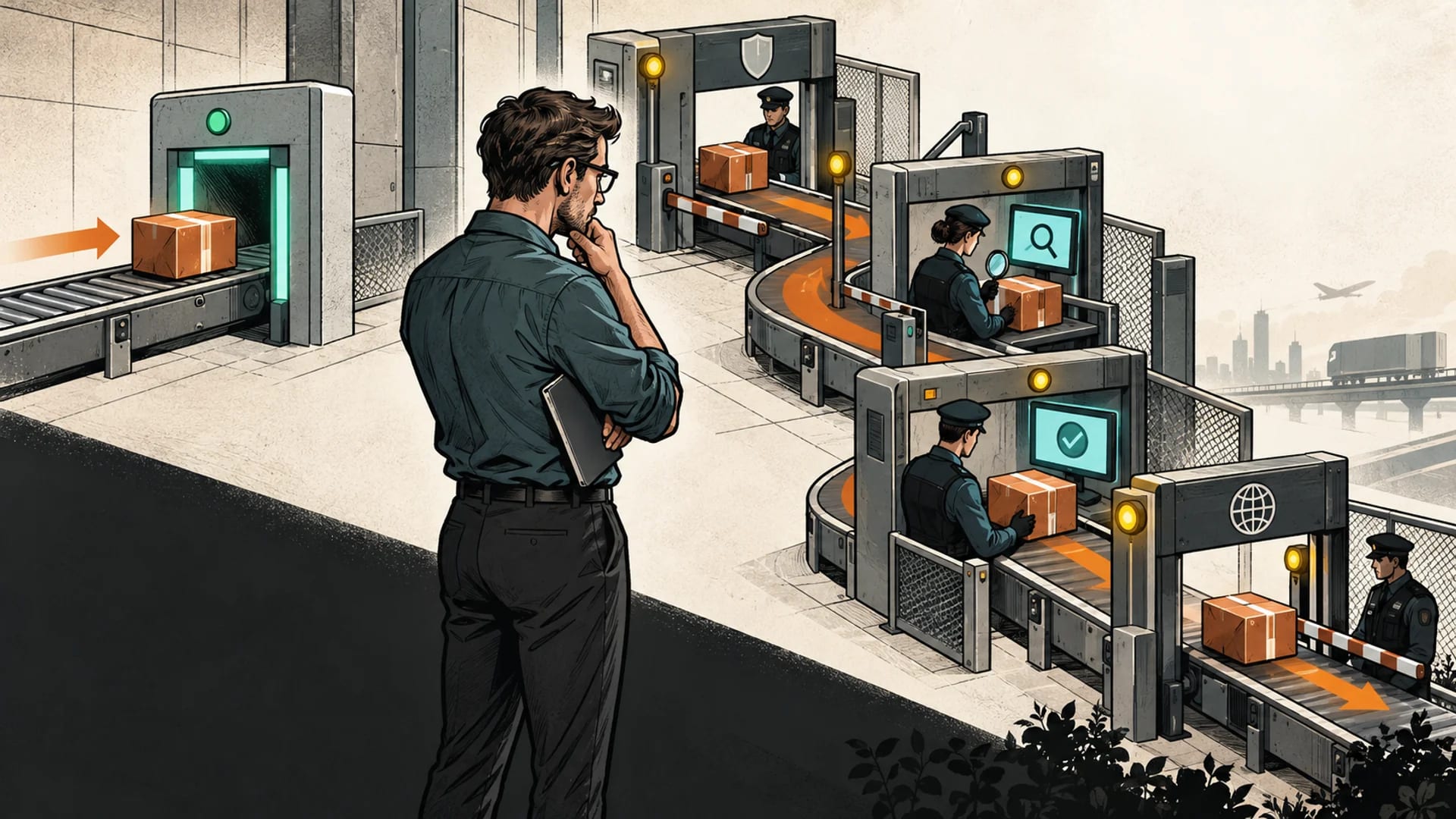

Requested money can remain pending without becoming playable again. At an online casino serving Great Britain under Gambling Commission rules, a customer must not be offered a way to cancel a withdrawal request and put that money back into play. The restriction concerns the request itself, even while the payment remains pending. It does not mean the bank has received the money.
A withdrawal request takes money out of play
The Commission's RTS 14B states: "Consumers must not be given the option to cancel their withdrawal request." Its guidance also prevents an option to deposit using those requested funds, and calls for frictionless withdrawals. The standard lists 14B as applying to all gambling within its scope, rather than only online slots. The casino example here belongs to Britain's regulated remote market; it is not a worldwide rule for every site displaying a casino lobby.
Consider a hypothetical account with 100 units available and a request to withdraw 70. The arithmetic leaves 30 outside that request. Returning the requested 70 to spendable gambling balance would reopen access to money the customer had chosen to take out. The example assumes no fees, other transactions or disputed balance. It illustrates the separation, not a prescribed screen layout or an account tested by Betting Tribune.
| Amount in the example | What it represents | What the number does not establish |
|---|---|---|
| 70 units requested | The amount the customer wants withdrawn | That an external transfer has already arrived |
| 30 units remaining | The balance outside that particular request | A recommendation to keep gambling |
| 100 units in total | The starting account balance in this illustration | A promise about any real casino's ledger display |
An account can show a pending withdrawal separately from its available balance. Another interface can combine them in a total and expose the split elsewhere. The design question is whether the requested funds are available for another wager. A total balance alone cannot answer that question; the transaction record and the amount available to play need to agree.
The ban reached further than the slots package
The Commission announced the permanent reverse-withdrawal ban on 2 February 2021. Much of that announcement concerned slot design, including spin speed and autoplay. Its withdrawal restriction covered all online gambling, however. Reading the headline as a slots-only rule misses that difference.
The regulator described reverse withdrawals as a function that let customers gamble money they had already requested back. It said the temptation to continue gambling created a risk. That is the stated rationale, not proof that removing one control eliminates gambling harm or that every withdrawal experience improved after the announcement.
This is an established rule being explained, not a new October 2026 ban. The current RTS page's January 2026 update concerns other wording in that standard; it should not be presented as the birth of the withdrawal restriction. Our article on Britain's removal of casino autoplay looks at a different part of the product-design changes.
One operator's public help makes the practical result plain. Slots Temple's UK pending-withdrawal answer, updated on 6 August 2024, says it cannot offer players the option to reverse a pending withdrawal under UKGC rules. That is an operator's published explanation, not an independent test of its cashier or an endorsement of the brand.
The answer also shows why a disabled control should not automatically be diagnosed as a fault. A player can still need help tracing a payment. Restoring a route from a pending withdrawal into play would solve a different problem, one the British restriction is intended to prevent.
A failed payment needs an explanation, not a replay button
"Cancelled" in a transaction history leaves important facts unstated. Did the customer ask to undo a withdrawal, did the operator reject it, or did a payment route fail? RTS 14B describes an option offered to the customer. The word in the history does not identify the actor or establish the reason. Nor does the rule supply a complete procedure for repairing every failed bank or wallet transfer.
Keep the original request amount and time, its reference, subsequent status changes and support messages. If money returns to the account, ask what event caused the return, whether a replacement withdrawal is being arranged and how the funds are being treated while the issue is resolved. Those questions are reporting and complaint prompts, not permission to gamble the returned balance or a legal verdict on a particular case.
The Commission's 18 July 2024 withdrawal guidance says operators should explain delays and decisions not to pay. It recognises that a financial-crime investigation can limit disclosure. It also rejects delaying withdrawals purely for safer-gambling customer interaction. Stopping further gambling and withholding a payout are separate decisions; one should not silently justify the other.
Identity checks have their own boundary. Licence Condition 17.1.1 prevents an operator from making a withdrawal conditional on information it could reasonably have requested earlier. Information needed at that time for another legal obligation remains an exception. The reversal ban therefore does not make every check invalid, or create an instant-payment deadline. Our withdrawal-timing guide separates the account review from the banking leg.
If the explanation remains inadequate, use the gambling business's complaints process and retain copies of the evidence. The Commission's complaint guide says the business has eight weeks to resolve a complaint after receiving it. That is a complaint-handling period, not permission to hold every withdrawal for eight weeks. The guide describes possible escalation to alternative dispute resolution after the business's process; it does not promise a refund in an individual dispute.
Self-exclusion raises a separate obligation concerning money held in an account, covered in our GAMSTOP balance guide. Neither an exclusion nor a pending payment should require a customer to resume play merely to ask where the money went.
For a pending withdrawal, the useful response is a record of what happened to the requested funds and what remains unresolved. A missing cancel button can be correct. An unexplained disappearance of the withdrawal still needs an answer.