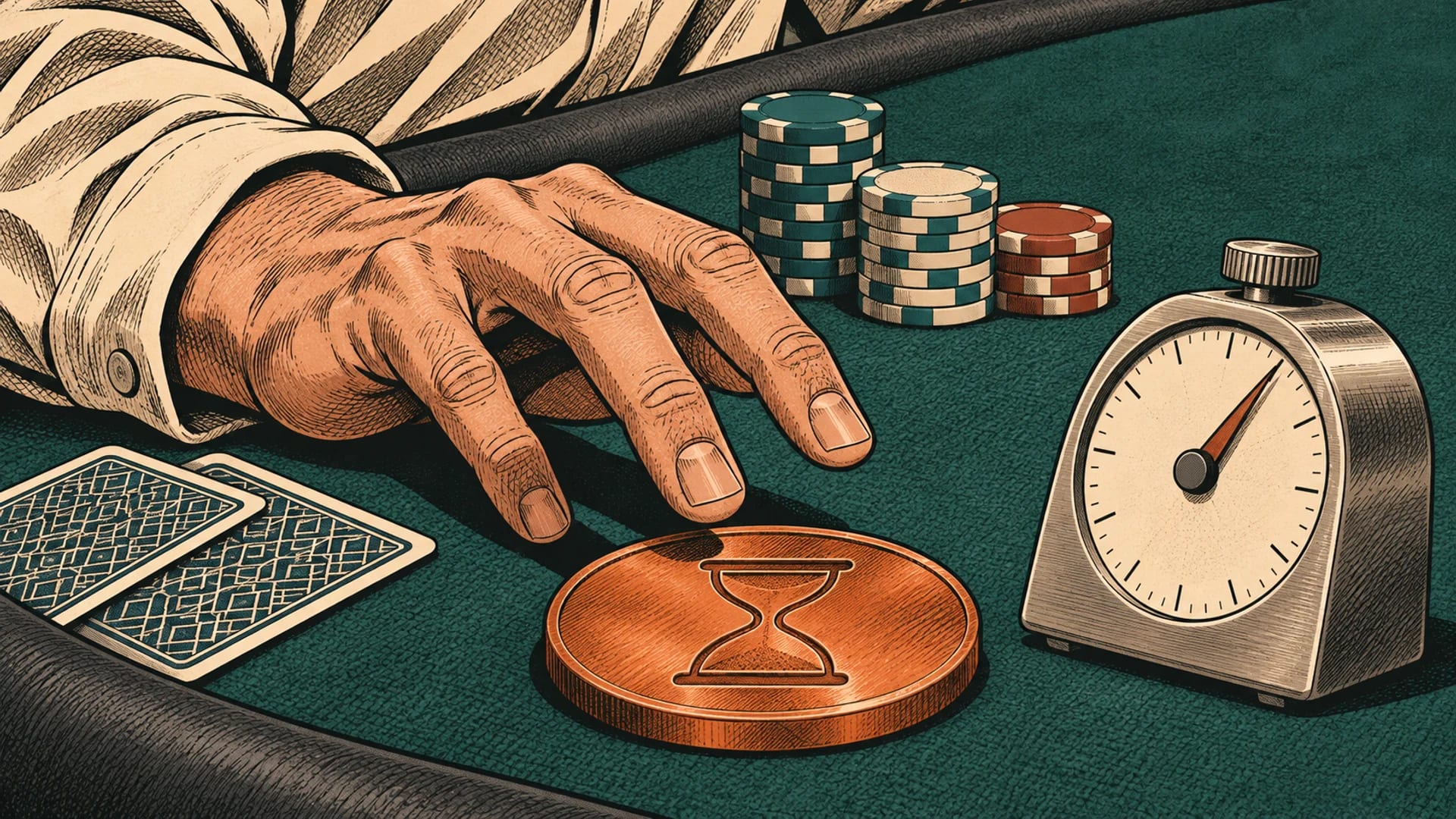

One poker table can finish a hand and still be unable to deal another. Near a tournament's first paid places, all remaining tables may have to complete their current hands before any table receives the next deal. A quick table has to wait for the slowest unfinished one.
Hand-for-hand play synchronises hands across tables. It also needs a rule for recording time and eliminations. Those details belong to the event: a stopped display does not, by itself, mean the blind level has stopped advancing.
The specific procedure below comes from rule 126 of the 2026 WSOP Official Tournament Rules, pages 27 and 28, checked on 4 November. The document defines its scope as the 2026 series at Paris Las Vegas and Horseshoe Las Vegas, with a stated 26 May to 5 August event window. It supplies a published case, rather than a promise about another WSOP event or an online client.
The announcement includes the hand already underway
Under rule 126-A, staff introduce hand-for-hand as the field approaches the money, meaning the first prize-paying positions. Every table completes its current hand. The tournament clock is paused once the first table finishes that hand.
After all tables finish, each dealer deals one hand and then suspends play when it is complete. The process continues until enough players have been eliminated to reach the money. Finishing sooner gives a table waiting time, rather than an extra deal.
The current hand matters for eligibility too. Rule 126-C starts payoff eligibility at the announcement to finish the hand and hold. If enough players bust on that hand to reach the paid positions, the busting players qualify for a share of the places paid on that hand. Staff cannot establish the result by looking only at who remains after one table has finished while another is still playing.
Three hands remove six minutes from the level
The WSOP document specifies a two-minute deduction for each hand, regardless of its actual duration. The deduction starts with the hand in progress when the announcement is made. Rule 126-D prefers recording the deduction after each hand, where possible, instead of removing several hands' time in one batch.
Consider an invented two-table record. Eight minutes remain in the blind level at the announcement. The wall times below measure how long it takes both tables to finish each paired hand. The first interval starts at the announcement; later intervals start when the next deal is released. Assume no extra interruption or break, and apply the stated two-minute deduction each time.
| Completed paired hand | Invented wall time | Level time remaining (minutes:seconds) |
|---|---|---|
| Hand underway at the announcement | 3 minutes 20 seconds | 6:00 |
| Next hand at both tables | 1 minute 10 seconds | 4:00 |
| Following hand at both tables | 4 minutes 40 seconds | 2:00 |
The three wall times add up to nine minutes and ten seconds. The recorded level has used six minutes: three deductions of two. No level change occurs within this example because two minutes remain after the last deduction.
Rule 126-E says blinds continue to increase when new levels are reached. The temporary pause in the display is therefore not a guarantee that the same blinds will last for however many real minutes the hands take.
This is separate from a shot clock or time bank, which governs an individual decision and its available extensions. The two-minute entry in this table gives no player two minutes to act.
An all-in and call can wait face down
Rule 126-G tells players in an all-in-and-call hand during hand-for-hand to keep their cards face down. Dealers must not deal more cards until instructed. The published procedure thus includes a wait inside the hand as well as a wait before the next deal.
A table with no further betting to complete cannot infer permission to expose the cards and run the board immediately. The instruction comes from staff under this named procedure. Our showdown article covers the separate question of properly showing a hand when the applicable procedure requires it.
The hand record also matters more than the order in which spectators see a bust. Under WSOP rule 126-B, players eliminated on the same hand at different tables tie for that finish. If they are eliminated on the same hand at the same table, the larger stack at the start of the hand receives the higher finish. That distinction should not be replaced with an assumption that every tournament ranks simultaneous eliminations in the same way.
The TDA framework is not a substitute for the house text
The Poker TDA's 2026 longform, version 1.1 dated 21 September, also includes hand-for-hand guidance in Recommended Procedure 8. Part B sets a maximum deduction of three minutes per hand, while parts C and D describe two-minute adjustments and level progression. A maximum is not an instruction to debit three minutes for every hand.
The calculations above use the explicit WSOP rule 126-C. They do not treat the TDA's maximum as a mandatory charge. An event's hand-for-hand announcement and governing procedure must identify the relevant hands, clock treatment and release of an all-in before a recording can establish whether the table followed them.
TDA rules used by permission of the Poker TDA, Copyright 2026, http://www.pokertda.com, All rights reserved.