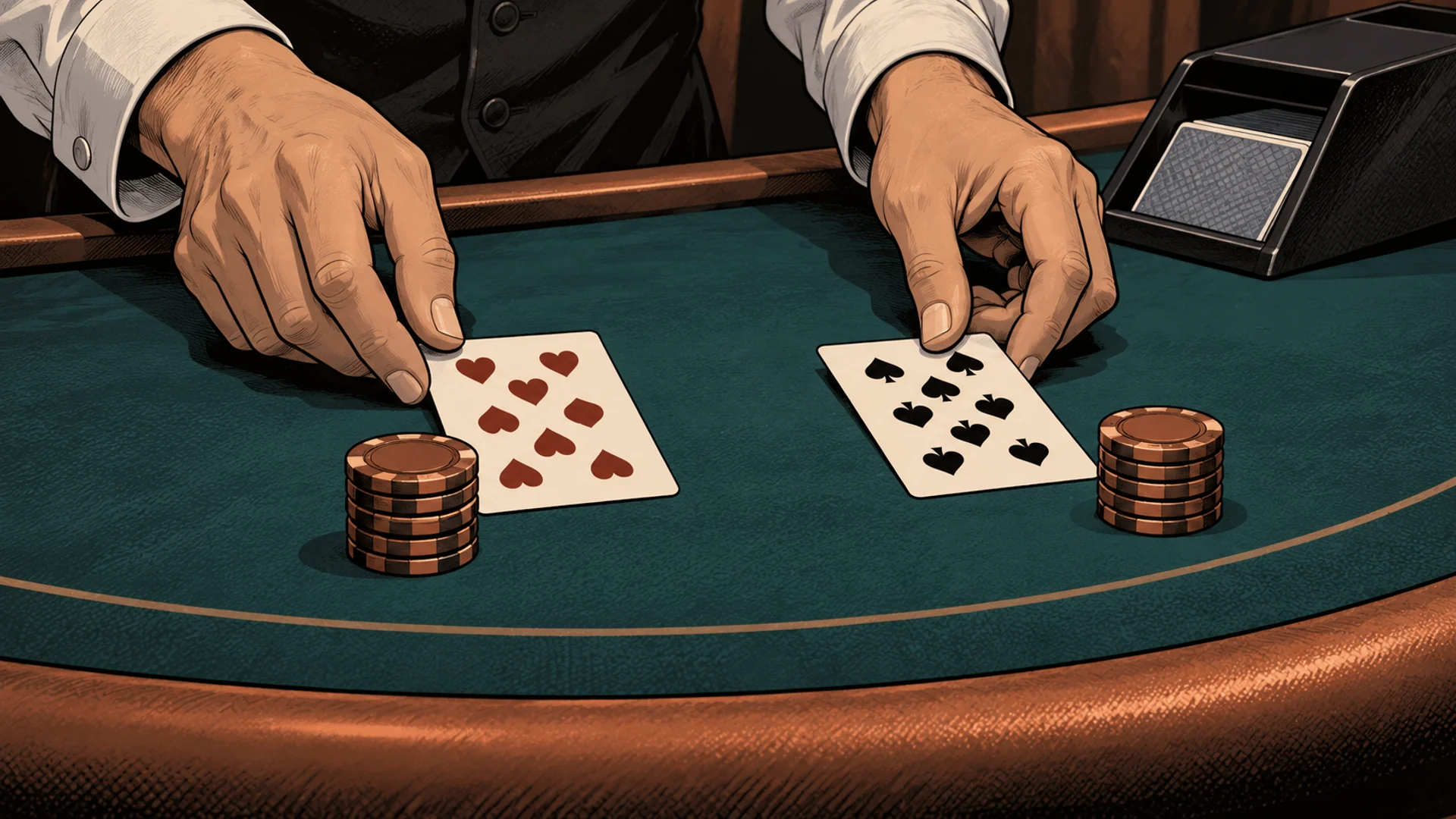
The Massachusetts Gaming Commission's Blackjack rulebook describes equal-score settlement in section 3 and a simultaneous blackjack in section 7. Its separate Free Bet Blackjack rules explicitly return a tied main wager in section 6(p). These are named Massachusetts procedures, not terms for every online table.
Read the return against the amount committed
Imagine a £12 cash wager, with neither doubling nor splitting and no extra bet. The currency is illustrative; it does not describe a Massachusetts casino's denominations. If that wager pushes, £12 returns. Subtract the £12 committed and the result is £0 profit. The return has restored the stake, not earned another £12.
For comparison, a £12 wager winning at an ordinary 1:1 rate produces £12 profit plus its £12 stake, a £24 return. A losing £12 wager returns £0. The three receipts therefore read £12, £24 and £0 for push, ordinary win and loss respectively. None of the examples predicts a result or recommends a stake.
The amount on an account's credit line is not enough to identify the result. It needs to be compared with the wager that left the balance. Our double-down article follows the extra amount committed when another stake is added.
Two totals of 21 need closer inspection
Under section 3 of the ordinary Massachusetts rules, a dealer's natural beats a player's 21 made without blackjack. Section 1 defines the natural through the initial ace and ten-value card and excludes the equivalent combination after splitting. Matching the number 21 alone does not establish a push.
When both participants have blackjack, section 7(b) calls the result a standoff. The word describes the tied main hand. It is not the premium payment made for a winning natural.
Even that result has a named exception in the same document. Section 6(j)'s alternative procedure exposes both dealer cards before further player cards: equal scores lose except that simultaneous blackjacks win. That optional procedure should not be confused with the base settlement just described.
A dealer's 22 can return the main wager
Free Bet Blackjack adds a different kind of push. Section 6(n) returns the remaining main wagers when the dealer reaches 22 and collects the Free Bet markers, called lammers. The hands need not have matching scores. A live 18 against dealer 22 can therefore have a returned stake rather than an ordinary dealer-bust win under this named rule.
The word "remaining" matters. Section 6(h) pays qualifying player blackjacks earlier in the sequence when the dealer has no blackjack. The 22 procedure is not a rule to reverse every payment or restore every previously lost hand.
There is also an optional, separately staked Push 22 wager under section 5(e). It wins on dealer 22 while the surviving main wager is returned. A main-bet push and a side-bet win can coexist. Our blackjack insurance explanation examines another case in which two wagers have different results.
For a disputed credit, the useful record identifies the game version, card sequence and each accepted wager separately. Ask which settlement clause produced the return. "Push" on its own does not reveal whether the money came from a tie, a named variant or another wager altogether.