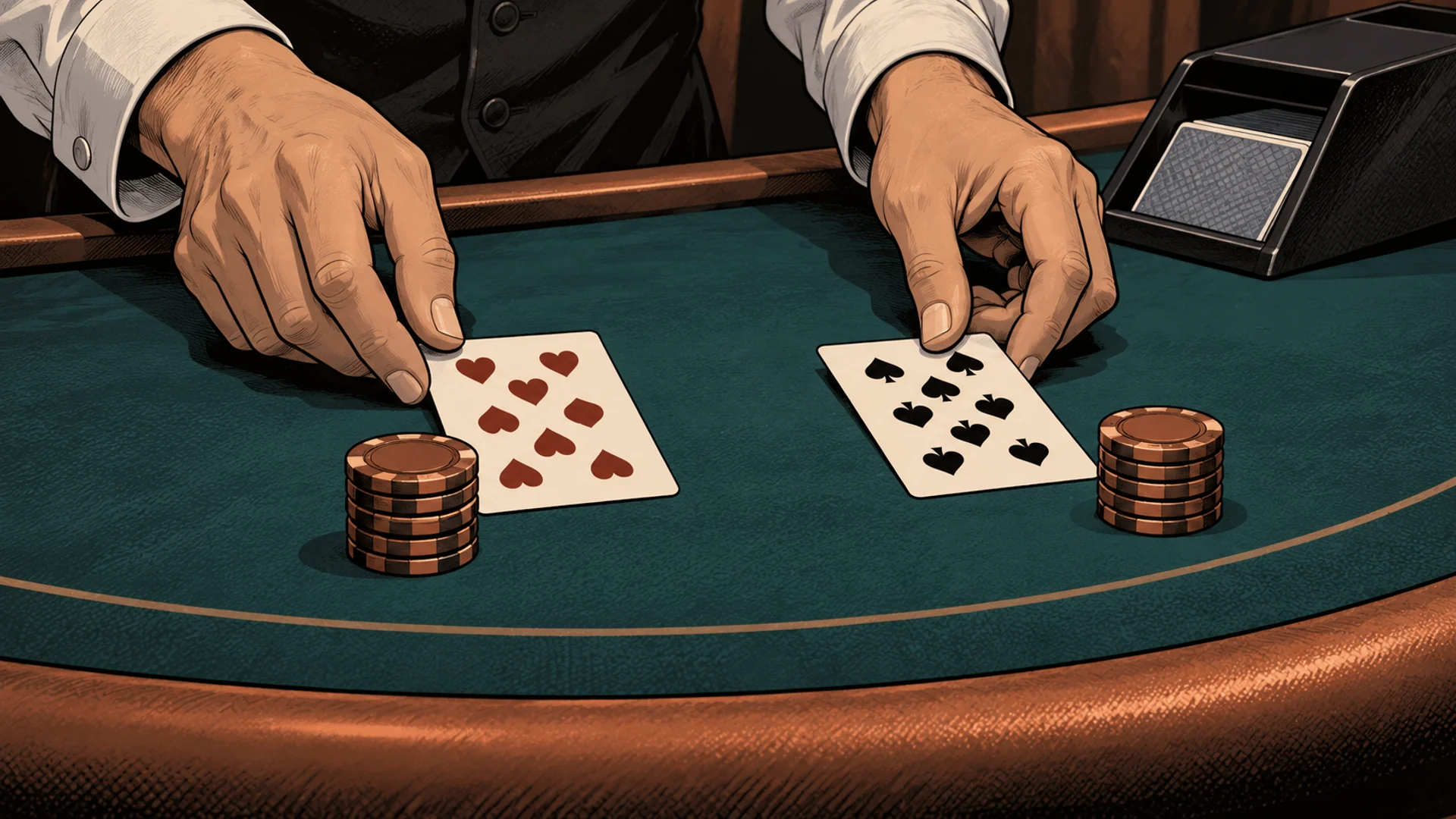
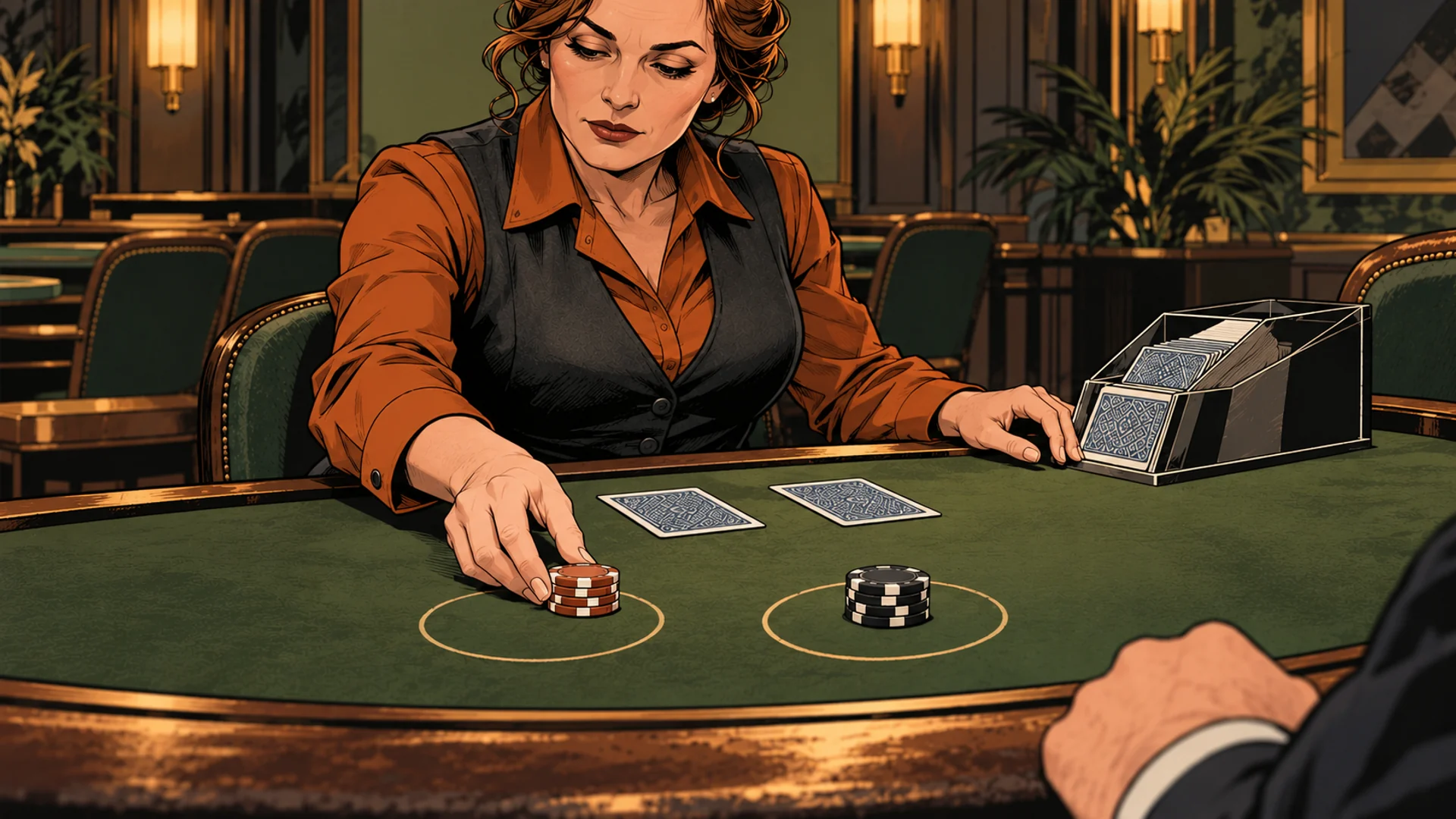
A dealer's ace can leave a question open until after a player has added money. In no-hole-card blackjack, the second dealer card arrives late. Original Bets Only (OBO) describes a separate issue: how much the dealer collects if that card completes a blackjack. The dealing sequence alone does not settle the extra wager.
One documented combination appears in Massachusetts. Its regulator's active table-game list links the Blackjack rules dated 9 April 2026. Section 6(g) deals the dealer's second card after players finish; sections 10(b) and 11(d) limit collection on a subsequent dealer blackjack to the original wager, excluding the added double or split amount. MGC Blackjack rules
That is a named regulatory example, not a finding that every Massachusetts table uses this dealing option, or that every game called European Blackjack protects added stakes.
The card's timing and the money's treatment
The same MGC document permits an alternative with a face-down hole card. Section 6(i) distinguishes waiting to look at it from using a card reader to check for blackjack before further player cards. A card already on the table but unchecked differs from a second card still in the shoe.
A useful rule comparison therefore records both the dealing procedure and the dealer-blackjack settlement. ENHC, short for European No Hole Card, describes the former; OBO names the latter. Neither abbreviation replaces the full terms of the loaded game.
Two receipts for money already committed
Consider a made-up $12 initial wager and a permitted $12 double. The player's cards total 19 without busting. The dealer has shown a king and receives an ace as the second card. Ignore insurance and side bets throughout these examples.
Applying the original-only collection rule gives $24 committed, $12 returned and a $12 net loss. The returned addition earns no profit. In an explicitly hypothetical all-stakes-lost comparison, the same $24 commitment returns $0 and loses $24. That comparison illustrates a different settlement condition; it does not identify an operator offering it.
The double-down explainer follows how the added amount enters the hand. Here the question begins after that money has been accepted: which part survives a late dealer blackjack?
Now use a separate $12-plus-$12 split example. Both hands finish below 21 without busting, then meet the dealer's blackjack. Collecting only the initial $12 leaves the added $12 to return. Again, $24 left the balance and $12 comes back. A $12 credit against that commitment records a loss, not a push of the whole round.
These examples deliberately exclude busted split hands, resplits and doubles after splitting. Their accounting needs the complete variant's terms. The split-hand article covers the separate permissions and costs of creating those hands.
A returned addition is not a tied hand
Under the base MGC procedure, simultaneous natural blackjacks produce a standoff under section 7(b). A player's ordinary 21 does not tie a dealer natural under section 3(b). Those are hand-ranking rules, separate from which added wagers the dealer collects.
For an illustrative $12 natural against a dealer natural, a standoff returns $12 against $12 committed: $0 profit. Compare that with the doubled example's $12 returned against $24 committed. The credit is identical; the net result differs by $12.
A settlement record needs the original amount, each accepted addition and the card sequence. Keep the game version and its dealer-blackjack clause with that record. A single balance credit cannot establish whether the operator returned an added stake or settled a tied hand.