Twenty-four ends a player's blackjack hand before the dealer reveals the hidden card. A later dealer bust would not rescue that wager. Following the order of a round explains why one person can lose while a neighbour, facing the same dealer, gets paid.
The main wager is against the dealer. A surviving hand can win by finishing higher than the dealer without exceeding 21, or by facing a dealer who goes over 21. Equal ordinary totals push, returning the stake. A qualifying two-card blackjack has separate treatment. MGM Resorts' GameSense guide introduces the game and flags that table rules differ.
Choose the rules before dealing the example
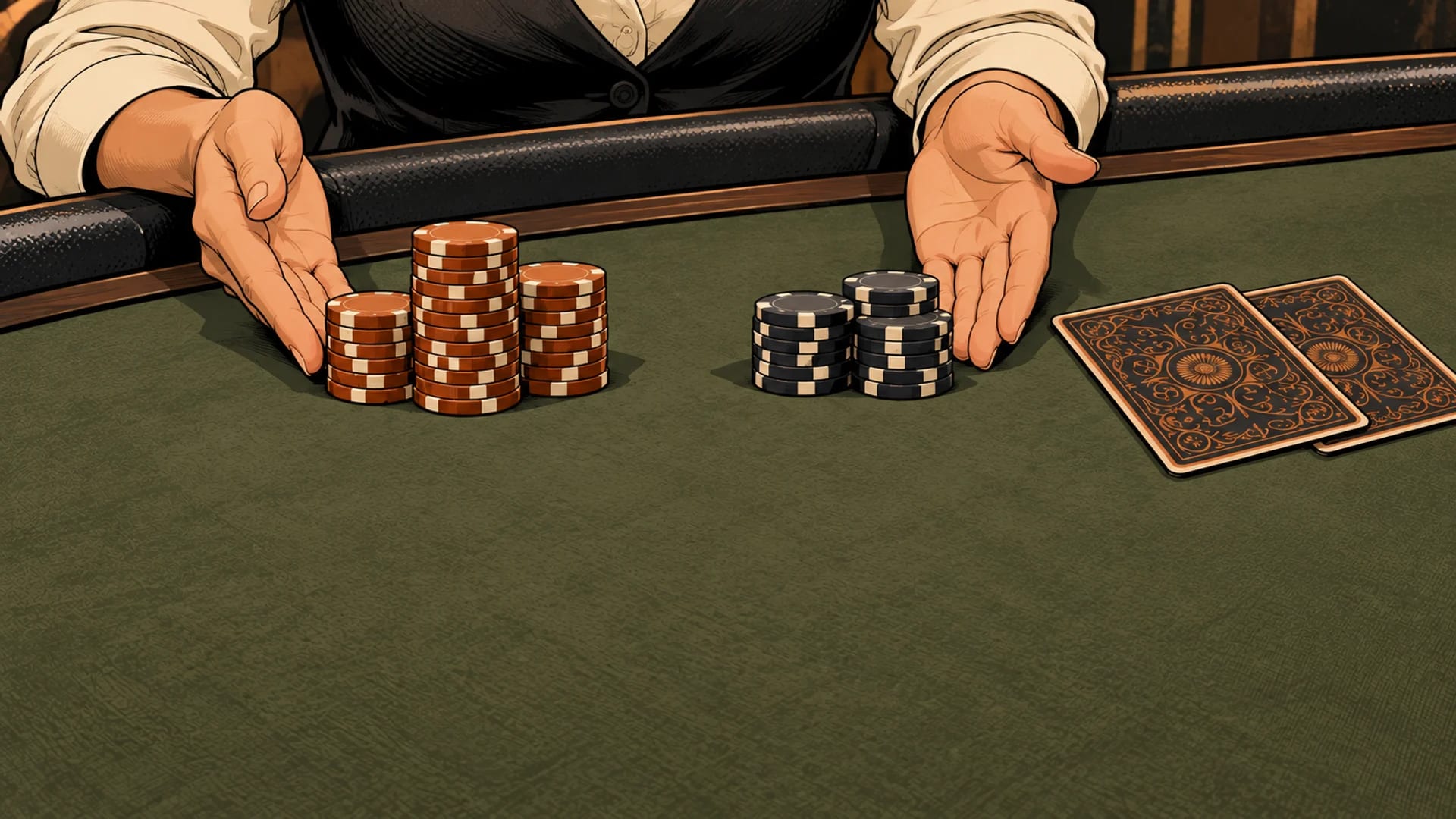
Our invented round uses six decks, a face-down dealer hole card, a dealer who stands on every 17, and a 3:2 payment for a winning natural blackjack. Ordinary wins pay 1:1. There are four players with one ten-unit cash wager each. No side bets, promotional stakes or optional bonus payouts enter the calculation.
Those selections follow the Massachusetts Gaming Commission's Blackjack rulebook: the hole-card procedure in section 6(i), the standing rule in section 12(b)(1), and the 3:2 payout permitted by section 3(e). Its active-rules register lists this edition as 9 April 2026. Both were checked on 5 November 2026.
The Massachusetts source governs a US jurisdiction. Our configuration illustrates the game; it does not establish which version a casino offers to readers in Britain. A different table may hit soft 17, pay 6:5 for blackjack or use a different dealing procedure. Those details belong to the game actually being played.
The first two cards give each hand a starting point
Cards from two through ten use their number. Jacks, queens and kings count ten. An ace counts 11 when that leaves the total at 21 or below; otherwise it counts one. Bicycle's blackjack explanation describes these values. Our soft and hard hand guide follows what happens when another card changes the ace's usable value.
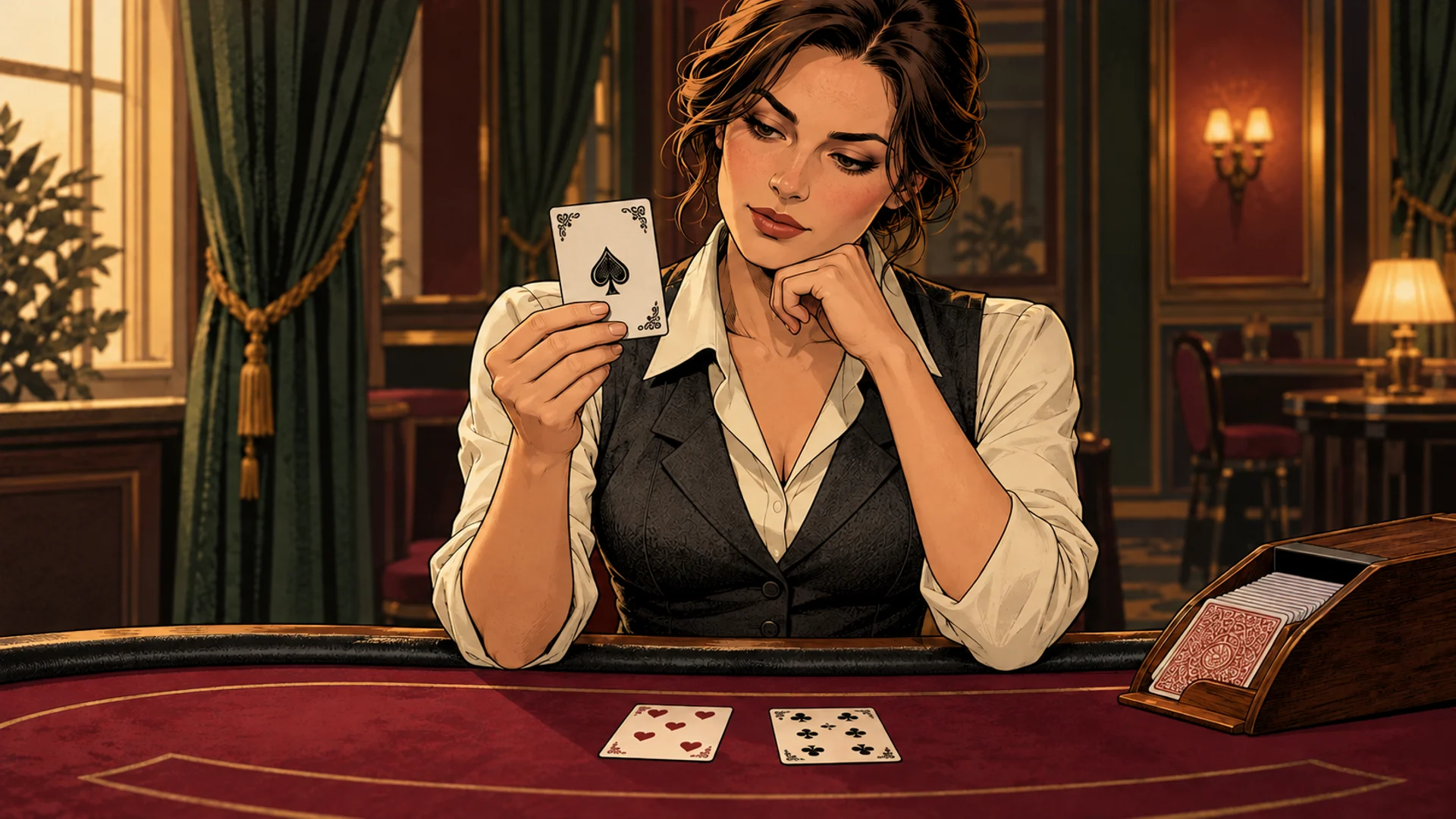
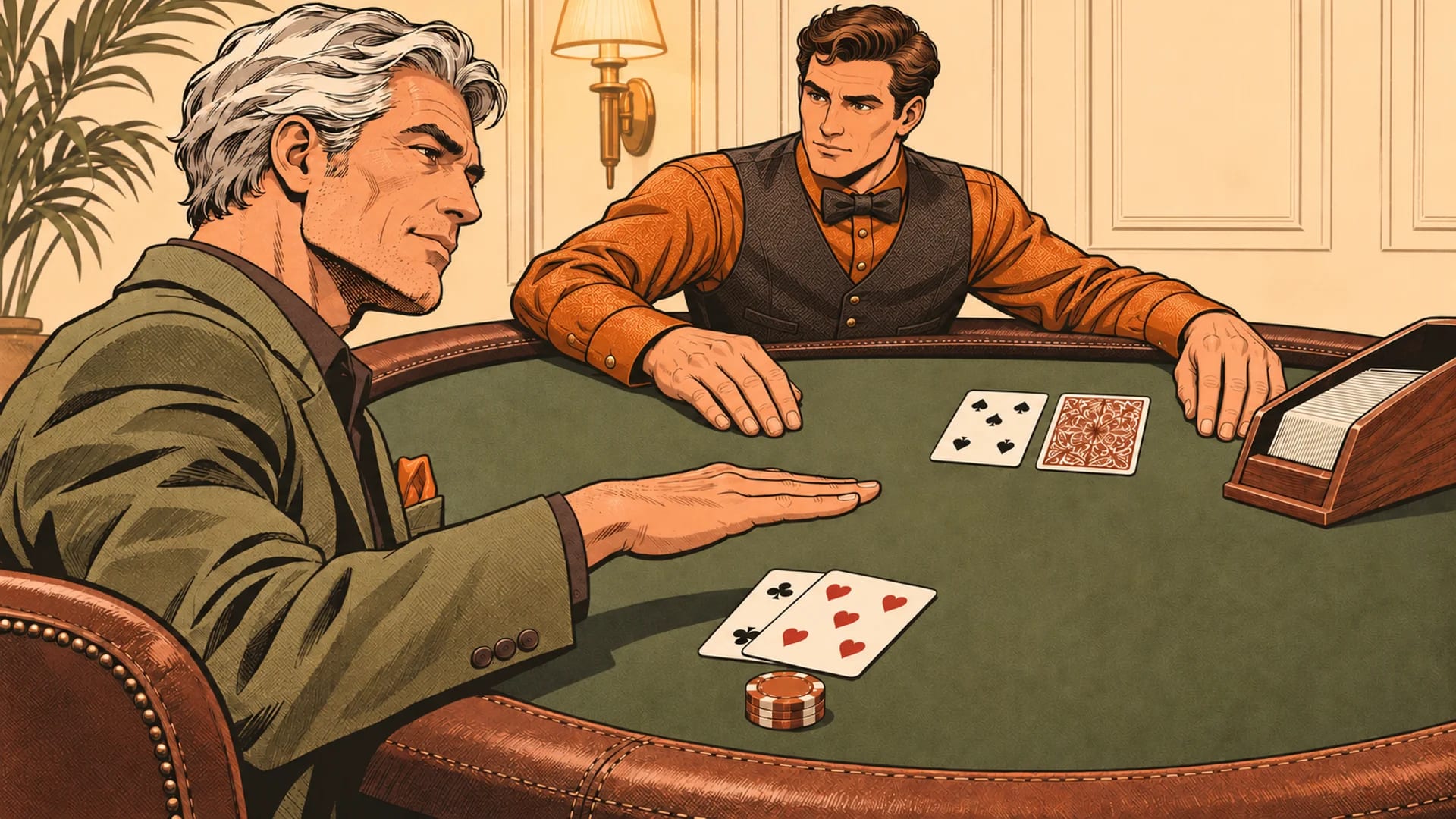
The four players sit in order A, B, C and D, starting at the dealer's left. Each places ten units before the deal. In the first pass, A receives the ace of spades, B the seven of clubs, C the nine of hearts and D the ten of diamonds. The dealer's visible card is the six of hearts.
The second player cards are the king of hearts for A, four of diamonds for B, seven of diamonds for C and queen of clubs for D. The dealer takes the nine of clubs face down. The dealer therefore has 15, but that hidden nine is not yet information available to the players.
A has an initial ace and king: a natural blackjack. B has 11, C has 16 and D has 20. These are separate hands against the dealer; nobody has to beat A's cards to collect their own winning wager.
Under section 7(a) of the named rulebook, a player natural facing the dealer's exposed two through nine is paid before any player receives a third card. The exposed six therefore lets the dealer settle A now. At 3:2, A earns 15 units and gets the original ten back, for 25 returned. The dealer removes A's cards.
Three remaining players make their decisions
B requests another card, a hit. It is the ten of spades, taking B from 11 to 21. That is a three-card 21, rather than a natural. B receives no further card in this example.
C also hits and receives the eight of clubs. Nine plus seven plus eight is 24. C busts, and the ten-unit main wager loses. D stands on 20, ending that hand's drawing decisions without adding another card or another wager.
These choices are invented to show the procedure. They are not a strategy chart or a recommendation to take a particular action on 11, 16 or 20.
Hit and stand are only part of the vocabulary. A permitted double down adds a wager and commits the hand to one further card; our double-down explainer separates that extra stake from the payout rate. Splitting makes separately staked hands from an eligible pair, subject to the table's limits. Our split-hand guide covers the restrictions, especially for aces. Neither action occurs in this round.
Surrender, where offered, has its own timing and settlement conditions. Insurance is a separate wager connected to dealer blackjack, rather than protection against every losing main hand. The visible dealer six in our example does not present an insurance decision.
The dealer finishes a different job
After the player decisions, the dealer reveals the nine of clubs. Six plus nine is 15, so the dealer must draw under our chosen rule. The next card is the five of spades. The dealer reaches 20 and stands.
The drawing rule determines when the dealer stops, even when a player has a higher total. A dealer who instead reached a soft 17 would also stop under the selected S17 rule; the H17/S17 comparison explains the alternative.
Settle each wager against its own stake
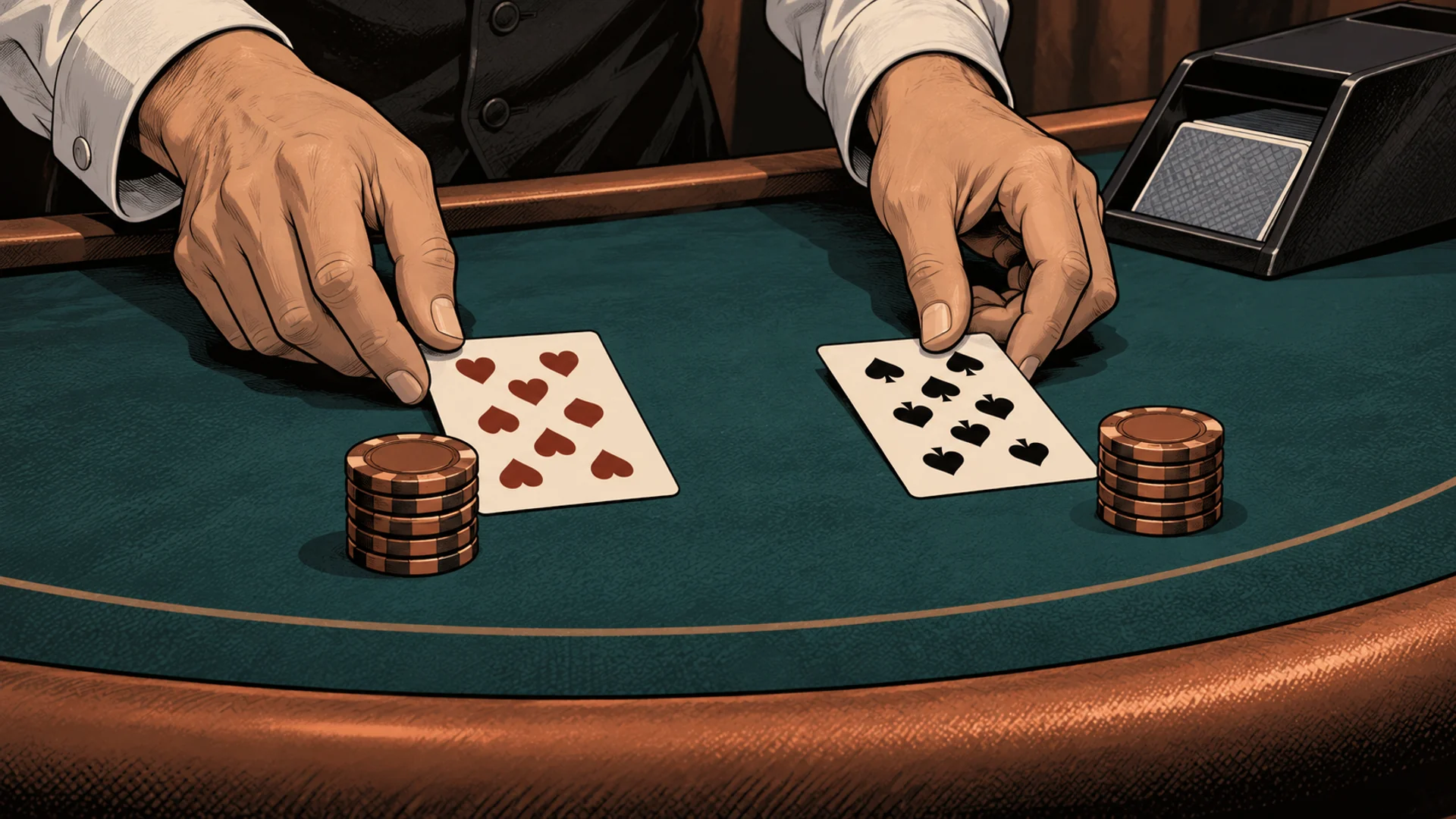
A has already received 25 on the natural. B's three-card 21 beats the dealer's 20 and pays as an ordinary win: ten units of profit plus the ten-unit stake, for 20 returned. C's bust returns nothing. D's 20 ties the dealer's 20, so the ten-unit stake comes back without profit.
The four players put in 40 and receive 55 altogether: 25 + 20 + 0 + 10. Their combined net result is a gain of 15 units, balanced by a 15-unit loss for the house in this invented round. Individually the results are A +15, B +10, C -10 and D zero. This one favourable table result does not predict a session or establish an expected return.
A and B both reached 21, but the original two-card history gives A the natural payment. Under the named rules, a dealer natural also beats an ordinary three-card 21; simultaneous naturals stand off. Our 3:2 versus 6:5 report examines the payment ratio, while the push guide deals with ties and variant exceptions.
If the dealer's final draw had instead produced a bust, the remaining eligible main hands would be settled against that result. C's earlier 24 would still have lost. The order of the round leaves that wager closed, even while the dealer is still taking cards.